
To find time for yourself as a mom, protect one small block on your calendar, decide in advance who covers your child during it, and tell your household the block is taken. Fifteen minutes counts. The plan is not about finding a free afternoon you will never get. It is about carving out a piece of the week that belongs to you and defending it.
Most advice about mom self care assumes a schedule with gaps in it. Therapy appointments, school runs, feeding schedules, sensory crises, work shifts, and the ordinary friction of a busy household leave very few clean openings. If your child has autism or another disability, the gaps get smaller and the stakes for taking a break get higher, because you are the person who holds the whole routine together.
So this is a plan built for a full life rather than an idealized one. It assumes you are tired, that your time is genuinely scarce, and that you would rather take something small and repeatable than plan a perfect afternoon you will keep postponing.
Table of Contents
- Why Finding Time for Yourself Can Feel Impossible
- How to Find Time for Yourself as a Mom Without Guilt
- Start With How to Find Time for Yourself by Naming the Need
- Look at Your Schedule and Find the Smallest Opening
- Share the Work Before Asking for More Time
- Set Boundaries Around Your Personal Time
- Make the Time Flexible and Low Pressure
- Build a Weekly Plan You Can Repeat
- When You Need More Support or Professional Help
- Where to Start This Week
- Frequently Asked Questions
- How can I find time for myself when my child has constant supervision needs?
- Is 10 minutes of alone time enough for a busy mom?
- How do I ask my family for help without feeling guilty?
- What if I do not have a quiet place to take personal time?
- How do I maintain a self-care plan when therapy and medical appointments change the schedule?
- When should a parent of a child with a disability consider professional support for caregiver stress?
- Where to Start Tonight
Why Finding Time for Yourself Can Feel Impossible
Because the time is genuinely taken. Supervision needs, therapy and medical appointments, work shifts, and your children’s transitions all compete for the same hours, and they compete from a position of necessity while your own needs compete from a position of wanting.
There is a difference between resting while your child sleeps and actually resting. Falling asleep on the couch during a nap means you wake up feeling worse, with the dishes still out and a mental checklist running in the background. Restorative time has to do something for you. It has to lower your shoulders, quiet the noise, or return you to yourself.
Small blocks matter because small blocks are what you will actually get. A woman who reliably protects 15 minutes four times a week ends up with an hour that is hers. A woman waiting for two free hours usually keeps waiting. Building the habit around what is realistic beats planning around what is ideal, every time.
Overwhelmed mother syndrome, the name sometimes given to the exhaustion, irritability, and numbness that come with sustained caregiving, is not a character flaw. It is a signal that the load and the support do not match. Personal time is one of the inputs that fixes that balance, though sometimes it is not enough on its own.
How to Find Time for Yourself as a Mom Without Guilt
The process has five parts, and the order matters. You will waste effort if you try to defend time before you know what you need it for, or if you ask other people to cover tasks you could simply hand off.
Start With How to Find Time for Yourself by Naming the Need
Time for yourself can mean different things, and the right kind depends on what is actually depleted. Quiet, sensory rest, movement, prayer, creative time, and social connection all restore, but they do not substitute for one another.
- Quiet. Low light, no input, no decisions. Useful when your nervous system is running hot from a loud or unpredictable week.
- Movement. A walk around the block, stretching, or a short workout. Often the only reliable way to shift physical tension.
- Creative time. Drawing, writing, music, crafts, cooking something that is not from a list. Restores a sense of identity outside caregiving.
- Prayer or reflection. Ten minutes of quiet, gratitude practice, or reading for many caregivers is the most replenishing block of the day.
- Connection. A phone call, a walk with a friend, a mom group. Isolation drains faster than most people expect.
- Practical personal tasks. Booking appointments, sending email, doing laundry for yourself alone. Sometimes the honest need is to finish one adult task without interruption.
Pick one to start with. The rest can come later, and many parents discover their real need was sleep or a phone call to a friend, not the bath and candle routine they assumed they wanted.
If mornings are the most reliable pocket you have, our guide to building a morning routine for yourself has a few low-effort starting points.
Look at Your Schedule and Find the Smallest Opening
Do a short time audit for one week, not a lifetime. Write down where your hours actually go: school and drop-off, therapy, work, meals, appointments, transitions, screen time, sleep, and the gaps in between. Most parents are surprised by how little of the week is genuinely unallocated.
Then look for openings that repeat weekly rather than openings that sound good on paper. Recurring windows work because you can plan around them in advance. Common ones: the hour before your child wakes, the drive while someone else drives, the time right after bedtime, the first thirty minutes after a nap starts, or a slow Sunday evening.
Then size the block honestly. If you have a reliable 20 minutes, plan for 20 minutes. Planning an hour into a 20-minute gap means the plan fails every single week, and a plan that fails teaches you that self care is not available to you.
Share the Work Before Asking for More Time
Most parents ask for time and hear no, because time is abstract. Tasks are concrete, and concrete requests get filled. Start there instead.
Hand off ownership rather than asking someone to help you. There is a difference between “can you help with the laundry” and “the laundry is yours this week.” The first leaves you managing it; the second removes it from your head.
- List every recurring task for one week, including the invisible ones: tracking appointments, refilling supplies, remembering forms, scheduling therapy, and keeping track of what school needs.
- Mark each one as yours, shareable, or delegable. Most mental load lives in the tasks nobody sees.
- Match each delegable task to a specific person. Vague offers of help rarely get used.
- Decide in advance which care tasks during your personal block belong to whom, so nobody has to improvise while you are gone.
Where money allows, a regular sitter, a cleaning service, or a laundry pickup removes more load than any amount of encouragement. Where it does not, the trade is the same: a standing weekly swap with another parent, a relative taking one fixed block, or a neighbor driving one school run each week.
Set Boundaries Around Your Personal Time
A block nobody knows about will be absorbed. Say it out loud, in specific language, and say it before you are exhausted, not after.
Try wording that leaves no room for negotiation: “I am taking 6:30 to 7:00 on Tuesday and Thursday for myself. You have the kids for that window.” Or: “I am stepping out at 4:15. Dinner starts at 5:30 and I will be back in time.” Concrete times and clear handovers work far better than a general request to need space, which tends to sound like an accusation.
A visible signal helps too. A note on the fridge, a calendar entry everyone can see, a closed door, or a specific status message on your phone. Pick one that fits your household and use it every single time so it becomes expected rather than surprising.
Expect pushback the first time. Answering “the appointments do not move, and I have not had 15 minutes in three days” keeps the conversation on logistics. You do not need to persuade anyone that you deserve time; you need to make the request plain.
Make the Time Flexible and Low Pressure
If the block only works when everything goes perfectly, it will never happen. Build a minimum version and a backup version.
The minimum version is two minutes. Water, a breath, a sip of tea at the counter while the kettle boils. The full version is a walk, a shower without an audience, or a chapter of a book. On good days you get the full version; on hard days you get the minimum and the habit still holds.
Think in tiers rather than in a single block:
| Time you have | What actually works |
|---|---|
| 2 minutes | Water, standing outside, three slow breaths, one song loud in the kitchen |
| 10 minutes | A short shower, a phone call to a friend, prayer, a page of reading |
| 30 minutes | A walk, journaling, a hobby session, coffee with another parent |
| 2 hours | A library or cafe trip alone, a haircut, a class, meeting a friend |
Keep a backup activity in your phone notes for the weeks that collapse. When appointments stack up and the morning routine falls apart, a named backup is faster than making a new decision while tired.
Build a Weekly Plan You Can Repeat
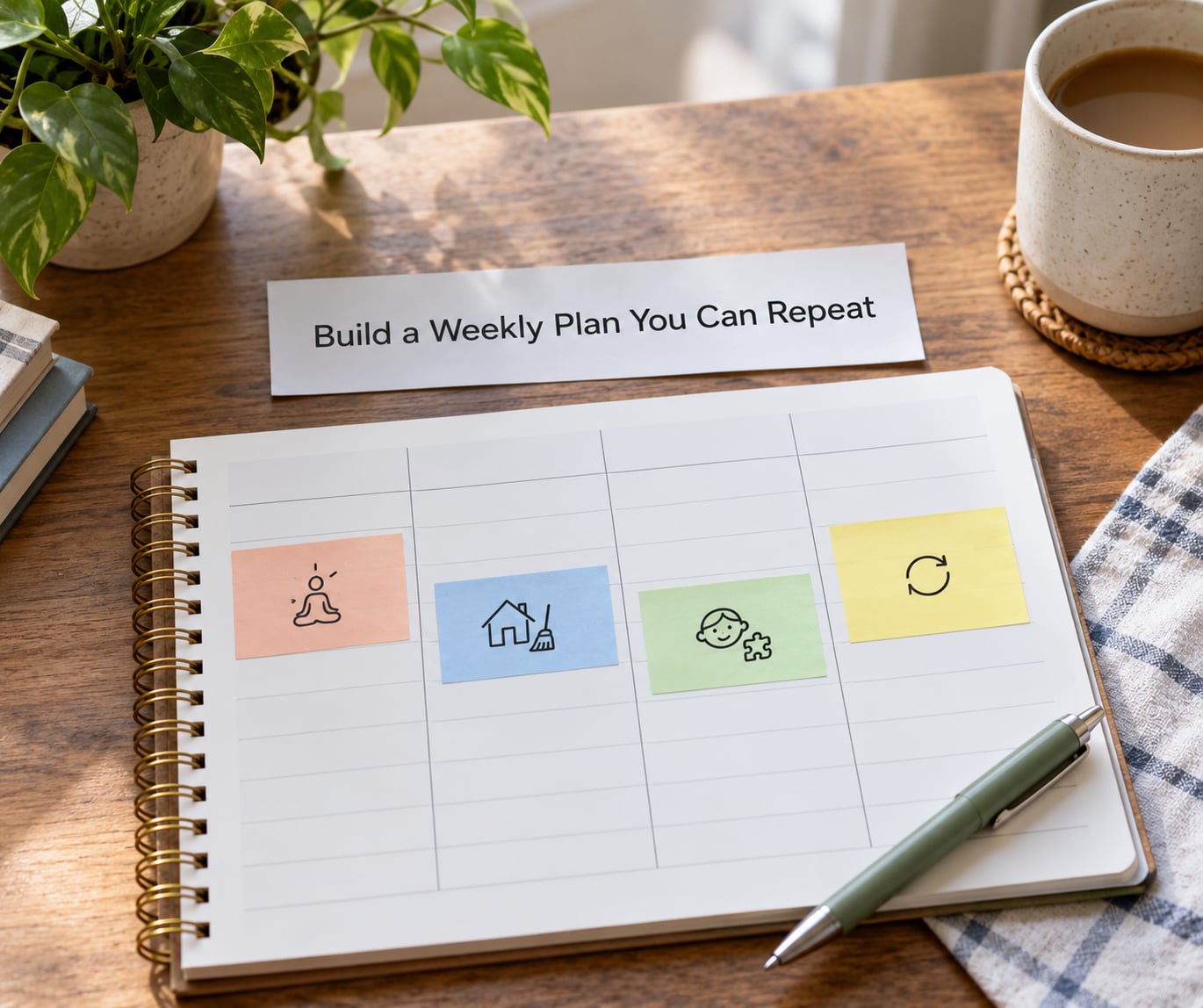
A repeatable week beats a perfect one. Combine three things: one protected personal block, one household task you no longer own, and a few daily restorative minutes. Example:
- Daily: ten minutes before anyone wakes, phone out of reach, for reading or quiet.
- Tuesday and Thursday: 30 minutes after bedtime, one recurring block, phone in another room.
- Wednesday: laundry handed to someone else entirely.
- Saturday: a standing 90-minute swap with another parent, backup indoors.
- Backup: if the week collapses, ten minutes in the car before you go inside.
Write the plan where everyone can see it, then review it once a week for five minutes. Ask one question: what did not happen, and whose job was it supposed to be? That single question does more than a monthly reset, because it puts the problem back where it belongs.
Track what you actually got rather than what you planned. Two out of three mornings is a real block. Most parents who keep a note of their personal time for a month stop guessing and start protecting, because the pattern shows up quickly.
When a stage changes, change the plan with it. School-age kids and teens give you more unsupervised hours than a toddler year does, and the block can grow. A new job, a new sibling, or a therapy schedule change means the plan needs a fresh pass.
When You Need More Support or Professional Help
Self care helps with ordinary depletion. It does not treat depression, anxiety, chronic pain, or prolonged exhaustion, and treating those with a bath and a gratitude journal delays getting real support.
Worth a conversation with your doctor sooner rather than later: low mood most of the day, loss of interest in things you used to enjoy, trouble sleeping even when the opportunity exists, difficulty functioning at basic tasks, or thoughts of harming yourself. If you have thoughts of harming yourself or anyone else, contact emergency services or a crisis line right away rather than waiting.
Other options beyond a physician: a therapist or counselor for caregiver stress and grief, a social worker at your child’s clinic or school who can help you access services, a parent support group, and respite care through your state or regional developmental disability agency. Respite care is often free or low cost for families with eligible children, and parents frequently report that the hardest part is asking rather than the service itself.
If you are still early in getting services, our walkthrough on how to find an early intervention program covers where to start and what to ask. This article is general information, not medical advice; your child’s doctor and your own provider know your situation.
Where to Start This Week
Pick one 10 to 20 minute block and put it in your calendar before anything else gets added. Tell one specific person what you need covered, in plain words, including when. Then decide what the block restores: sleep, prayer, movement, quiet, or a phone call.
That is the whole plan for week one. Everything after that, the boundaries, the delegated laundry, the monthly review, is built on one block that actually happened.
Frequently Asked Questions
How can I find time for myself when my child has constant supervision needs?
Most parents waiting for free time never get it, so plan around supervision rather than around free hours. Pick a short window that repeats every week, decide in advance which adult covers your child during it, and tell that person before the week starts. Morning time before anyone wakes, the drive while another adult drives, and the first half hour after bedtime are the windows most families can repeat. Keep the block small enough that losing it once does not break the habit.
Is 10 minutes of alone time enough for a busy mom?
Yes, if you protect it. Ten uninterrupted minutes with a specific purpose, such as prayer, a shower, or a phone call, restores more than an hour of half-attention while you supervise. What matters is that nothing is being asked of you during those minutes. Ten minutes four times a week is 40 minutes of genuine personal time, and it is realistic for families whose schedules are genuinely full.
How do I ask my family for help without feeling guilty?
Name the task instead of asking for time, because specific requests get filled. List your recurring jobs for one week, mark which ones can be handed off, and give each one to a named person with a day attached. Saying the laundry is theirs on Wednesday removes it from your head; saying you would appreciate help with laundry does not. Start with one task and one person, and expect resistance to fade once the routine holds.
What if I do not have a quiet place to take personal time?
Use a location that changes your state rather than your surroundings. A short walk, the front porch, the car in the driveway before you go inside, or headphones with a walk all reduce input enough to matter. If noise is not the problem and stimulation is, choose calm settings instead: dim light, no screen, one repetitive task. The environment matters less than whether your attention belongs to you during those minutes.
How do I maintain a self-care plan when therapy and medical appointments change the schedule?
Keep two versions of your block: the full one and a backup of two to five minutes in a parked car or a hallway. Appointment weeks are the normal case, not the failure case, so plan for them instead of rescheduling constantly. After any schedule change, spend two minutes moving the block rather than rebuilding the plan. Review the week once and decide whether the block still fits the shape of your family this month.
When should a parent of a child with a disability consider professional support for caregiver stress?
Consider it when the exhaustion lasts beyond a bad week, when you feel low or hopeless most days, when you cannot sleep even when rest is available, or when caring tasks start feeling unmanageable. A physician can rule out medical causes of fatigue and mood changes, and a therapist or counselor can work with caregiver grief and stress directly. A social worker connected to your child’s team can help you access respite care, support groups, and financial assistance.
Where to Start Tonight
Put one 15-minute block on tomorrow’s calendar, name the adult who covers it, and decide what that block gives you. Guard it like an appointment, because that is what it is. Everything else, the audits, the delegation, the weekly review, gets easier once the first block actually happens.