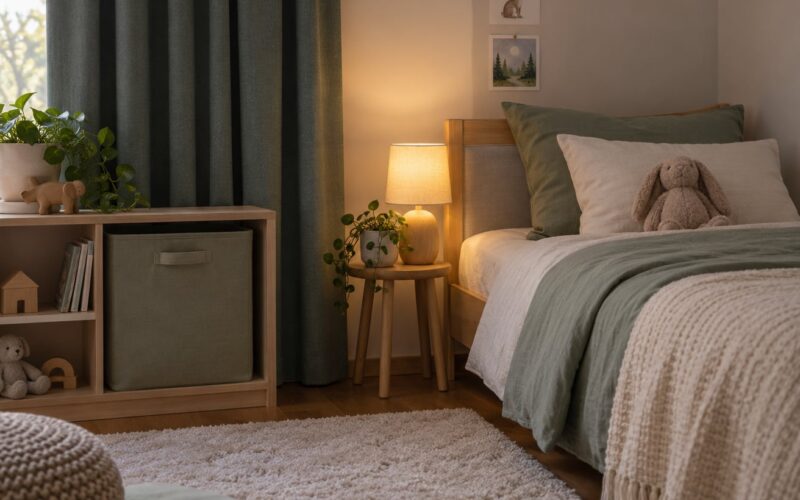
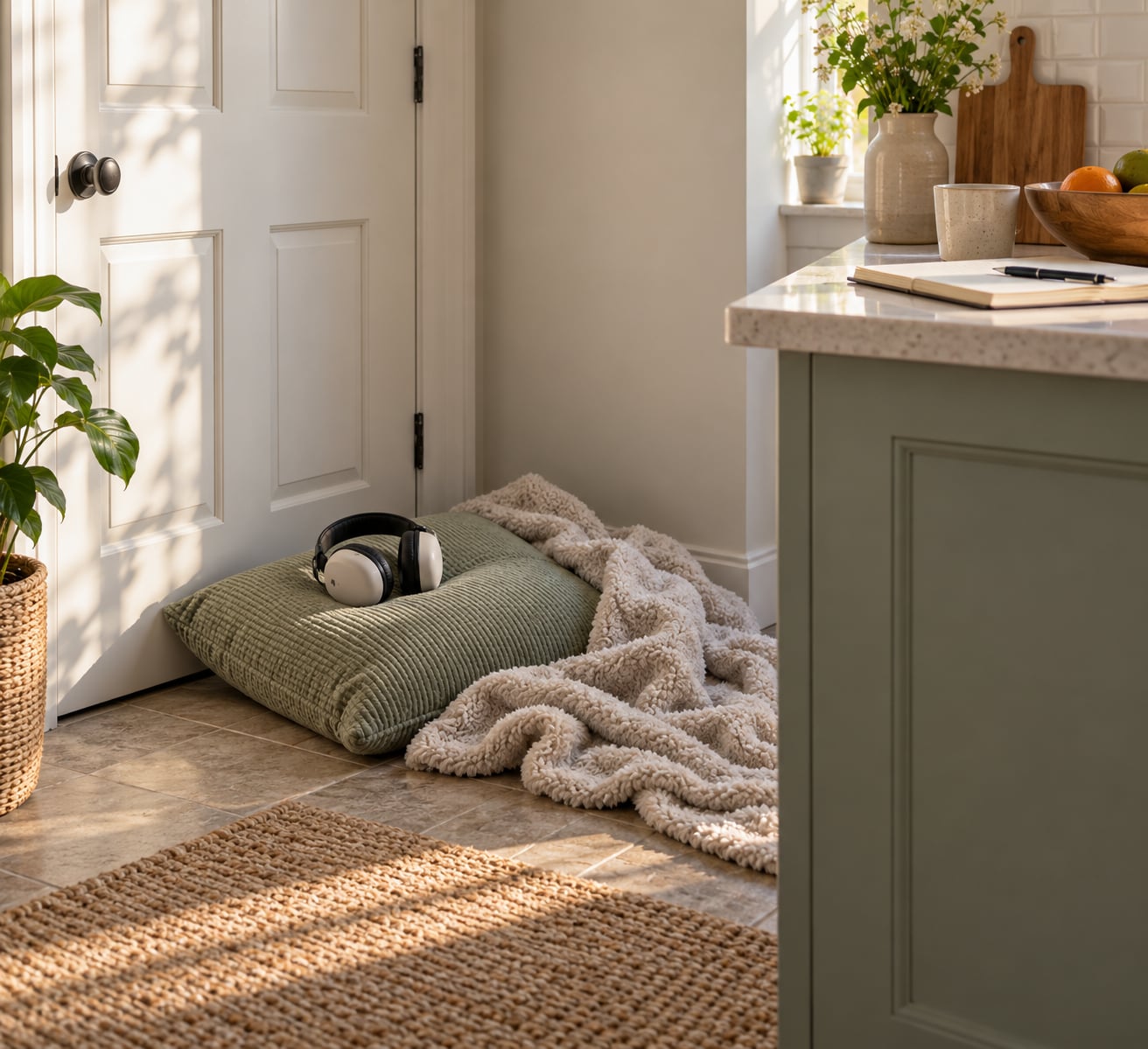
A child who clamps both hands over their ears at a loud noise is not being difficult. They are trying to change what they hear, because the sound feels too intense or too unpredictable for their nervous system. The response that works is simple: lower the noise, offer protection or distance, and give them a way to say “too much” before they reach for their ears.
One thing up front, because it is the question behind almost every search on this topic. Covering the ears on its own is not a diagnosis of anything. Many toddlers do it. Some sensory-sensitive children do it whether or not they have autism or ADHD. And a few children cover their ears for reasons that have nothing to do with sound at all, including ear pain.
The same pattern shows up at the hairdresser, where nobody can simply leave the room, so it is worth pairing this guide with how to help a child who hates haircuts for the sensory-heavy version of the same problem. Last reviewed and updated for October 2026.
Table of Contents
- What You Need
- Step-by-Step: How to Help a Child Who Covers Their Ears at Loud Noises
- 1. Notice What Happens Before the Ear-Covering Begins
- 2. Reduce the Noise or Move Away From It
- 3. Offer Calm, Practical Support
- 4. Teach an Alternative Way to Say ‘Too Loud’
- 5. Prepare for Predictable Noisy Places
- 6. Work With the Child’s Care Team
- 7. Track Small Changes Without Rushing Progress
- Common Mistakes
- Frequently Asked Questions
- Is covering the ears a sign of autism?
- Do non-autistic children cover their ears at loud noises?
- Can hearing loss make a child sensitive to loud noise?
- Is covering the ears stimming?
- Should my child wear noise-canceling headphones all day?
- When should I see a doctor about my child’s noise sensitivity?
- Start With One Trigger and One Safer Response
What You Need
You do not need a full sensory toolkit before you start. You need five things, and most families already have four of them in a drawer somewhere.
- A trigger log. A notebook or a note on your phone. Six or seven days of entries is enough to start seeing a pattern.
- One or two pairs of ear defenders that actually fit. Kids’s heads are small, so adult headphones rarely seal well and many are too heavy to wear for an hour.
- A signal your child can use. A card, a hand sign, a word on a talker, or a movement you both recognise.
- A known quiet spot. Not necessarily a special room. A corner of the kitchen with a blanket and a cushion counts.
- Notes for the doctor. Dates, places, sounds, and how long your child took to settle afterwards.
The log is the piece most parents skip and most regret skipping. Write down the date, the place, what was making the sound, the first thing you noticed, what you did, and how long the calm took to come back.
| Date and time | Where we were | The sound | First thing I noticed | What helped | Time to settle |
|---|---|---|---|---|---|
| Tuesday 4:15pm | Our kitchen | Food mixer | Went still, then both hands | Moved to hallway, waited it out | About 3 minutes |
| Saturday 11:00am | Supermarket | Overlapping voices, trolley wheels | Tucked her head down | Ear defenders, quieter aisle | About 10 minutes |
| Sunday 6:30pm | Living room | TV at normal volume | Held one ear with her hand | Nothing needed, she managed it | Under a minute |
Those three lines already tell you more than you would guess. The first one is a predictable household sound you can schedule around. The second is the public one that needs a plan. The third is the child managing it herself, which is worth noticing and naming out loud.
A quiet corner is also where the rest of the evening goes. If your child is running on empty, winding down matters more than any single trick, and our guide to helping an autistic child sleep through the night covers the same regulation work after bedtime.
Step-by-Step: How to Help a Child Who Covers Their Ears at Loud Noises
This is the repeatable version. Seven steps, in order, starting from the moment you notice something is building. It takes a few minutes to read and about ten seconds to run through when a sound hits.
1. Notice What Happens Before the Ear-Covering Begins
The hands are the late signal. By the time they land, your child has already been dealing with something for a minute or two, and that earlier stage is where your help does the most good.
Watch for the run-up rather than the result:
- A flinch, twitch, or whole-body jolt at a sudden sound
- Humming, whistling or talking over a noise to cover it
- Freezing, going very still, or dropping whatever they were holding
- Hand flapping, rocking, or spinning
- Suddenly finding something very urgent to do anywhere else
- Asking the same question over and over, or going unusually quiet
- Leaving the room, or trying to get you to leave with them
Write down the setting, the sound, and how loud it actually was on a phone app if you are not sure. Volume numbers turn arguments into information, and the difference between 62 decibels and 85 matters when a hand dryer is involved.
It also helps to know the words are different things. Sound sensitivity means ordinary sound feels too intense or too much. Misophonia is a strong reaction to specific sounds that bother you, such as chewing or a particular voice, often with real anger. Hyperacusis is sound sensitivity severe enough that ordinary sounds hurt, and it is a medical term. If your child flinches at everything, that is sound sensitivity. If they flinch at one person chewing, that is closer to misophonia, and it is worth mentioning to their doctor.
2. Reduce the Noise or Move Away From It
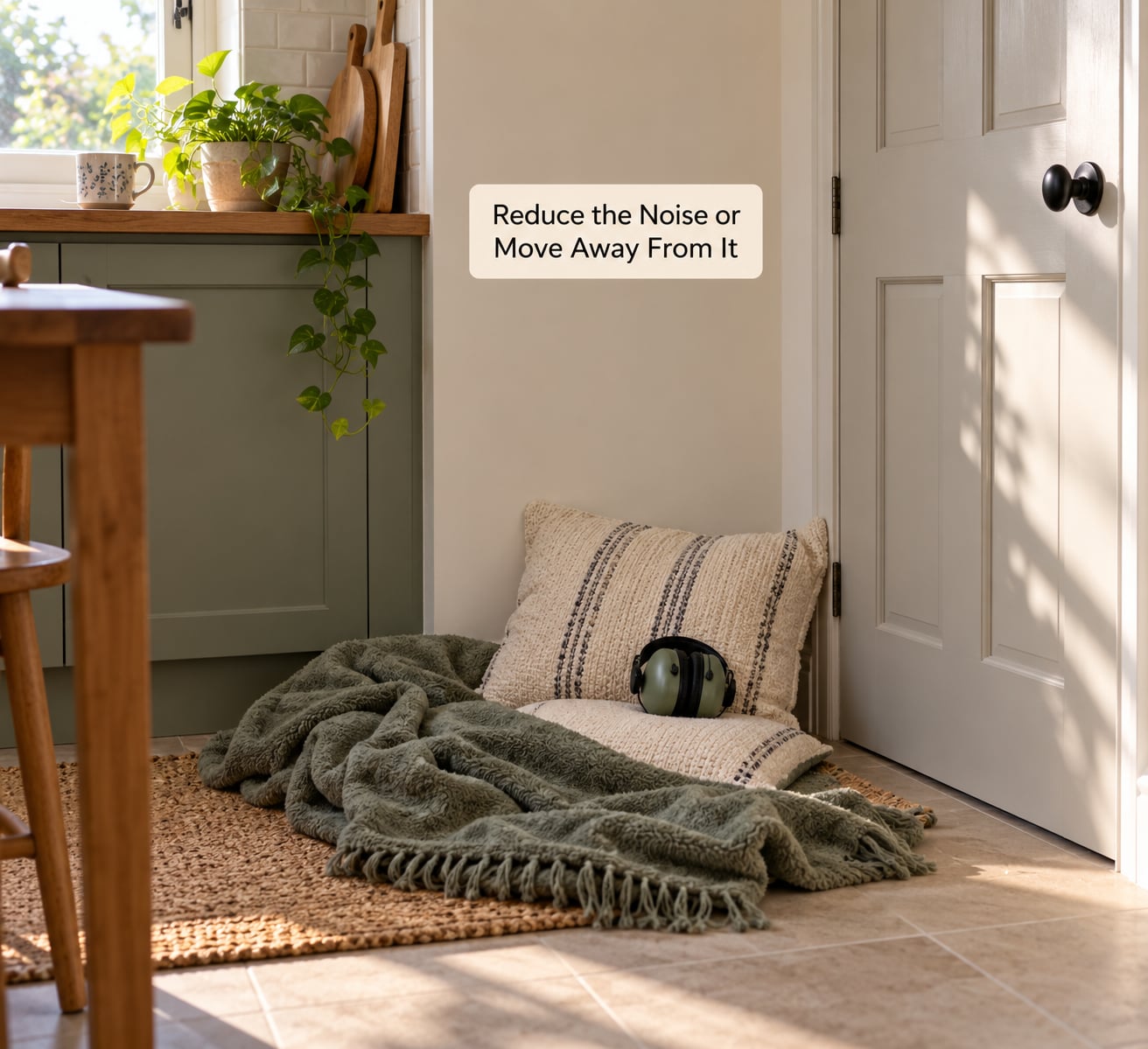
Cut the sound before you address the behaviour. Distance is the fastest tool you have and it costs nothing. Move one room away, close a door, step outside, or put the child on the far side of a room from the source.
Then work the source. Run the vacuum when the child is out, or plug in headphones for the two minutes it takes rather than letting them sit through it. Vacuum and mop before breakfast, not during it. Cook the loud part of dinner first and let the kitchen settle before the child comes in. Time the food mixer, blender, and hairdryer for the ten minutes nobody is home, or accept that they run and your child is elsewhere.
Some sounds are not volume problems but frequency problems, and distance fixes those better than turning something down. Vacuums, hand dryers, blenders, and hair dryers are all low-frequency and carry further than you expect, which is why a child can tolerate a screaming child but not the bathroom dryer.
If you cannot leave and cannot stop the sound, cover it rather than the child. A towel over the blender, a pillow against the closed door of the laundry room, or ear defenders in the car all buy a few minutes.
3. Offer Calm, Practical Support
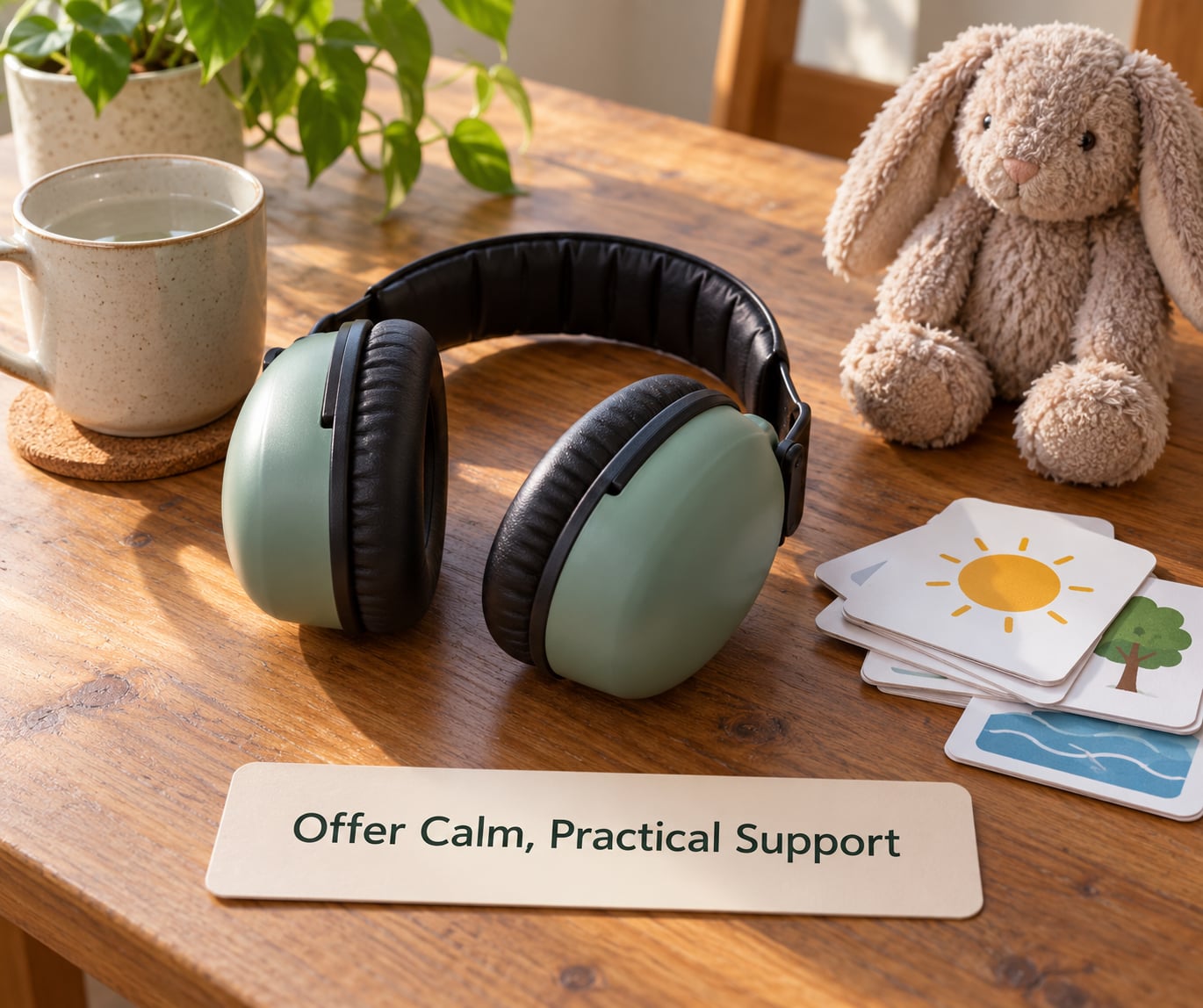
Offer help in a sentence, not a demand. “Too loud, let’s go to the hallway,” then wait. Many parents find it easier to say that once and let the silence do the work than to repeat it five times.
What tends to help in the moment:
- Ear defenders, offered without a sales pitch, in a size that fits properly
- A quiet break somewhere predictable, with a comfort item already there
- Breathing together, slowly, with your hand on their back. Breathe out longer than you breathe in
- Firm pressure or a firm hug if that is what your child reaches for
- A real choice between two options, like the quiet room or the car
Do not grab their hands away from their ears. That removes the tool they were using and leaves them with the sound and no option. Repeated persuasion, bargaining, and counting to three work once or twice, then train you as the adult to keep talking while they are overwhelmed.
Match your calm to theirs rather than matching theirs to yours. A flat, quiet voice and a still adult body do more for a dysregulated child than three enthusiastic sentences.
4. Teach an Alternative Way to Say ‘Too Loud’
This is the step that pays off most over time. If the hands are the only available option, the hands are what you get. Give your child a second option that costs them less than covering their ears.
Keep it small and specific:
- A card on a lanyard, or a small keychain they keep in a pocket
- A hand sign, such as a flat palm pushed toward you for too much
- One AAC button labelled “too loud” or “break” on their talker or phone
- A single word for pre-verbal children, taught the same way every time
- A movement, such as pushing the palm of their hand against your palm
Teach it while things are calm, not during a meltdown. Practise in the kitchen with the mixer running briefly, praise the first small try, and let them still use their hands when they need to. The signal is an addition to ear covering, never a replacement on day one.
Then tell the adults in their life. The card only works if the teacher, the grandparent, and the restaurant staff know what it means and what you want them to do about it.
5. Prepare for Predictable Noisy Places
Most of the hard moments are not surprises; they are places you can walk into on purpose with a plan. A rehearsed exit and a known quiet corner are what turn a new environment into a manageable one, and the change usually shows up over a few weeks rather than the first visit.
| Situation | Common triggers | How to prepare |
|---|---|---|
| Restaurants | Music, chatter, clattering dishes, a hard room | First table of the day, quiet corner, exit route shown before you sit |
| School and daycare | Hallway, cafeteria, assemblies, fire drills | Advance warning, agreed signal, ear defenders permitted and stored where the child can reach them |
| Playgrounds | Large groups, whistles, equipment, overlapping voices | Arrive early, choose a spot away from the middle, agree a signal for leaving |
| Birthday parties | Music, games, group shrieking, paper horns | Visual prep the day before, ear defenders in a bag you carry, plan to stay for twenty minutes |
| Supermarkets and shops | Trolley wheels, overhead music, one specific voice | Quieter hours, headphones on before you go through the doors, no questions asked if you skip a row |
| Airports and stations | Announcements, boarding calls, crowd noise | Ear defenders for the whole wait, hand signal for urgent announcements, gate with fewer people |
| Public restrooms | Automatic hand dryer, hard surfaces, echo | Folded paper for the dryer, or skip it. Many families just use a quiet wash at home before leaving |
Preview it in writing or with pictures if your child uses a social story. Most parents find a simple “first this, then this, and if it is too loud you show me the card” sequence on paper works better than a paragraph.
Rehearse the exit before you go, not during it. Walk the child to the car or the quiet spot once while things are still fine, so leaving is a practised action rather than a new decision under stress.
For school, ask for the quiet corner to be a named place they can go without asking, and for the fire drill warning to come with as much notice as the building allows. That last request comes up constantly from parents, since an unannounced alarm is the hardest sound of all to prepare for. If the child is also behind on schoolwork, keeping up with the classroom pace covers how to talk to the teacher about the wider picture.
6. Work With the Child’s Care Team
You do not need a diagnosis to get good help, and you do not need to prove anything before you ring. Bring notes, keep it brief, and describe the behaviour rather than the label you think it might be.
A useful script sounds like this: “In the past two weeks, she has covered both ears at the food mixer, in the supermarket, and at soft play. It lasts five to ten minutes. She sleeps and eats well. I would like a hearing check and some advice on sensory support.”
Who to involve:
- Pediatrician for ear pain, ear infections, hearing screening, and any sudden change in behaviour or hearing
- Audiologist if there is any question at all about hearing itself
- Occupational therapist for sensory processing differences, graded exposure plans, and the home program
- Teacher and school team for the quiet corner, the ear defenders, the drill warning, and any written plan
Ask your pediatrician about hearing loss first whenever you can. A child who cannot hear certain frequencies clearly can find the remaining ones unbearable, so hearing changes sit above sensory explanations until they are ruled out.
Decreased sound tolerance is well documented in autistic children, so if your child has an autism diagnosis, sound sensitivity is a known part of the picture rather than a parenting failure. Ask for a sensory profile in writing so every adult your child meets is working from the same page.
7. Track Small Changes Without Rushing Progress
Progress here is slow and mostly invisible from the inside, so you need the log to see it. Add three columns to what you already keep: how long before the hands came up, how long to settle, and whether the signal was used at all.
Then change one thing at a time. Ear defenders for the supermarket only. Quiet hours for shopping only. Nothing brand new on the same week you introduce a support, or you will not know which one did the work.
If you want to build tolerance gradually, work up in three separate stages: short exposure at a lower volume, then the same length at the everyday volume, then the everyday volume for longer. The third stage is the one families rush, and it is the one that holds.
Expect weeks rather than days. Anyone promising your child will be fine with the hairdryer by next week is guessing.
Common Mistakes
Almost every mistake here comes from treating ear covering as defiance rather than information. These are the ones that come up most, with what to do instead.
Forcing your child to stay in the noise. Holding a hand down, counting to three, or keeping them in the room teaches them that their signal does not work. It also removes the one strategy they already had. Offer the alternative and let them take it.
Dismissing it as attention-seeking or a habit. “He just wants attention” is the sentence parents most often regret. Covering the ears works reliably, which makes it a poor attention-seeker anyway. Treat it as a signal about something the sound is doing to them.
Adding six supports in one week. Ear defenders, a quiet room, white noise, a reward chart, a new schedule, and a talker all at once leaves you with no idea which one helped and a child who has lost track of what is normal now. Change one thing.
Assuming every ear cover means the same thing. A child covering their ears at a hand dryer is reacting to sound. A child covering their ears in a silent room, or holding their ears when nervous, or doing it for the interesting hollow sound it creates, is doing something else. Noise, emotional overload, sensory seeking, and ear pain each need their own response.
Making ear defenders permanent with no safety plan. Constant blocking can stop your child hearing speech, warnings, and their own name, and worn too continuously it can delay building tolerance. Agree in advance that they come off for alarms, drills, and the car.
Skipping the ear-pain check. An ear infection, recent ear tubes, or a mild hearing change can look exactly like fussiness over noise. Rule that out first, every time, before building any plan on top of it.
Letting other adults shame the behaviour. “Stop covering your ears” at a playground or a family gathering is not helpful advice. Give relatives one line to use instead: “he needs a break, we will be back.”
Frequently Asked Questions
Is covering the ears a sign of autism?
Covering the ears is common in autistic children, and decreased sound tolerance is well documented, but on its own it is not a diagnostic sign of autism. Plenty of non-autistic toddlers do it during loud or unpredictable play, and many autistic children have no sound sensitivity at all. Autism is diagnosed from a pattern of social communication and restricted behaviours over time, not from one sensory behaviour. If you are wondering about a diagnosis, a developmental evaluation is the right route.
Do non-autistic children cover their ears at loud noises?
Yes, and it is more common than search results suggest. Young children have a developing nervous system and often find sudden or unpredictable sound genuinely overwhelming, with vacuum cleaners, hand dryers, blenders, and large groups the usual culprits. ADHD, anxiety, and some genetic conditions are also linked with sound sensitivity. Sensory differences sit on a spectrum, and a diagnosis is never required before you give a child ear defenders or a quiet corner.
Can hearing loss make a child sensitive to loud noise?
It can, and this is the first thing to rule out. If certain frequencies come in faintly, the remaining ones can register as harsh and painful, so a child with reduced hearing may flinch at the same sounds everyone else ignores. Sudden changes in hearing, or a child asking for the volume to be turned up, are both reasons to ask a pediatrician for a hearing screening. An ear infection can create the same picture, and both are easy to check.
Is covering the ears stimming?
Sometimes. If your child covers their ears in a quiet room, or does it for the hollow muffled sound it makes, they may be seeking that sound rather than avoiding it, which is closer to sensory seeking or proprioceptive pressure than to avoidance. If it only ever happens at loud, unpredictable sounds, it is more likely self-regulation. You do not need to decide which is which, or stop either one. Just do not punish a stim or hand over the child to a clinician for it.
Should my child wear noise-canceling headphones all day?
Use them for the noisy moments rather than around the clock. Noise-cancelling headphones reduce volume and are fine at the supermarket, on a bus, or in a cafeteria, but constant blocking can stop your child hearing speech, warnings, and their own name, and it can delay building tolerance over time. Agree in advance that they come off for fire alarms, drills, and any safety instruction. Keep the volume low enough that you can talk to them without raising your voice.
When should I see a doctor about my child’s noise sensitivity?
Book an appointment if your child covers their ears along with ear pain, discharge, fever, or recent illness, if hearing seems to have changed, or if the behaviour appeared suddenly in a child who never did it before. Also ask if reactions are getting worse, happening in quiet rooms, or interfering with sleep, eating, or school. A pediatrician can rule out infection and arrange hearing screening, and a referral to an occupational therapist can build a sensory plan. Bring your trigger log with you.
Start With One Trigger and One Safer Response
Pick the single sound your child reacts to most, write it at the top of the trigger log, and build one reliable response for it. Maybe that is a quiet morning in the kitchen before anyone else is up. Maybe it is ear defenders and a quiet aisle every time you shop.
Give your child one way to say it is too much, and make sure the adults in their life know what that means. Keep the household volume steady for a week, then look at the log together.
If the reactions are frequent, painful, happening in quiet rooms, or changing week to week, take the log to a pediatrician and ask about hearing screening and an occupational therapist referral. That is general information, not a diagnosis, and it is a good first conversation either way.