
A food allergy action plan for school is a signed, written set of instructions that tells staff exactly what your child reacts to, what a reaction looks like, and what to do in the first minutes. Knowing how to write one takes most parents an afternoon of work plus a short appointment with their child’s doctor, and the finished plan usually takes 30 to 60 minutes to review.
The biggest misconception is that parents write all of it themselves. Your child’s allergist or pediatrician writes the allergen list, the symptoms, and the emergency medication instructions, then signs and dates the form. Your job is everything around that — collecting the records, making sure the wording is unambiguous, requesting the daily accommodations, and delivering the plan to the right people.
Table of Contents
- What You Need
- Step-by-Step: How to Write a Food Allergy Action Plan for School
- Common Mistakes
- Frequently Asked Questions
- Who should complete my child’s food allergy action plan?
- What should a school food allergy action plan include?
- Can a school nurse change the emergency medication instructions?
- How often should I update the food allergy action plan?
- What if the school will not use the plan I provide?
- Where should the action plan be stored at school?
- Conclusion
What You Need
The form documents and communicates a care plan your child’s healthcare professional has already established. It does not diagnose an allergy, and it does not prescribe or change any treatment. Everything clinical on the page has to trace back to that clinician’s written instructions.
Before you start drafting, gather these items:
- The child’s current allergen list and the name of the clinician who manages the allergy
- The school’s own form, if the district requires one, plus any medication authorization form
- The number and expiration dates of the child’s prescribed epinephrine auto-injectors
- Two emergency contacts who answer during school hours, with at least one cell number
- A recent photo of your child for the corner of the form
- Notes on specific accommodations: cafeteria seating, meal substitutions, bus, field trips, art class
- The school year dates the plan covers and the date it needs to be resubmitted
You will also run into three different names for what sounds like one document. Parents frequently are not sure which one the school is asking for, and search summaries of this topic blur them together, so here is the distinction:
| Plan | Who creates it | What it covers | Review cycle |
|---|---|---|---|
| Emergency Care Plan (ECP), also called an anaphylaxis action plan | Physician-signed | Symptoms, emergency treatment, medication, contacts | Yearly, and whenever anything changes |
| Individual Health Care Plan (IHCP) | School nurse with the parent | Daily management at school: prevention, meals, storage, who does what | Yearly |
| Section 504 plan | 504 team with the parent | Legal accommodations, including self-carry rights | Every three years, or sooner if circumstances change |
Most children need the ECP and the IHCP. A Section 504 plan is worth requesting when the accommodation is not something a reasonable adult would do on their own — lunch substitutions that require a change to the meal, for example.
Step-by-Step: How to Write a Food Allergy Action Plan for School
Six steps, in this order. The first three are about accuracy, the last three are about making sure the right people act on it.
1. Gather Current Medical Information
Start with whatever the healthcare professional has already written: the diagnosis, the confirmed allergen list, the recorded severity, the prescribed avoidance measures, the medication with its dose instructions, and the emergency response guidance.
Check that every item is current before you transfer it. An action plan written two years ago may list an old brand of auto-injector, a dose that has since changed, or an allergy list that grew when the child was tested again.
You will know this step is done when you can point to a single, dated document from the clinician that contains all of it, and the date on that document is from the current school year.
2. Identify Allergens and Cross-Contact Risks
List each confirmed allergen the way the clinician listed it, in plain language. “Peanuts and tree nuts” is useless; “peanuts, cashews, almonds, walnuts, pistachios, hazelnuts” tells a cafeteria worker what to pull from the tray.
Keep allergies and intolerances separate if the child’s care team has done that. A lactose intolerance and a milk allergy lead to different cafeteria instructions, and mixing them on one line is how a substitute teacher ends up guessing.
Then describe realistic exposure, because a child rarely eats a food to trigger a reaction:
- Shared utensils, spatulas, toasters, and fryers in the cafeteria line
- Hands and surfaces after another child handled the food
- Trays, tables, and desks wiped with the same cloth
- Substitutions the kitchen makes without checking with the family
- Classroom celebrations, birthday treats, and shared snack boxes
- Play dough, sensory bins, and craft materials containing milk, wheat, or egg
- Bus snacks, sports drinks, and emergency snacks kept on the bus
You will know this step is done when a teacher who has never met your child could read the list and correctly describe what must not happen at lunch.
3. Document Prevention and Accommodation Requests
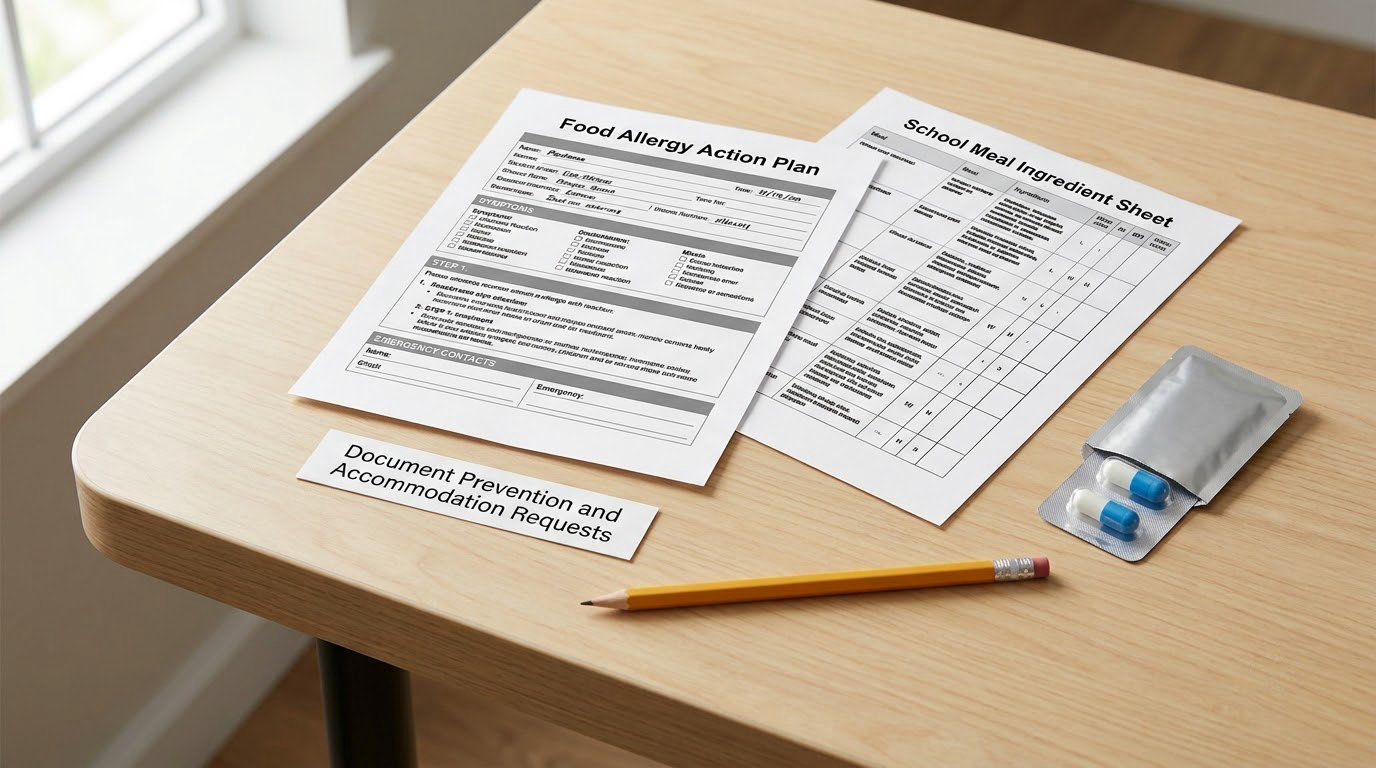
Write the prevention section as specific requests, each tied to something in the medical record. Vague asks get vague answers.
- Ingredient information or advance meal menus from food service before the school day
- A designated safe seating area that is cleaned before and after lunch
- Handwashing before meals for the child’s table group
- A written cleaning protocol for cafeteria tables, trays, and classroom surfaces
- Label checks on any packaged snack brought from home or delivered
- A no-shared-food rule for classroom celebrations, with an alternative the child can join
- A named alternative for art and sensory materials containing wheat, milk, or egg
If the school has a nut-free policy, ask for the definition. “Nut-free” can mean no peanuts, no tree nuts, or no products processed in a facility that handles them, and parents report that unclear wording causes more anxiety than the policy itself.
For autistic children or children with food-related anxiety, name it. A predictable written plan reduces the daily negotiation around meals, and a plan that says who sits where and what happens during a reaction gives staff a script instead of improvising while a child is already distressed.
Check this step by asking the nurse to read the prevention section back to you. If she cannot say what will happen at lunch tomorrow, it is not specific enough.
4. Write Clear Emergency Instructions
This is the part that has to be transcribed, not composed. Copy your clinician’s instructions exactly — the symptom list, which medication may be given and by whom, the dose, when to call emergency services, and when to call you. Do not add a medication that was not prescribed, and do not soften a symptom line into something vaguer.
Most plans follow this sequence. Use your clinician’s wording where you have it.
- Give epinephrine immediately at the first sign of a serious reaction, using the prescribed auto-injector, and note who is authorized to administer it.
- Call 911 right away. Do not wait to see whether symptoms improve, and do not drive the child yourself.
- Keep the child lying down with legs raised if breathing is difficult, and do not let them stand or walk.
- Give a second dose after the interval your clinician specified if symptoms continue and a second device is available.
- Observe in the emergency department for the period your clinician wrote, commonly four hours, because symptoms can return after epinephrine wears off.
Two details cause most of the confusion in a real emergency. Write the dose as a number on the form, and leave it blank only if the clinician has not specified one — never guess, and never write a dose you calculated yourself. Second, name who gives the medication. School staff are far more willing to act quickly when the line says “any trained staff member” or a specific person’s name, rather than leaving the responsibility implied.
Also decide in advance what is explicitly prohibited. If the clinician has said no antihistamine as a first response, write that in so nobody reaches for it during the panic.
5. Add Contact Information and Signatures
The identifying block is simple: the child’s full name, the school and grade, a photo, the date the plan covers, and the date it expires or will be reviewed.
Then add contacts. Two emergency contacts are standard, at least one with a cell number that is answered during school hours. Include the child’s healthcare professional and practice name, plus the prescriber’s details if the school asks for them on a separate authorization form.
Finish with signature and date lines for the clinician and for the parent or guardian. Note on the plan who must receive it and by when. You will know this step is done when there is no blank field a reader would have to interpret, and a signature line that is dated rather than just signed.
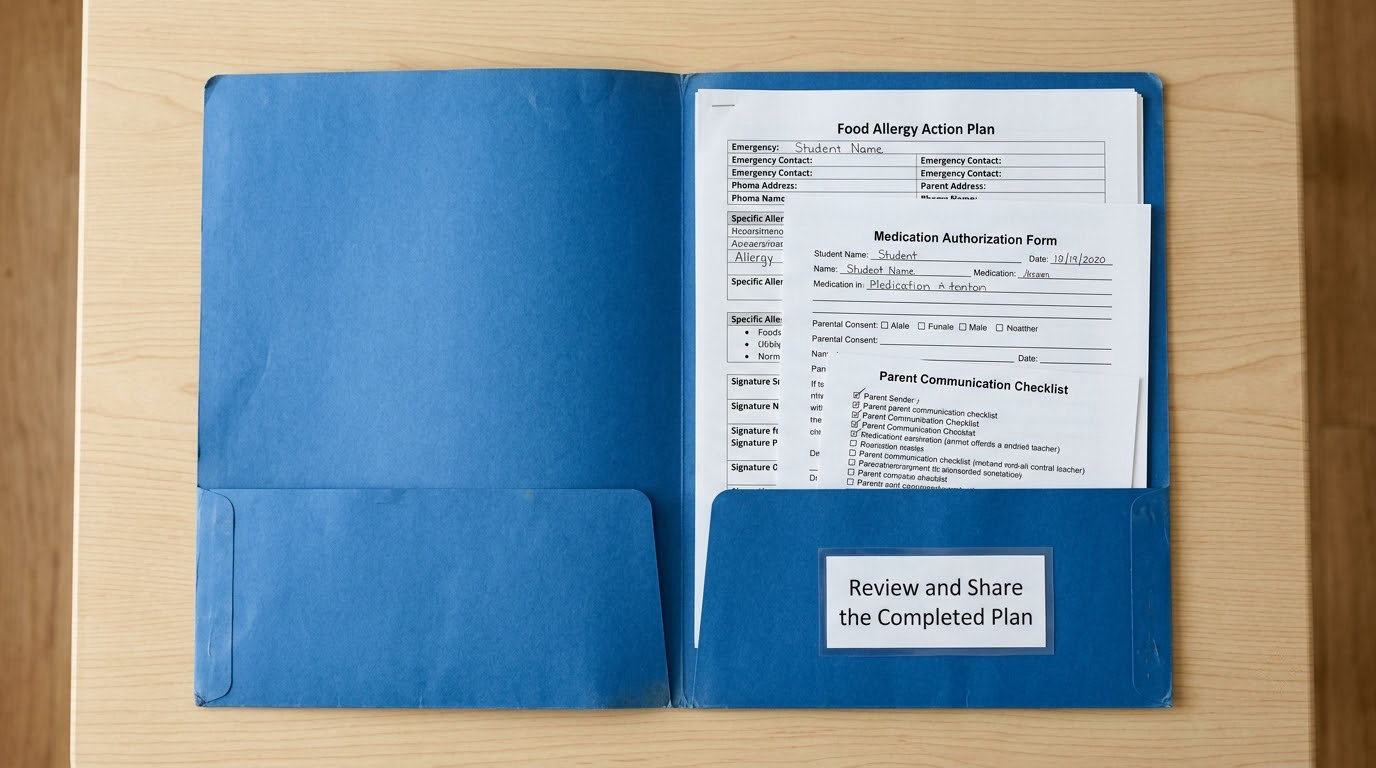
6. Review and Share the Completed Plan
Read the finished plan out loud once. You are looking for four problems: language a non-medical adult would have to guess at, a missing field, two instructions that contradict each other, and medication details that are inaccessible — a locked office where nobody knows the code, or a device stored where a teacher cannot reach it.
Here is roughly what a filled-in plan looks like. Treat the content as a model, not a template to copy, because every line must match your child’s own clinician instructions.
| Field | Example entry |
|---|---|
| Child | Child’s full name, grade, school, photo attached |
| Allergens to avoid | Peanuts; tree nuts (cashew, almond, walnut, pistachio, hazelnut) |
| Symptoms — mild | Hives, itchy mouth, nausea |
| Symptoms — severe | Throat tightness, wheezing, faintness, repeated vomiting, swelling of tongue or lips |
| Emergency medication | Prescribed epinephrine auto-injector, dose as written by the prescriber, second dose after the interval the prescriber specified |
| Who may give it | Any trained school staff member |
| Steps | Epinephrine first, then 911, then position and monitor, then second dose if needed, then emergency department observation |
| Medication location | Main dose in the nurse’s office; second dose with the classroom teacher; locations reviewed at the start of each school year |
| Contacts | Parent cell number; second contact cell number; both answered during school hours |
| Signatures | Physician signature and date; parent or guardian signature and date; valid for the 2026 school year |
Then get the medical review and signatures, then deliver it. Under most district policies the plan goes to the school nurse first, who reviews and files it and distributes copies.
- Nurse: holds the original and the medication
- Homeroom and classroom teachers: their own copy, in the room, not in a filing cabinet
- Specials teachers: art, music, PE, and any activity with food or physical exertion
- Bus driver: if the child rides, plus the bus attendant if there is one
- Food service staff: the allergen list and substitution instructions
- After-school and club staff: any program the child joins
- Field trip chaperones: a copy per trip, per district policy
Parents on parent forums say the single biggest failure is a plan that lives only in the nurse’s office while the classroom and the substitute teacher never see it. Ask for the distribution list in writing and confirm who has received it.
If the school hands you its own form instead of the clinician’s, that is common and workable. Port your clinician’s instructions onto the district form, attach the signed ECP behind it, and ask the nurse to confirm that the district form will not be used to replace the medical instructions. If the district form is the only document that gets filed, that needs to be resolved in writing before the first day.
A useful habit is to print every copy on brightly colored paper and attach a photo to each one. In a panic, a pink page in a stack of white ones gets found faster.
Common Mistakes
Writing the clinical content yourself. Parents sometimes add a symptom or a medication from memory at a late-night appointment. If the plan is going to be acted on in an emergency, every clinical line has to come from the healthcare professional who signed it.
Emergency steps that are too vague. “Use epinephrine if needed” gives a hesitant adult permission to wait. Write the trigger symptom, the dose, and the requirement to call 911 immediately.
Omitting the dose or leaving it implied. If the prescriber did not write a number, leave the field blank and have them complete it. Never calculate it.
Leaving out the second dose. Many old forms mention one device. Ask explicitly where the backup dose lives and who carries it.
Asking for accommodations that do not trace to the record. A request tied to a documented medical need is far easier to approve than a general worry. Attach the relevant clinical line.
Handwritten edits. Anything added in pen after the signature can be challenged later, and staff are unsure whether it was authorized. Print a fresh copy for every change.
Out-of-date medication details. Check expiration dates over the summer, not after term starts. Note a monthly calendar reminder, because nobody tracks this otherwise.
Delivering the plan and assuming it was read. The nurse filing it does not mean the teacher received it. Ask each person to confirm.
Waiting for the school year to start. Forms requested in late August are rushed. Parents who bring the signed plan in spring, and attend the first meeting in person rather than only emailing, report noticeably better cooperation.
A few final habits keep a plan useful. Rehearse it with the staff who matter, the way you would a fire drill, and ask the nurse to demonstrate the child’s specific device with a trainer. Review the plan every summer, and sooner if the allergen list, medications, or symptoms change.
Frequently Asked Questions
Who should complete my child’s food allergy action plan?
A parent and the child’s healthcare professional complete it together. The physician or allergist supplies the clinical content, including allergens, symptoms, emergency medication and dose, and signs and dates the form. The parent supplies identifying details, emergency contacts, medication locations, and specific accommodation requests. Parents may write a draft to save time at the appointment, but any medical instruction has to come from the clinician who signs it.
What should a school food allergy action plan include?
It should include the child’s name and photo, the confirmed allergen list, the symptoms that signal a mild reaction and those that signal a severe one, the prescribed emergency medication with its dose, who is authorized to give it, numbered emergency steps including calling 911, where each dose is stored, two emergency contacts with cell numbers, and signature and date lines. Add a prevention section covering meals, seating, cleaning, and celebrations.
Can a school nurse change the emergency medication instructions?
No. The emergency medication instructions are medical orders written and signed by the child’s healthcare professional. School staff administer the medication and follow the plan as written, and they do not alter doses or substitute products. If the written instructions are unclear or conflict with the medication in hand, staff should follow the signed clinician order and call the prescriber or emergency services. Request a corrected plan rather than an informal change.
How often should I update the food allergy action plan?
Review it every summer before the new school year, and update it any time the allergen list, medication, dose, symptoms, or emergency contacts change. The signed plan should carry the school year it covers and an expiration or review date. A Section 504 plan is formally reviewed about every three years, but an allergy change still warrants an earlier update. Keep one current copy and archive older versions.
What if the school will not use the plan I provide?
Ask, in writing, which document the school will file and which it will follow in an emergency, and request the answer before the first day. Submit both the district form and the clinician-signed Emergency Care Plan, with the medical instructions attached. If the school lacks its own epinephrine or a nurse on site, raise it explicitly. For a conflict you cannot resolve, ask the district’s special education or 504 coordinator, and keep a copy of everything you sent.
Where should the action plan be stored at school?
The original goes to the school nurse, with copies in the classroom and with any staff who supervise your child, including specials teachers, the bus driver, and after-school leaders. Each copy should carry a photo and be easy to find fast, which is why parents print them on colored paper. Medication is stored per the plan, with one dose accessible to the classroom teacher and a second dose in the nurse’s office, checked for expiration each summer.
Conclusion
Start with two things: current written guidance from your child’s healthcare professional, and the school’s own required form. Fill in the parent sections, have the clinician review, sign, and date the clinical content, then hand the completed plan to the school nurse before the first day.
Ask for confirmation, in writing, that every authorized staff member has received and reviewed it, including classroom and specials teachers, food service, and transportation. Call emergency services first for severe symptoms such as trouble breathing, throat tightness, faintness, or symptoms involving more than one body system. No plan replaces current instructions from your child’s doctor.