Most children can learn their full name, a parent’s name, their home address and one phone number between ages four and six, with five to ten minutes of practice a day over a few weeks. The method matters more than the timeline: short, repeated, low-pressure practice built on pictures, rhythm and pretend play works far better than worksheets or drills that turn into nagging.
If you are working out how to teach a child their name and address, the good news is that it is a skill you can build in a few minutes at a time, without a curriculum and without a single flashcard vendor. The trick is chunking the address into pieces, attaching each piece to something visual, and rehearsing it inside play until it comes out without thinking.
Table of Contents
- What You Need
- Step-by-Step: How to Teach a Child Their Name and Address
- Common Mistakes
- Frequently Asked Questions
- At what age should a child know their name and address?
- My child can say their name but will not say their address. Is that a problem?
- How do I teach a non-verbal or autistic child their name and address?
- Is it safe to teach my child our address? Who should they tell it to?
- How do I handle a move, or a child who lives in two homes?
- How long does it take a child to memorize their address?
- Conclusion
What You Need
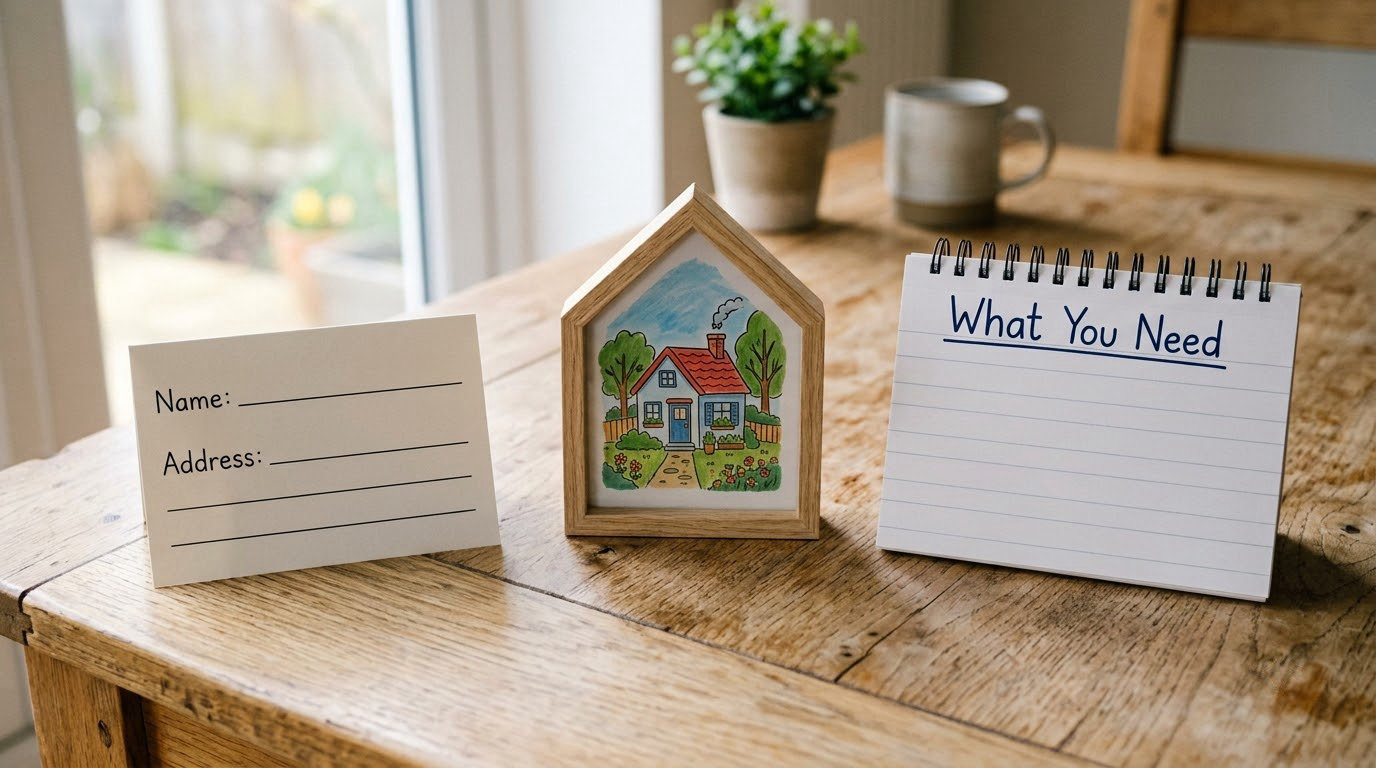
You need very little, and you can assemble all of it in about ten minutes. Most of it is preparation rather than equipment.
- One visual cue card. A laminated index card with the child’s name at the top, the address underneath, and one phone number at the bottom. One card, not five. Visual clutter is the enemy of recall for a lot of children.
- The real address, written out in full. House or flat number, street name, and any unit. If you live somewhere without a street name, write exactly what you would tell a postman, and include the nearest landmark.
- One picture per part. A photo of your house, a picture of the street sign, and a small symbol for the unit or apartment. Children remember the picture long before they remember the word.
- A decision about the name. One form, used by everyone, everywhere. Decide this before you start.
- A familiar routine slot. Practice attaches to something that already happens: getting into the car, brushing teeth at night, coming home from the shop. New habits need a hook.
- Optional communication supports. A picture-exchange board, a talker, a printed script, or a first-then board if your child uses one. Whatever your child already has for communicating should carry this content too.
- A toy phone and a pretend adult. A play phone, a police officer hat from a dress-up box, or a stuffed animal to play the dispatcher. Role-play needs a prop to get going.
Step-by-Step: How to Teach a Child Their Name and Address
Teaching the name first, then the address, then the phone number, in that order, gives the child a chain to hold. Each piece links to the one before it, so the final skill is not one long memory task but four short ones stacked together.
1. Choose One Consistent Form of the Child’s Name
Pick the version of the name your child will hear from a teacher, a paramedic, or a police officer, and use that exact version everywhere. For most children that is first and last name, spelled the way it appears on their documents.
What to avoid is a household running three names at once. If Grandma calls him “Buddy”, his uncle calls him “Bear”, and school says “Bartholomew”, the child has to translate before he can answer. Parents often mean affection when they do this. The child experiences it as a test he keeps failing.
Also decide on a parent’s name to practise alongside it. Parent communities consistently point out that a child who can say “Dad” but not his dad’s actual name gives a searcher very little to work with. One family group post described a lost four-year-old who told a stranger his own name clearly, then could only manage “dad” when asked for a parent’s name.
2. Teach the Name With a Visual and Spoken Routine
Say the name, point to the name, and let your child say it back. The whole exchange should take under a minute. Then let it go and come back to it later in the day rather than repeating it thirty times in a row.
Attach the name to something your child already loves. A melody you both know, a silly voice, a hand gesture, a high-five when it comes out right. For children who are autistic or otherwise neurodivergent, the version of the words matters more than the play: pick one script and use those exact words every time, so the phrase never has to be decoded again in a moment of stress.
You will know the name step is working when your child offers it without being asked, for example when a delivery arrives or when a neighbor says hello at the door.
3. Break the Address Into Meaningful Parts
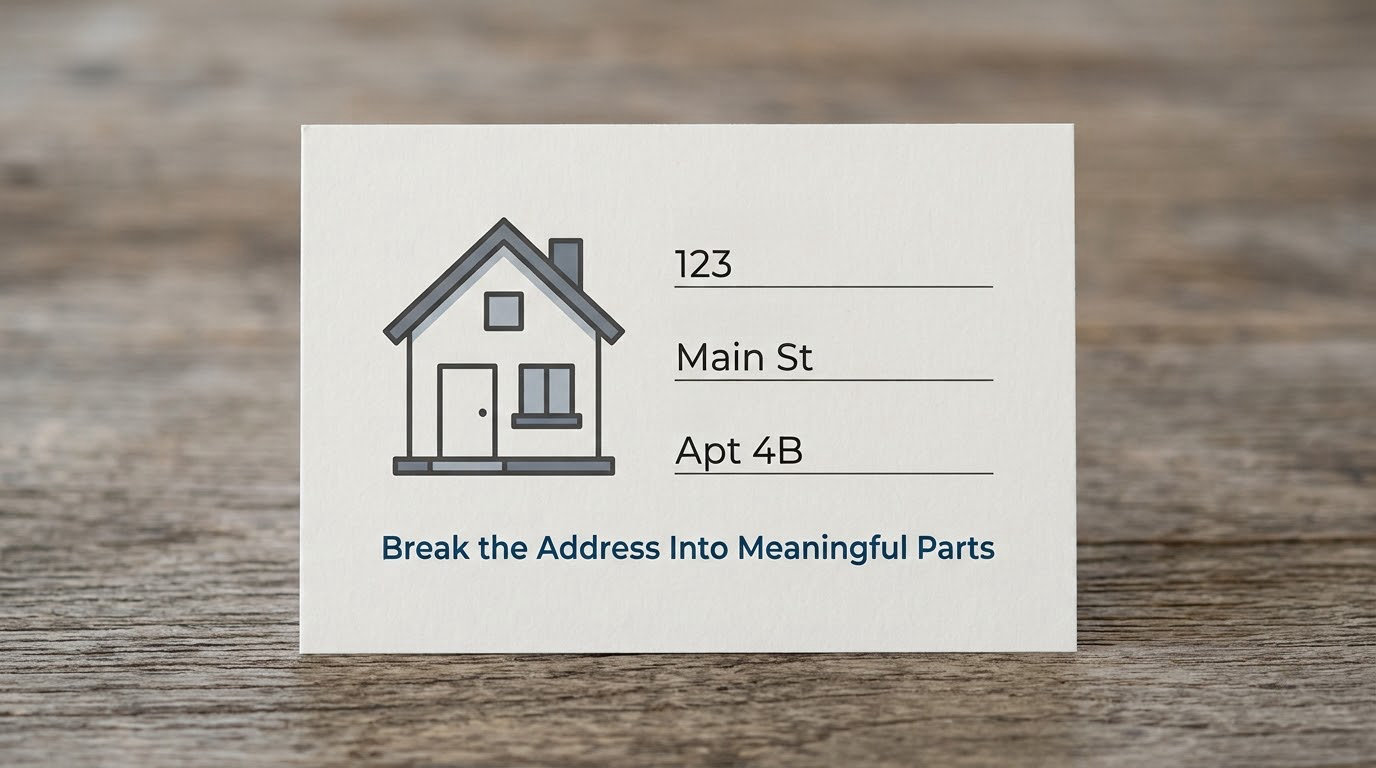
Do not ask a four-year-old to memorize “14 Rosewood Close, Apartment 3B” as one string. That is four memories, and they will tangle.
Teach one part at a time, in this order:
- House or flat number. The easiest piece, because it is short. Say it while pointing at the number on the door.
- Street name. Pair it with the street sign on your walk, or a photo of the sign.
- Any unit, apartment, or floor. Last, because most young children live somewhere without one and adding it early adds noise.
- Town, city, and postcode or zip. Add this later, once the first three are automatic.
Keep the phrasing identical each round. “Fourteen Rosewood Close” and “fourteen rosewood close” are the same sentence, but a child building a memory from sound has to check that they are the same one, and that check costs them the thread. Adults do this constantly and never notice.
If you live somewhere with no street name, in temporary accommodation, or between homes, the parts become what an adult would actually use to find you: the area, the nearest shop or junction, the building or shelter name, and a phone number. The structure holds even when the address is unusual.
4. Practice Saying and Finding the Information
Rehearsal turns into skill when the child has to produce it, not just hear it. Call-and-response works: you ask “what is your name?”, your child answers, you ask for the address, they answer. Keep the questions identical so the response becomes automatic rather than a fresh problem each time.
Matching activities add another route in. Lay out the number card, the street sign photo, and the house photo, and have your child put them in order. This is useful for children who learn better by doing than by hearing, and it costs you ten minutes of printing or drawing.
Then put it in pretend play, which is where most of the transfer happens:
- Supermarket role-play. The child is separated from you in an aisle and needs to tell a “staff member” their name and where they live.
- The front door. A neighbour knocks. Your child answers and says their name but does not open the door.
- A practice emergency call. Use a toy phone and let your child say the emergency number. Never dial a real emergency line to practise, and never leave a real phone in a child’s hands to test.
- The school drop-off. A child who can say their name and address to a teacher at the door is already solving a real problem on a real day.
With autistic children, a written script or social story makes the role-play predictable: “Someone might say they need help. I can tell them my name is ___. I can tell them I live at ___. Then I stay where I am and wait.” Exact words, written down, remove the improvisation that makes unfamiliar social situations so costly for them.
5. Generalize the Skill With Short, Repeated Practice
Five to ten minutes a day, most days, beats an hour on Sunday. Spaced practice is what moves something from short-term to automatic memory, and short sessions keep the child willing to come back tomorrow.
Raise the difficulty gradually rather than all at once. When the name is solid, add the house number. When the house number is solid, add the street name. When the full address holds, add the phone number. If your child is reversing digits, cut back a step and stay there for a few days. Going slower feels like failure and is actually faster.
Celebrate the specific thing, not the general praise. “You said Rosewood by yourself” is useful information for your child. “Good job, genius” is pleasant and teaches nothing about what to repeat next time.
Notice the signs that practice has become too much: shutting down, crying, leaving the room, hand flapping or other stimming that escalates, repeating your words back without answering. On those days, stop and switch to something else. A skill you push through a meltdown is a skill the child starts to dread.
6. Connect the Information to Safety Without Fear
Here is the tension most parents get stuck on, and it deserves a clear answer. The message is not “never share personal information”. It is: know your name and address, and give it to the right people.
Say it that way to your child. Full name, a parent’s name, the address, and a phone number belong to a police officer, a paramedic, a fire crew member, a trusted adult you have named in advance, and a teacher or childcare worker. They do not belong to someone who asks a child to keep a secret, who wants to come inside, or who contacts them online.
Keep the tone matter-of-fact rather than alarmed. A calm line like “your name helps us find your family” is enough. A long stranger-danger lecture tends to produce a child who is frightened of adults in general, which is not the outcome you want, and it does not change what the child knows in an actual emergency.
Then give the child the script for the moment, not just the facts. A widely shared parent post made exactly this point: almost every parent teaches the address and phone number, almost none teaches the child what to say when an adult tells them not to make a scene. Practise the assertive version too: loud and clear, staying put, going to a nearby adult, asking for help by name.
Common Mistakes
Most slow progress comes down to a handful of habits. Each one has a straightforward fix.
Drilling for too long in one sitting
Five minutes of daily practice builds more than a half-hour of repetition on a Saturday, because sleep is when the memory consolidates. Fix: set a timer you can hear, stop when it rings, and pick it up tomorrow.
Changing the wording every session
Say “what’s your name?” on Monday, “tell me your full name” on Tuesday, and “who are you?” on Wednesday, and you have built three questions where one would do. Fix: write your exact prompts on the back of the practice card and use them word for word.
Teaching the address before the name
The address is several pieces long, and it lands on a child who cannot yet hold their own name. Fix: get the name automatic, then the house number, then the rest, in that order.
Practising only with worksheets
A worksheet teaches recognition, not recall. A child can match the address to a picture perfectly and still be unable to say it to an adult. Fix: keep the pictures, lose the reading, and make the child the one talking.
Scaring the child to motivate them
Fear produces compliance once and avoidance afterwards, and it makes the child less likely to speak to a helpful adult when they actually need to. Fix: describe the skill as a tool that helps them, and keep every example concrete.
Having no backup for a move, a changed number, or a locked phone
A phone that is out of battery or locked to an adult’s face is no help to a child standing alone. Fix: keep a card in the school bag, in the jacket pocket, and in the car, and re-teach from scratch after any move, change of number, or change of households.
A few safety habits go alongside the memorization. Update the card the day the address changes, and treat a move as a fresh teaching window rather than assuming the old answer still applies. Include a second contact, so there is a backup number if a parent’s phone is off. And keep the information on the practice card out of sight on social media, where a photo of a child’s full details is genuinely risky.
Frequently Asked Questions
At what age should a child know their name and address?
Most children are ready between four and six, though some preschoolers can manage parts of it earlier. There is no single correct age. A useful check is whether the child can hold a three-step phone number or follow a two-step instruction. If they can, start with the name and house number, and expect the full address to follow a few months later. For a child who is nonverbal or has a speech delay, the same content can be taught through a communication device, cards, or pointing long before speech develops.
My child can say their name but will not say their address. Is that a problem?
It is normal, and it is one of the most common questions parents raise. A child who speaks their name confidently is a good sign; the address simply involves more chunks and arrives later. Return to the house number alone, add a picture of the street sign, and skip ahead only once the shorter piece is automatic. Do not add the street name, the city, and the postcode at the same time, and keep every session short enough that it stays enjoyable.
How do I teach a non-verbal or autistic child their name and address?
The content is the same; the access route is different. For a nonverbal child, put the name, the address and a phone number into their existing communication system, whether that is a speech-generating device, a picture-exchange board, or printed cards, and practise retrieving it on request. For an autistic child, use a visual schedule, a written or social story with exact wording, and a predictable time and place. Keep prompts low-pressure, allow processing time, and stop before the child reaches shutdown.
Is it safe to teach my child our address? Who should they tell it to?
Yes, with clear limits attached. The rule to teach is not never share your information, it is know your information and give it to the right person. Full name, a parent’s name, the address, and a phone number can go to a police officer, a paramedic, a firefighter, a teacher, and a trusted adult named in advance. They should not go to someone who asks the child to keep a secret from their parent, wants to come inside, or makes contact online. Practise the second list as firmly as the first.
How do I handle a move, or a child who lives in two homes?
Treat a new address as new content, not a small edit. The old answer is now wrong, and a child who recites it confidently may send a searcher to the wrong street, so retire the old card immediately. With shared custody, decide which address is the primary one, teach that one to full accuracy, and keep the second as a clearly labelled backup rather than an equal-weight alternative. If your housing has no street name, teach the area, the nearest landmark, and a phone number in place of the full street address.
How long does it take a child to memorize their address?
For a typical four-to-six-year-old, five to ten minutes of daily practice over two to four weeks is a realistic expectation for a confident, automatic full name and home address. Adding a phone number usually takes longer because of the number of digits. Some children pick it up in a week; others take a few months, especially with speech delays. Consistency matters far more than session length, and short daily practice always outperforms one long weekly drill.
Conclusion
Start with one thing this week: write the child’s full name on a single card, agree on the one version of the name everyone will use, and practise that exchange for five minutes at a predictable moment each day. Add the house number once the name comes back without a prompt, then the street name, then the phone number.
Progress here is individual and rarely linear. A child who is autistic, nonverbal, or has a speech delay will move at their own pace, and the right method is usually whatever already supports their communication, extended to carry this content rather than replacing it. Keep the existing communication and safety plan, keep the practice low-pressure, and revisit the address whenever your home or your family’s circumstances change.