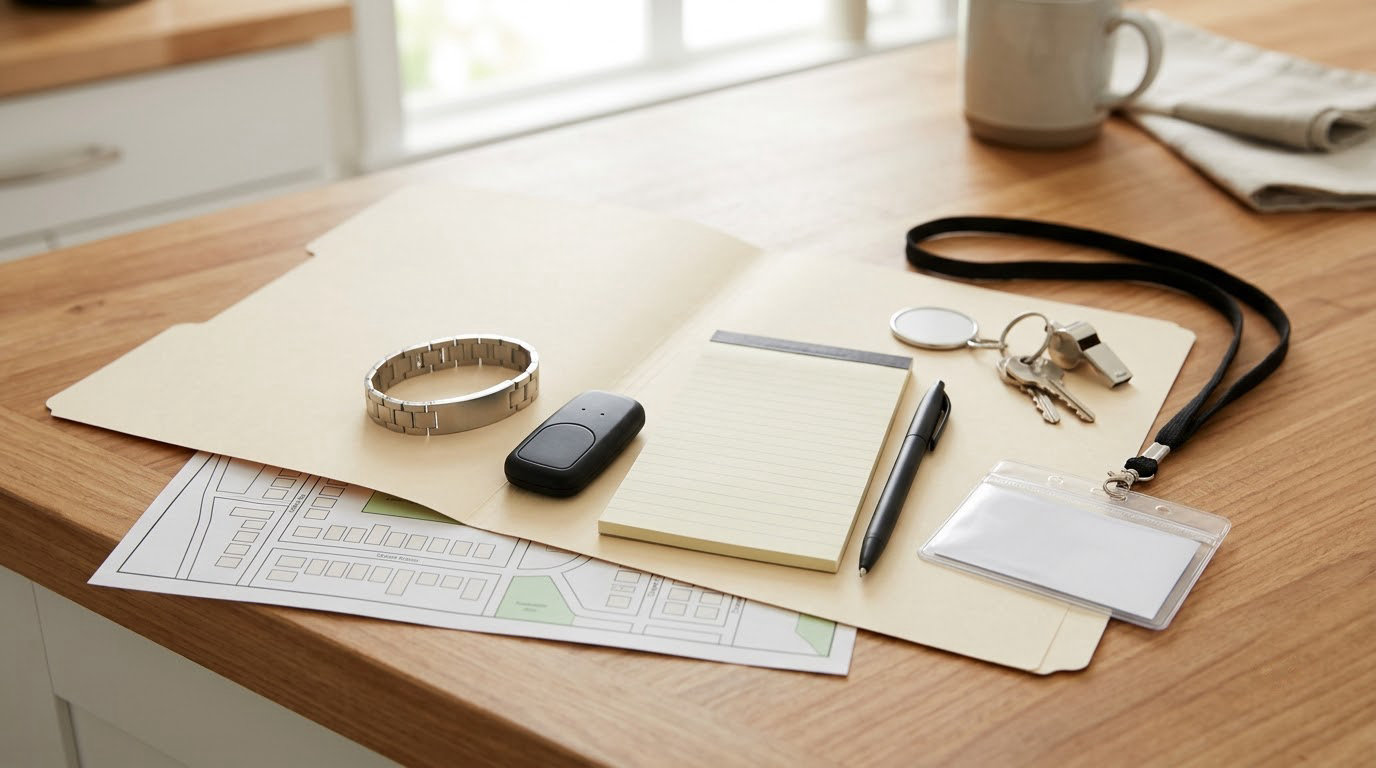
A wandering emergency plan is one page that tells anyone who finds your missing child who they are, what they look like, what they need, where they usually go, and what to do first. Put these twelve things in it: a recent full-body photo, a physical description, clothing last worn, diagnoses, medications, allergies, communication style, sensory triggers and calming strategies, favorite places, nearby water hazards, a priority-ordered contact list, and a written search order. Twelve items, one page, and it lives in a wallet, a backpack, and a school file.
Most families I talk to already have a photo somewhere. Far fewer have the rest, in writing, in a form a stranger can act on in the first ten minutes of a crisis. That gap is why this page exists.
Table of Contents
- What to Put in a Wandering Emergency Plan for Your Child
- The Core Parts of a Wandering Emergency Plan
- Contact Information and Places to Search
- How to Describe Your Child Clearly
- Medical, Medication, and Disability Information
- Special Diet, Sensory, and Communication Needs
- How to Make an ID Kit for Your Child
- What to Do When Your Child Is Missing
- How to Keep the Plan Current
- Frequently Asked Questions
- Should police, the school, and relatives each have a copy of the wandering emergency plan?
- What do I write in the plan if my child cannot speak or communicate verbally?
- How do I include medical and medication information without sharing too much?
- Should a wandering emergency plan include a special diet, and how detailed should it be?
- How often should I update the photo, contacts, and details in the plan?
- Conclusion
What to Put in a Wandering Emergency Plan for Your Child
Here is the itemized list, in the order responders and caregivers tend to need it.
- A recent full-body photo. Face plus body, in clothes they actually wear, taken within the last few months. Most phone cameras do this well.
- A plain physical description. Height, build, hair, eyes, skin tone, and any distinguishing marks or features, written so a stranger can picture them.
- Clothing last worn. What they had on when they left, including shoes. Shoe descriptions help more people recognize them than you would expect.
- Diagnoses and support needs. Autism, intellectual disability, or other diagnoses that explain why they may not respond to a stranger’s voice.
- Medications and allergies. Names only, as written on the label, plus allergy information. Ask your clinician or pharmacist to confirm the list before you print it.
- Communication style. Whether they speak, how they communicate, and what to expect if they cannot answer a question.
- Sensory triggers and what calms them. The specific things that cause a shutdown or a flight response, and the items that help.
- Favorite places and habitual routes. The park, the bus stop, the store, the path they walk to school, in order.
- Nearby water hazards. Pools, ponds, lakes, canals, drainage ditches, and empty containers that collect water, with directions to each.
- A priority-ordered contact list. Two or three names, not ten, with the first person’s phone number at the top.
- What first responders should and should not do. How to approach, what may get a response, what makes things worse.
- A written search order. Call 911 first, then water, then familiar places, then everyone else on the list.
Two of those deserve emphasis because they are the ones that change outcomes. Water is where the danger concentrates: drowning accounts for roughly 70 to 90 percent of fatal wandering incidents, according to the Children’s Hospital of Philadelphia, and about 91 percent of deaths in autistic children under 14 follow accidental drowning after wandering, per the Autism Society. And the response order matters more than most people expect, because searching first delays the call that starts a search.
The Core Parts of a Wandering Emergency Plan
Organize the page so a responder can scan it in under a minute. Group the items into sections, keep the photo at the top, and leave the bottom half for the search order and contact list.
| Plan section | What to record | Where the copy lives |
|---|---|---|
| Identification | Recent full-body photo, height, build, hair, eyes, distinguishing features, clothing last worn | Wallet card, phone photo album, glove compartment, school file |
| Health | Diagnoses, medications, allergies, adaptive equipment, clinician contacts | Printed plan, medical summary letter, pharmacy record |
| Communication and sensory | Speech status, communication device, triggers, calming items, signs of overload | Printed plan, caregiver copy, teacher copy |
| Places and hazards | Favorite locations, habitual routes, nearby bodies of water and landmarks | Printed plan plus a marked map |
| People | Primary contact, secondary contact, clinician, school staff, relative nearby | Printed plan, fridge copy, relative’s copy |
| Response | Call 911 first, then water, then familiar places, then share the plan | Printed plan only; this is the part people skip |
Here is a copy-and-fill version. Print two copies and keep one in the child’s backpack or bag.
CHILD’S NAME: ____________ DATE OF BIRTH: ______ CURRENT PHOTO ATTACHED: YES / NO
HEIGHT: ______ BUILD: ______ HAIR: ______ EYES: ______ DISTINGUISHING FEATURES: ____________
CLOTHING LAST WORN: ____________ SHOES: ____________
DIAGNOSES / SUPPORT NEEDS: ____________
MEDICATIONS: ____________ ALLERGIES: ____________
COMMUNICATION: speaks / uses device / non-verbal. REACTIONS TO STRANGERS: ____________
SENSORY TRIGGERS: ____________ CALMING ITEMS: ____________
FAVORITE PLACES IN ORDER: ____________
WATER HAZARDS AND DIRECTIONS: ____________
REGULAR ROUTES (SCHOOL, BUS STOP, PARK): ____________
FIRST CALL: ____________ PHONE: ____________
SECOND CALL: ____________ PHONE: ____________
CLINICIAN: ____________ PHONE: ____________
SCHOOL / DAY PROGRAM: ____________ PHONE: ____________
APPROACH: ____________ DO NOT: ____________
SEARCH ORDER: call 911, check water first, then familiar places, then notify contacts
Contact Information and Places to Search
Keep the contact list short. Two or three names, ranked, with the first person’s mobile number at the top. Long lists slow responders down, because they have to work out who is actually available.
Who belongs on the list
- First call. The person who can reach the scene fastest, usually a parent who is still nearby.
- Second call. A co-caregiver, partner, or close relative who knows the child’s patterns.
- Third call. Someone local who can open a home or check a usual hiding spot, such as a grandparent living on the same street.
- School or day program staff. Even on a weekend, the program number reaches someone who knows the child’s triggers.
- Clinician. The pediatrician or specialist who can confirm medications and conditions if responders have questions.
Add the missing child’s school, last known location, and the time they were last seen. If the child takes a bus or a transport route, write down the route number and the stops, because that narrows a search enormously.
Places to record before you ever need them
Mark on a printed map: favorite parks, playgrounds, the school and its exits, the bus stop, the convenience store, the parking lot, and the quiet spots behind buildings where a child who is overwhelmed might sit down. Children who are not looking for a thrill are often looking for somewhere quiet, dark, and out of the way, and that is not always near home.
List every body of water within a short drive, with a one-line description of each: community pool on Elm Street behind the church, retention pond past the school, canal along the rail trail. Add the small things that hold water, because a five-gallon bucket and a wading pool have ended more searches than a pond has.
Some parents also give neighbors and nearby business owners a short briefing card: a photo, the name, and a single line asking them to call 911 and then the parent. A brief conversation with the closest five or six households takes ten minutes and gives your child a network that notices things before a search does.
How to Describe Your Child Clearly
Write the description the way you would say it out loud to a stranger at a gas station, not the way a medical chart reads. Skip the diagnostic language in the description itself and put it in the health section.
Include age, approximate height in feet and inches, build, hair color and style, eye color, skin tone, and anything distinctive: a mole, a scar, glasses, braces, hearing aids, a prosthetic, a gait that is noticeably uneven. Say which side, and say it twice. If your child has a communication device, name it and say what it looks like, because responders will not recognize it.
Then add the parts a photo cannot show. How they communicate, what happens when a stranger speaks to them, and what they do when overwhelmed: cover their ears, stop talking, run, hide, or lash out. Most parents can describe the first two instantly and freeze on the third. Write it anyway.
Finish with the pattern. Where they have gone before, how far, which direction, and at what time of day. Elopement is often repetitive, and the same route is usually tried first. Include the trigger if you know it, such as a schedule change, a loud room, or a cancelled plan, since familiar routines are the usual warning sign.
Use their name and pronouns as they are used at home, and keep the tone plain. This page gets read to strangers under stress.
Medical, Medication, and Disability Information
Include general health information in the plan and leave the clinical decisions to your child’s healthcare team. Your child’s doctor, nurse, or pharmacist is the right person to confirm medication names, allergy details, and dosing instructions. If the child’s medication is complex or changes often, ask the clinician for a one-page medical summary letter you can attach, and ask them to note what should happen if the child is found and is distressed.
The plan itself should carry: diagnoses or support needs that shape a response, allergies, medication names, the clinician’s name and number, insurance information if you want it shared, adaptive equipment such as glasses, hearing aids, braces, or a wheelchair, and any emergency instructions your clinician has given you. It should also note whether the child takes anything regularly that a stranger might not expect, and whether there is a condition that makes noise, touch, or sudden movement genuinely dangerous.
Do not put full medical records in a plan that lives in a glove compartment. Names, conditions, and who to call cover what a first responder needs. Keep detailed records where the clinic keeps them.
Special Diet, Sensory, and Communication Needs
This is where a standard form falls short, and it is the section families most often skip. If your child is on a gluten-free, dairy-free, low-sodium, or medically restricted diet for allergy reasons rather than preference, write the restriction plainly and say why. A stranger handing your child a granola bar is doing it out of kindness, and the plan is how you stop that.
Add safe snacks. Name the specific products, the sizes, and where they are, because “gluten-free food” is not a usable instruction at a roadside store. If your child eats only a small set of foods, list those foods and include a couple of spare sealed items in the go bag so a well-meaning adult has something to offer that is actually safe.
For sensory needs, write the triggers and the remedies. Noise, fluorescent light, hand flapping, unexpected touch, smells, crowds, or a specific texture, and then what helps: headphones, a weighted item, a quiet space, a lap, a specific word, or simply dimming the lights. If your child carries a comfort object, name it, because a worn blanket or a small toy is a strong identifier.
For communication, note whether they speak, whether speech is reliable under stress, whether they use a device, and what happens when they cannot answer. Tell responders plainly that a child who does not respond to a name or to being touched is not necessarily ignoring them. Add the signs of overload: hands over the ears, going very still, dropping to the floor, rocking, or a sudden change in volume. Those signs tell a responder to back off and wait, which is usually more effective than repeating questions.
How to Make an ID Kit for Your Child
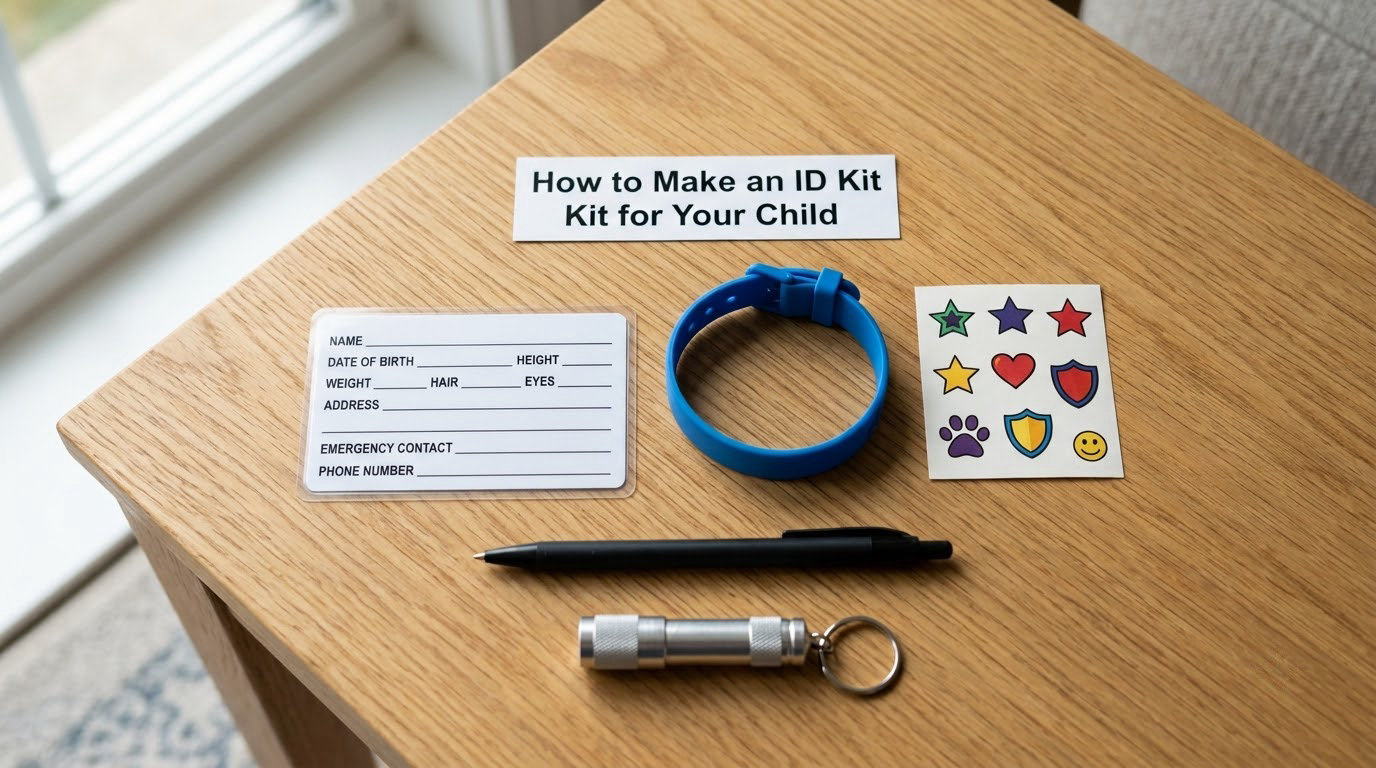
Identification does not replace the plan. It buys responders a few seconds and a name to call.
- A card. A laminated wallet card or a bracelet with a caregiver’s mobile number, the child’s name, and a line noting that the person may not respond or understand the situation. Simple layouts work better than decorated ones, because a responder is reading it fast.
- A wristband or necklace. Good for everyday use. Some families add a small tracker in the same place, and a second copy goes in a pocket rather than on the wrist, in case it is removed.
- Shoe tags. Often overlooked, often the item a passing adult notices first, especially with younger children.
- A temporary tattoo. Useful when a child will not wear a bracelet or gets irritated by one. Put a phone number on it, not just a name.
- A phone profile. Set the lock screen to the child’s photo and your contact details, keep a medical alert entry current, and make sure someone at home knows the passcode so police can reach the information.
Where to keep each option: card in your purse and the child’s bag, a copy in the glove compartment, one at school, and one with a relative who could be the first adult on scene. Update anything that holds a phone number or address the same week you change it, and check it during your monthly review. A stale number is worse than no number, because it wastes a responder’s time.
What to Do When Your Child Is Missing
Write this order down in advance and rehearse it. Rules for reporting a missing person vary by jurisdiction, so follow what your local authorities tell you on the phone. The sequence below is the general order most safety organizations recommend.
- Call your local emergency number first. Do not search on your own for long before making the call. Time lost searching is time the response is not starting.
- Give the responder the plan. Read out the description, the last known location and time, the clothing, and the likely places. The marked map is faster than describing it.
- Then check water. Pools, ponds, canals, ditches, and containers near the last known location, with a second adult so nobody is left alone at a body of water.
- Search familiar places. The routes and hideouts from your plan, in the order you wrote them down.
- Notify the other contacts. The second and third names, then school or the day program, then nearby family.
- Share more widely. Social media and community alert networks with the photo, description, and last known location, and only accurate information.
- Record everything. Times, places checked, who you contacted, and every call, in case you need a timeline later.
If you are the one who finds your child, stay calm and get close slowly. Speak from the side or front rather than from behind, do not grab without warning, use their name, and do not ask a string of questions. A child in a flight response often needs low stimulation and a familiar voice more than questions.
If you are the relative who arrives first, look for the plan in the bag, the glove compartment, or on the fridge before you start calling around. That is the whole point of putting copies in more than one place.
How to Keep the Plan Current
A plan with an out-of-date photo and a disconnected phone number is worse than no plan, because people trust it. Set a recurring review rather than waiting for a scare.
Your monthly checklist:
- Photograph your child again if the last one is more than a few months old, or after a haircut, glasses change, or growth spurt.
- Confirm the first and second contacts still answer, and that the numbers match the ID card and bracelet.
- Recheck medications, allergies, and equipment with your clinician at scheduled appointments, not on the monthly call.
- Look at the map. New construction, a new fence, a closed path, or a new pond all change the search picture.
- Confirm the school, day program, and relative copies are current and complete.
- Add a new favorite place or hiding spot after every incident, however small.
Rehearse with the people who hold copies: school staff, day program staff, grandparents, the sitter. Ten minutes once a term is enough to walk through who calls whom and where the plan lives. Practicing with your child matters too, in whatever form works for them, because a familiar route and a rehearsed response can stop an episode before it becomes a disappearance.
Frequently Asked Questions
Should police, the school, and relatives each have a copy of the wandering emergency plan?
Yes. Keep a full copy with your local police or fire department so they have a photo and description before you arrive, give the school and day program a copy for the child’s file, and leave one with a relative who could be the first adult on scene. Each copy needs the same current photo and the same prioritized contact list. A plan that lives only in your phone is a plan nobody else can read when you are not calm enough to unlock it.
What do I write in the plan if my child cannot speak or communicate verbally?
Say so directly, then describe what they do communicate. Note whether they use sign language, gestures, a communication device, or picture cards, and what their yes and no look like. Tell responders that silence or no eye contact does not mean the child is ignoring them, and add what helps: lower voice, more space, a familiar word, or waiting quietly. Also note what a meltdown looks like, so nobody mistakes it for defiance.
How do I include medical and medication information without sharing too much?
Keep it to what a first responder would need in the first hour: diagnoses or support needs, medication names, allergies, adaptive equipment, and your clinician’s name and number. Ask your clinician or pharmacist to confirm the list, and request a one-page medical summary letter if the chart is complicated. Leave out diagnoses that do not change how a stranger should respond, and skip full medical records entirely. Store the detailed chart with the clinic, not in a glove compartment.
Should a wandering emergency plan include a special diet, and how detailed should it be?
Include it whenever the restriction is medical rather than a preference, such as a gluten-free, dairy-free, or low-allergy diet. Name the specific products and sizes that are safe, say why the restriction matters, and list them separately from general food preferences. A responder who hands a child a snack cannot judge safety by appearance. Keep a couple of sealed safe snacks in the go bag so a helpful stranger has an option that already works.
How often should I update the photo, contacts, and details in the plan?
Set a monthly review and update immediately after any change. Refresh the photo after a haircut, new glasses, or noticeable growth, and confirm that the first and second contacts still answer their numbers. Recheck medications and allergies at scheduled clinician visits, and review the map for new construction, fences, or water features. After every incident, add whatever you learned, even a small detail such as a new hiding spot, then update the school and relative copies.
Conclusion
Start with one page today: your child’s identifying details and a recent photo, a primary and secondary contact, the last known location and likely places, the water hazards nearby, and any medical, dietary, sensory, or communication needs. Write the search order on the same page, ending with the rule that the emergency call comes before the search.
Then put copies where people will actually find them. Wallet, bag, glove compartment, school file, relative’s house, and with local police if your program offers it. Practice the response once a term with the adults who hold a copy, and check the numbers and the photo on a set day each month. An updated plan is the part that works.