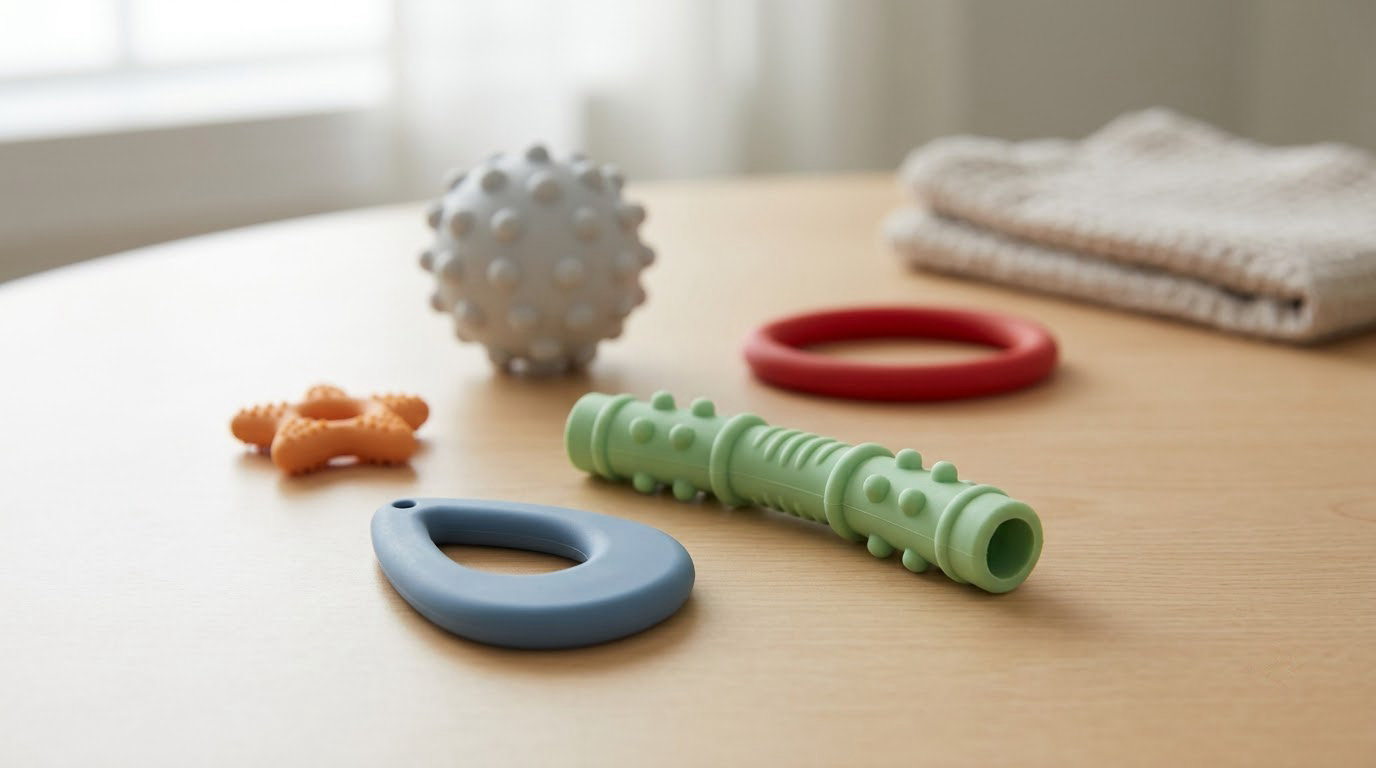
Oral sensory activities for chewing and mouthing are play-based ways of giving a child safe, deliberate input through the mouth and jaw: chewing a crunchy food, sucking through a thick straw, blowing bubbles, biting down on a resistance tool. For a child who mouths everything or chews shirt collars, this input usually calms them rather than winding them up, because chewing sends deep-pressure and proprioceptive signals through the trigeminal nerve to the brainstem and switches on the parasympathetic, calming side of the nervous system.
The goal is regulation and engagement, not teaching a child to chew a particular way or making them stop. Most families can start with a handful of cheap items already in the kitchen drawer. This guide covers what to try, how to build it into an ordinary day, and the handful of signs that mean a pediatric occupational therapist or doctor should take a look.
A note before we start: this is general information, not medical advice. Anything involving food, allergies, swallowing or a child who already has feeding difficulties belongs with your own pediatrician, dentist or feeding team.
Table of Contents
- What Are Oral Sensory Activities for Chewing and Mouthing?
- How to Choose Safe Activities for Your Child
- Easy Oral Sensory Activities for Chewing and Mouthing at Home
- How to Use These Activities During Everyday Routines
- When Chewing or Mouthing May Need Professional Support
- Frequently Asked Questions
- A Simple Place to Start
What Are Oral Sensory Activities for Chewing and Mouthing?
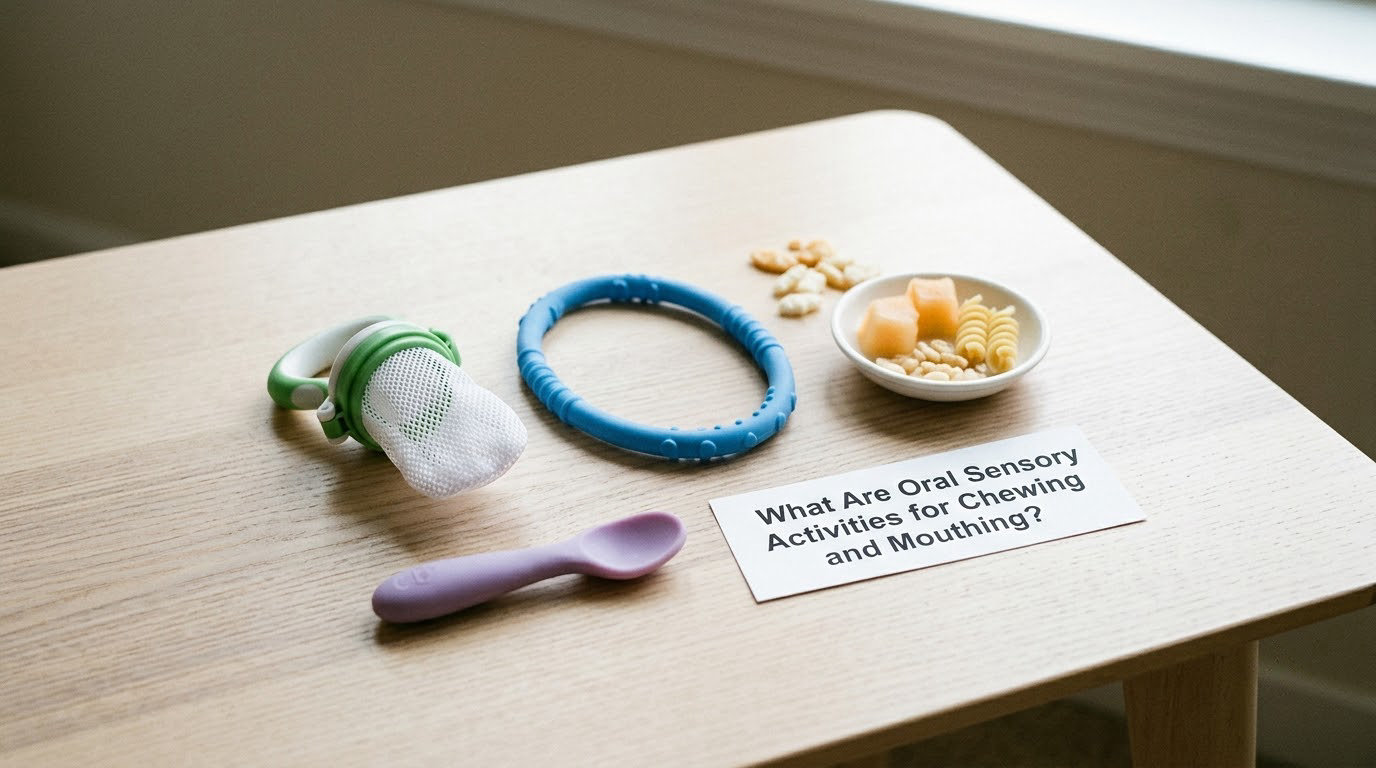
Oral sensory seeking is the drive for extra input around the mouth. Chewing is a mix of touch, pressure and resistance, and the pressure half is the important part: a firm chew fires up proprioceptors in the jaw, face and neck much the same way a weighted blanket or compression clothing works on the body. That is why the chewing tends to cluster around homework, transitions, waiting rooms and other overstimulating moments rather than running all day.
Research on sensory processing in autistic children, including work by Tomchek and Dunn in 2007 and by Leekam and colleagues in 2007, found sensory processing differences in the large majority of the autistic children studied, with oral and taste processing among the most commonly affected systems. Neurodivergent children with ADHD or sensory processing disorder often show the same pattern.
It helps to separate three behaviors, because they mean different things. Mouthing is putting objects in the mouth to explore or self-soothe. Chewing is applying and releasing pressure on something resistant. Biting is the same action with more force and less control, usually from a dysregulated child rather than a seeking one.
A related term you will see is pica, which is eating substances with no nutritional value such as dirt, paper, hair or chalk. Ordinary sensory chewing is not pica. Parents searching for “pica versus sensory chewing in autism” usually just want to know where the line sits, and the line is whether material is actually being swallowed.
How to Choose Safe Activities for Your Child
Start with what your child can already do safely, not with the most exciting tool in the cupboard.
Development level beats chronological age. A three-year-old who swallows food well usually manages a chewy tube. A five-year-old who still coughs on thin liquids should start with blowing games rather than chew tools, because the risk sits with the muscles, not the birthday.
Watch resistance level. Chew tools come in soft, medium and firm. Occupational therapists generally recommend starting at the softest level your child can bite and moving up only after they are comfortable, since a tool that is too hard leads to a bitten-off chunk or an empty mouth.
Check allergens and diet rules first. If your child has a food allergy or follows a restricted diet, keep the food-based activities off the table entirely and work with non-food tools. Check any new item with your pediatrician before the first use.
Know your child’s oral sensitivity. Some children seek input; others flinch at a toothbrush or gag at cold food. For a sensory avoider, start tiny and quiet, such as licking a single drop of yogurt, and build up over days.
Decide how much supervision you can give. Anything that can break, tear or come apart in the mouth needs an adult within arm’s reach. Anything round, small or breakable does not belong in the mouth at all.
Know your own first-aid plan. If your child is under one year, is gagging, or has a swallowing condition, speak to a clinician before running any of this.
Easy Oral Sensory Activities for Chewing and Mouthing at Home
Chewing and Crunching Textures
Crunchy foods give real resistance with no equipment. Raw carrot sticks, cucumber rounds, apple chips, pretzels, crackers and toasted bread are common starting points. Serve thin pieces lengthwise rather than round, and stay seated with the child while they eat.
The no-equipment version is a frozen yogurt spoon or a frozen yogurt tube: cold plus resistance, and it dissolves rather than splintering. Sit nearby, use a plastic spoon rather than metal, and let the child decide how much goes in the mouth.
Safe chew tools fall into a few categories. Mesh or textured feeders hold small food inside a handle so a child can gnaw on it. Chew tubes and chew pendants, often called chewelry, are worn around the neck or wrist. Pencil toppers stay on a pencil instead of the pencil going in the mouth. Look for food-grade silicone, a breakaway clasp on anything worn, and no small detachable parts.
Comfort looks like relaxed jaw, a steady rhythm of chewing, and the tool staying in the mouth rather than being chewed in two seconds. A child who stops after three bites and looks at you is done.
Sucking, Licking and Drinking
Resistive sucking means the child works harder than they would through an open straw. A thick or reusable straw in a smoothie, yogurt drink or mashed fruit gives that resistance naturally, and the drink doubles as oral motor practice for children who struggle with thin liquids.
For licking, try yogurt, pudding or ice cream spooned onto a plate so the child can explore it with fingers, then a spoon, then a straw across the same food over a few days. Sponge lollipops frozen overnight are another simple option for a child who chews things anyway.
Stop if you see gagging, coughing during the swallow, or a wet or gurgly voice after drinking. Those signs mean a swallow evaluation is needed, not a harder straw.
Blowing and Breath Control
Blowing is the easiest oral motor activity to run and the one families mention most often as calming before homework or bedtime. Put a cotton ball or pom-pom at one end of a straw and have the child blow it across the table without touching it. Blow bubbles in a cup, or through a plastic straw into a bottle of soapy water to make big shapes.
Whistles and bubbles work too, and a party blower held horizontally gives a long slow exhale that helps a child find the breath control they need. Puffing out cheeks without air, then cheeks puffed with air, isolates lip and cheek strength and is often used in speech work.
Comfort here is a steady round exhale rather than a gasp. If the child gets light-headed, stop immediately and let them breathe normally for a minute.
Biting Pressure and Oral Resistance
Some children want resistance that does not come from food. A silicone chew tube, a clean damp washcloth rolled and frozen, or a knotted strip of soft cotton fabric given under supervision can fill that gap. Wet fabric is easier to bite through than dry, so check it before handing it over and replace it as soon as it thins.
For resistance that is not chewed, push gently against a closed mouth with a gloved finger while the child pushes back. Twenty seconds of that is enough, and it mirrors a technique speech-language pathologists use for jaw strength.
Teething toddlers do well with a chilled, not frozen, teething ring or with a chilled damp cloth. Cold numbs the gums, and the biting pressure settles an aching mouth.
Temperature and Strong Flavors
Temperature is one of the easiest ways to change how a food feels in the mouth. Offer the same food cool and then warmed, such as yogurt straight from the fridge and then slightly warmed in a bowl. A frozen fruit ice or a plain ice cube held in the cheek pocket is another route to cold input.
Strong flavors such as sour lemon drops or unsweetened sour drinks add gustatory input. Use sparingly and watch closely, since sour plus chewing can be uncomfortable for a child with a sensitive mouth.
A toothbrush with vibration, or an electric toothbrush used by an adult, adds mild buzzing input. Keep it light and stop at the first sign of distress.
Parents often ask why children lick so much, especially autistic children. Licking is a way of getting taste and moisture information cheaply and quickly, and it is the same seeking pattern as chewing. Offering an intense, intentional flavor once gives the same information in a safer form.
Rhythmic Mouth Movement
Chewing gum is the classic rhythmic input, but for children under about four it is a choking risk and most choking deaths from gum happen in that group. For older children, plain, unsweetened gum with no wrappers or small pieces is the usual choice, used for a few minutes at a time.
Cheerios or other soft ring shapes moved from one side of the mouth to the other work well for school-age children. Chewing slowly with a count, or singing a familiar tune while chewing, adds rhythm without adding difficulty.
Oral Sensory Activities for Chewing and Mouthing by Skill Level
Choose the least challenging row that fits your child, and move up only when the current level is comfortable and boring.
- Beginners and sensory avoiders: cold yogurt off a spoon, blowing pom-poms through a straw, puffing out cheeks, licking a drop of puree from a plate. Nothing to chew, nothing that breaks.
- Building oral strength or coordination: chew tubes at soft resistance, thick-straw drinking, blowing bubbles, straw-and-cotton-ball games, side-to-side chewing of soft cooked pasta, cheek puffing with resistance.
- Needing more structured sensory input: medium and firm resistance chew tools, cold and frozen foods, sour flavors, rhythmic gum or soft ring-shaped snacks, vibration, longer chew sessions placed deliberately in a visual daily schedule.
Durability is the most common complaint families raise about chew tools. A heavy chewer can get weeks out of a firm tube and a few months out of a soft one, and a torn or cracked tool becomes a choking hazard, so check before every use and swap it out when the surface dulls or tears.
Cleaning matters too. Most silicone tools can be rinsed in warm soapy water or run through a dishwasher on a top rack, and anything shared at daycare or kept at school needs its own named container.
What Older Children and Teens Can Use Discreetly
Almost every guide online stops at toddler tools, which is exactly why teenagers and adults get left out. Parents posting in Reddit’s r/SPD forum about school-safe options for a sensory-seeking teen get concrete answers: a silicone bead threaded onto a replaceable hoodie string, silicone drinking straws, a cotton or t-shirt strip cut for chewing, and low-sugar mints held in the cheek rather than chewed.
The pattern is useful for school and work. Something worn, something contained, something that looks ordinary. A chew pendant under a collar does all three.
How to Use These Activities During Everyday Routines
Oral sensory input works far better as a planned part of the day than as a reaction to a problem. Parents report the biggest change when the safe option is already in their pocket or on the hook before the difficult moment starts, rather than handed over after the shirt collar has been chewed.
At meals, use a two-minute pre-meal oral warm-up: straw drinking, a chewy bite of a safe texture, or a few blows of a straw. It relaxes the jaw for food and takes pressure off a selective eater. During snacks, “sensory snack time” makes chewing an ordinary activity rather than something hidden.
At toothbrushing, switch to a soft-bristled brush and let the child use vibration, mint flavor or a chilled brush head as the input. This is where many children already want strong sensation and get a toothbrush instead.
Before homework and at transitions, five minutes of chew time or blowing games gives the child something to do with their jaw while the task starts. In the car, a chew tool, a straw and a packet of mints handle the wait. At bedtime, a long slow blow-out and a chew tool in the last ten minutes often replaces half an hour of restlessness.
Put all of it on a visual schedule. A simple chart with pictures for “chew time”, “sensory snack” and “breathe” lets a child ask for input themselves instead of the adults tracking it. On school paperwork, an oral sensory item fits neatly as a small, non-academic accommodation alongside breaks and fidget tools.
And keep most of this playful. If oral sensory activities turn into a lesson with instructions and targets, they stop working as regulation.
When Chewing or Mouthing May Need Professional Support
Most mouthing needs no appointment. These signs are different, and they are worth a phone call rather than a wait-and-see approach.
- Non-food materials are being swallowed. Dirt, paper, hair, chalk, stones or fabric in the stool or in the mouth points to pica rather than sensory chewing. Research reported in a 2023 autism clinic review put pica prevalence at around 23% in autistic children compared with about 3.5% in the general child population.
- Teeth or gums are showing damage. Flattened molars, cracked enamel or bleeding gums mean the input is too hard or too frequent.
- Anything is being bitten off and swallowed. Pieces of the chew tool, pen or toothbrush coming away in the mouth is a choking emergency waiting to happen.
- Biting other people. Play biting that leaves marks needs a behaviour and safety plan, not a chew tool.
- Pain, gagging or difficulty swallowing. Coughing during meals, a wet voice after drinking or obvious pain on eating needs a feeding evaluation.
- Food refusal is widening. Losing foods already accepted, or eating only one or two items across all settings, is a feeding difficulty worth assessing.
- Clothes, furniture or schoolwork are being destroyed, or the behavior is causing social problems with teachers and peers.
Who to contact depends on the concern. A pediatrician is the right first stop for swallowing, pain, teeth, growth and pica. A dentist covers tooth damage. A pediatric occupational therapist covers sensory seeking, chew tool selection, daily routine and school accommodations. A speech-language pathologist covers oral motor skills and chewing and drinking technique. A feeding team covers severe food refusal. Many feeding clinics run on all four.
Persistent mouthing on its own is not dangerous, and neither is an oral sensory need. The concern is what gets swallowed, what gets damaged, and what it costs the child socially.
Frequently Asked Questions
What are some examples of oral sensory activities?
Common examples include chewing crunchy foods such as carrot sticks or pretzels, chewing a silicone chew tube or chew pendant, drinking a thick smoothie through a sturdy straw, blowing pom-poms through a straw, blowing bubbles, puffing out cheeks, licking yogurt off a plate, and vibrating with an electric toothbrush. Group them by goal: chewing for resistance, sucking for oral muscle work, blowing for breath control.
What are some alternatives to chewing for kids who need to chew?
A chew tube, chew pendant, pencil topper, frozen yogurt spoon, washcloth knotted and chilled, a soft cotton fabric strip, or a thick-straw drink all give the same jaw resistance without the shirt collar. Keep several options available at the times chewing usually happens, because a tool handed over after the behaviour has started does far less than one that was already there.
How do I reduce mouthing in autism without punishing it?
Add input rather than removing the behavior. Put a chew tool within reach before the predictable trigger, add a scheduled chew break to a visual daily schedule, and give a structured alternative such as blowing or straw drinking when mouthing is intense. Punishment and repeated redirection rarely stop the need behind the behaviour, and they add pressure to a routine that is already hard.
Are non-food oral sensory toys safe?
They can be, with checks. Look for food-grade silicone, a breakaway clasp on anything worn, no small detachable parts, and no item that can snap or tear. Inspect before every use and discard anything cracked, torn or dulled. Never give a tool to a child under one year, and stay within arm’s reach whenever something goes in the mouth.
When should I stop an oral sensory activity?
Stop for gagging, coughing during or after swallowing, a wet or gurgly voice, light-headedness during blowing, flinching, going quiet and tense, or any attempt to swallow the whole tool. Those are signs to end the activity and simplify it next time rather than pushing through. Coughing during eating and a wet voice after drinking are swallowing signals, so book an assessment instead of repeating the activity.
A Simple Place to Start
Pick one safe texture your child already eats happily and offer it at a seated snack, while you sit with them and watch their jaw, their face and their breathing. Repeat that same thing for a week. Nothing about it has to look like a lesson, and nothing has to change beyond that first week.
Keep one backup item within reach for the moments you already know are coming, and if the chewing is damaging teeth, swallowing things, or leaving marks on people, that is the point to book a chat with your pediatrician or ask about a pediatric occupational therapy referral. The right first move for most families is small, repeatable, and supervised.