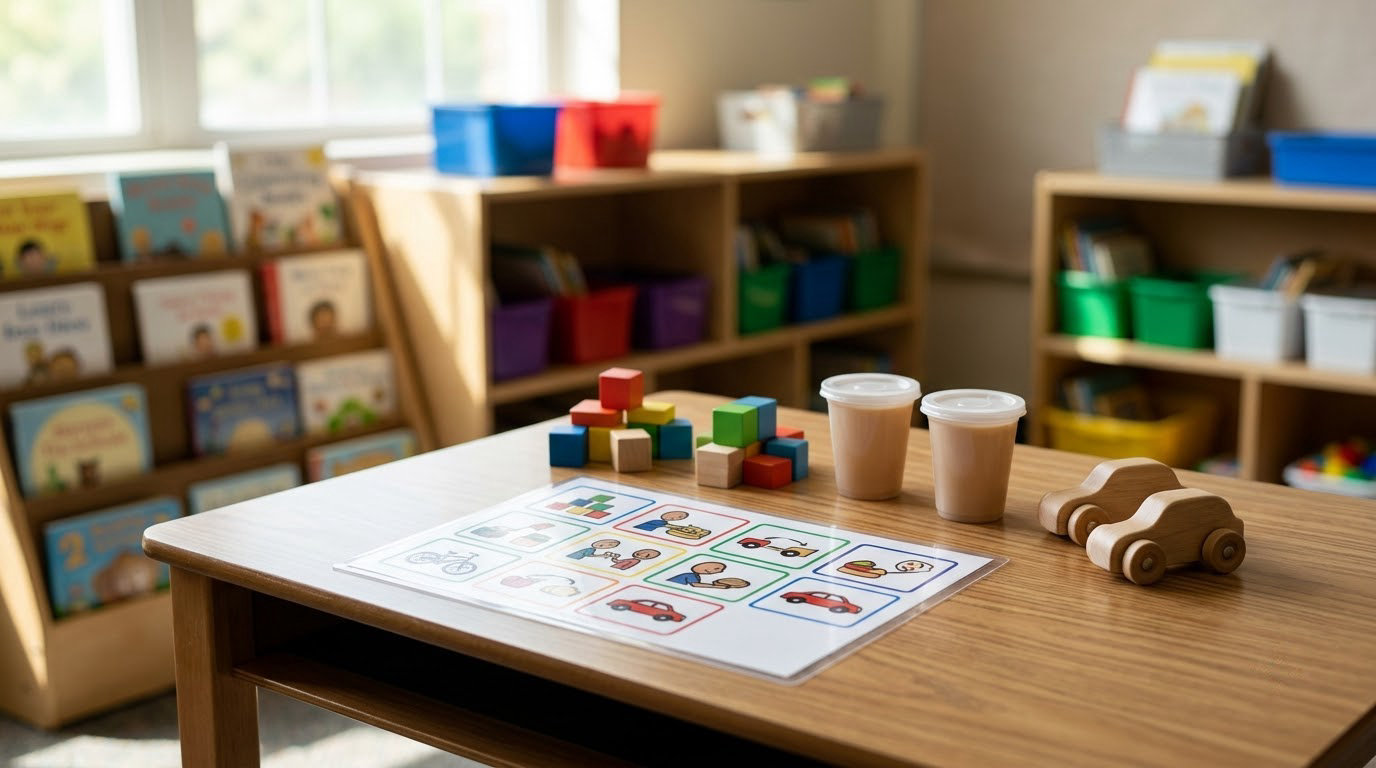
How to help an autistic child make friends at school comes down to small, predictable opportunities to connect, built around something your child already enjoys. You are not trying to turn a quiet kid into an extrovert. You are arranging repeated, low-pressure contact with one safe peer, then protecting the child’s autonomy over who they actually spend time with.
Expect this to take weeks, not weeks of constant socializing. What follows is the sequence I wish someone had handed me before my own child sat alone in the corner of the cafeteria for a whole year, followed by the mistakes I made along the way and the smaller list of things that actually helped.
This article covers the school-day side of the problem. Out-of-school friendships matter too, and I touch on where they fit at the end. If your child is in the middle or high school years, skip ahead; the peer landscape changes completely at that transition and most advice stops right before it.
Table of Contents
- What You Need
- Step-by-Step: How to Help an Autistic Child Make Friends at School
- Common Mistakes
- Frequently Asked Questions
- How can I tell if my autistic child is ready to interact with another child at school?
- How should I teach an autistic child how to ask to join a game?
- Does my autistic child need to make eye contact to build friendships?
- What if my child is friendly with one child but overwhelmed by groups?
- How can teachers support an autistic child who wants friends but struggles socially?
- When should I ask for help from a school counselor or autism specialist?
- Start With One Small School Connection
What You Need
Most parents arrive with a diagnosis and no plan. Before any strategy, you need a shared picture of your child, so that the adults at school are working from the same page rather than from whatever the child looked like on a bad Tuesday.
A one-page profile of your child. One page, plain language, that a substitute teacher could read in two minutes. Include how your child communicates when they want something, what their sensory triggers are, what helps them settle, and what a good day looks like. Share it with the teacher, the office, the lunch monitor and the specials teachers. More than one parent has found out weeks later that the aide assigned to their child never got the memo.
One activity your child already tolerates. Not one you hope they will learn to love. If they currently manage ten minutes of Legos at the kitchen table, start there. The activity is a container for the relationship, and the container should not be the hard part.
A short list of two or three peers who are safe. Safe means kind, predictable, and not known to bully. Watch how they treat a quieter or smaller classmate for a week before you name anyone. Teachers usually know this well before parents do, and asking directly which students are reliable in unstructured time is a reasonable question.
One adult at school who is actually paying attention. Often a classroom teacher, sometimes the counselor or a paraprofessional. Friendship formation at school is less about the child and more about whether an adult keeps noticing.
A place to keep notes. A notes app on your phone. Two lines a week: what happened, how your child rated it. Without it, you will remember the worst day and assume that is the pattern.
An honest estimate of your own bandwidth. Some of this is school-side work, some is home rehearsal, and some is short playdates. If you are already running on empty, pick the two items that cost you the least energy and do those consistently.
Step-by-Step: How to Help an Autistic Child Make Friends at School
How to help an autistic child make friends at school one safe step at a time
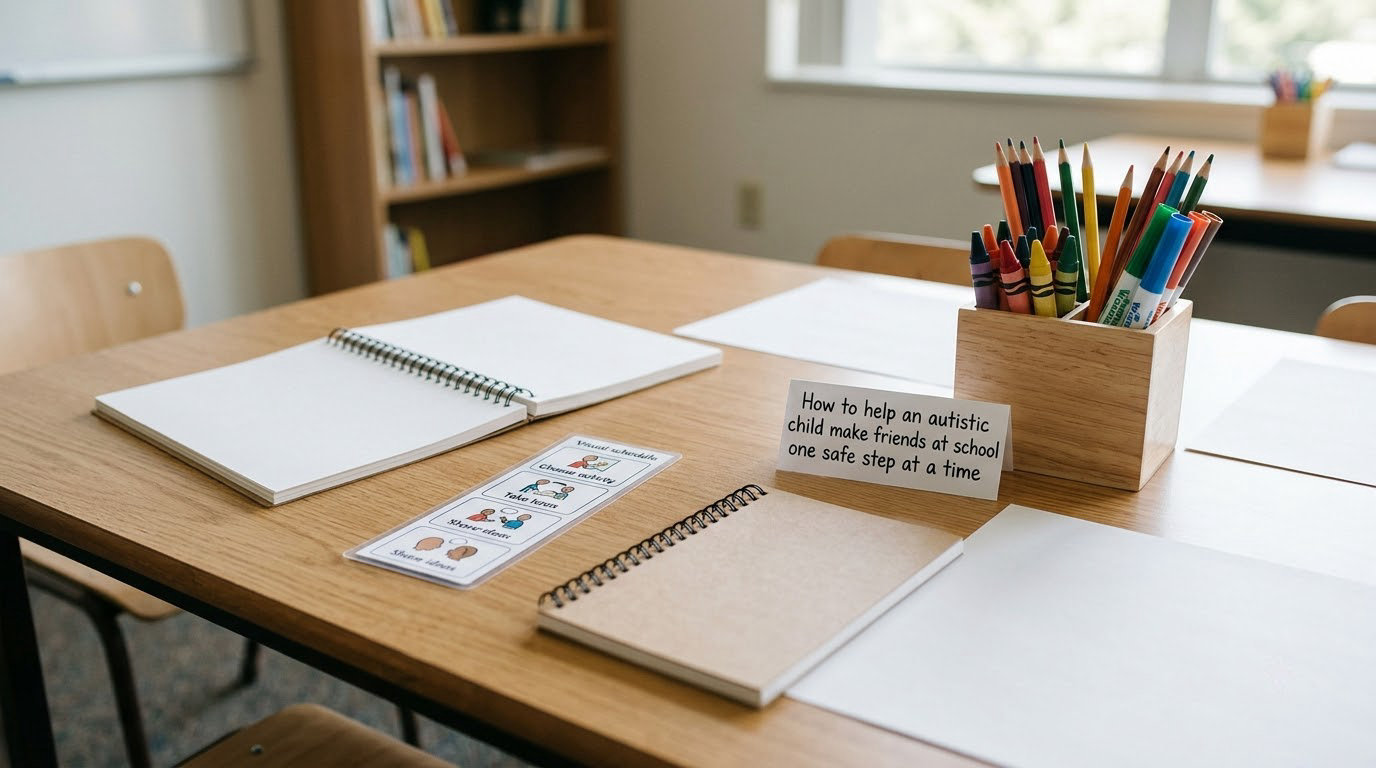
Begin with a school activity your child already handles, just shortened. Ten minutes of a familiar thing with one adult nearby beats an hour of unstructured play with a group. If the cafeteria is too loud, move the meeting to the library, the classroom during a quiet period, or the resource room.
Have the adult introduce the peer rather than watching your child hover and hoping. A simple bridge works: joining in by putting a piece down without a word, sitting nearby, or handing something over without speaking.
You know it worked when your child comes home and mentions the person without being asked, even if all they say is that so-and-so was also there. One visit is a data point, not a verdict. Repeat it once or twice in the same setting before you change anything.
Choose one shared interest
Interest-based connection is the single most reliable route I have seen work, because the conversation has a floor. Two children who both care deeply about dinosaurs do not have to invent a topic, read social cues perfectly, or keep a bid for connection going. The subject does the work.
Use whatever the interest already is: building sets, a particular game, animals, comics, music, art, a sport, a science or computing club. If the child will not join a mainstream club, look for the room where the interest already lives. A chess club, a robotics team, a library lunch group, a drama class, or an anime or gaming group often has a quieter member in it who nobody else is talking to.
Interests are also the thing parents get told to hide so a child seems more like other kids. That advice backfires. The interest is the reason the friendship works, not a problem to be managed around it.
One caution worth knowing: a special interest that becomes the only route in can narrow things over time. Aim for one or two recurring interest-based contacts, plus unstructured time that is not interest-bound.
Teach a simple way to join and leave
Most autistic children are not choosing solitude. They are missing the entry rules, which are unwritten and change hourly. Give your child a small set of rehearsed moves, written down, reviewed at home, and kept somewhere they can reach at school.
Some lines that work, in the child’s own words, not yours:
- Joining without a greeting: walk over, put a piece down, and wait.
- Asking: do you want to come play with us, or do you want me to leave you alone?
- Leaving cleanly: I am going to go read now, and I will talk to you later.
- Turning an invitation down: not right now, maybe another day.
- Recovering from being left out: I was not included. I feel sad. I can try again tomorrow.
Practice by role-playing at home, including the version where it does not work. Most scripts read like they only cover success, and the child needs the failed version rehearsed as much as the good one.
A first-then card helps more than people expect: first ten minutes of Legos, then headphones and break. It turns an open-ended social demand into a bounded one.
Practice with one familiar classmate first
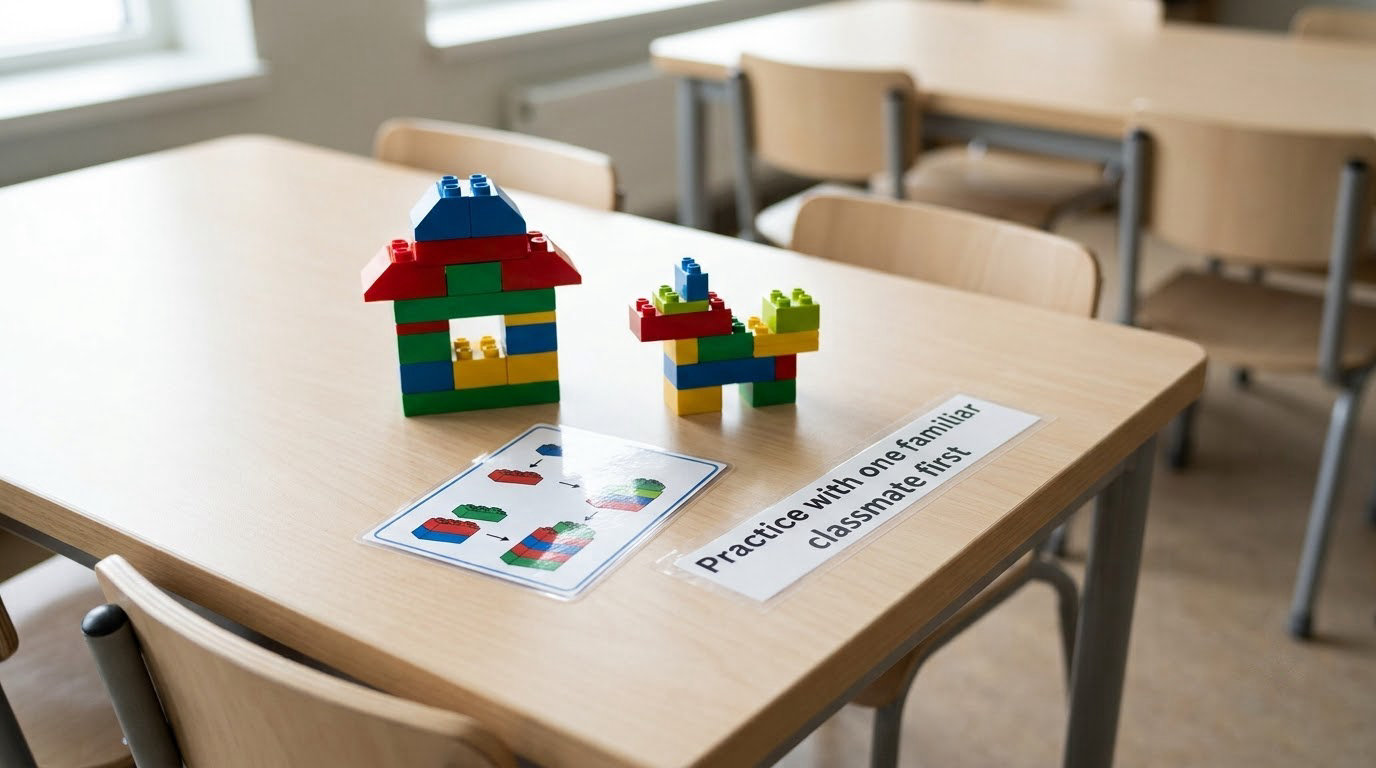
Two children are a very different proposition from a group of eight. Once your child has one reliable peer, you have something to build on. Arrange the same pair in the same place, at the same time, for three or four short sessions.
Keep the adult role small. Sit nearby for the first session, step back for the second, and stay available rather than visible. An adult who introduces, watches and interprets for the whole session teaches the child that the relationship is supervised, which makes it harder to own once you leave.
Coach both sides. Tell the other child something concrete and true ahead of time: your child likes trains, might cover their ears if it gets loud, does not always answer, and does not mean no when they go quiet. Most peer conflict with autistic children is not cruelty. It is two kids with different expectations and no shared manual.
Then let the adults drift out of the frame and see what is left. Sometimes nothing is left, and that tells you the pairing needs more scaffolding, not a different child.
Ask the school to reduce social demands
Do not leave the school with the friendship goal and nothing else. Ask for specific accommodations, in writing, and be concrete about which unstructured window is the problem.
Reasonable asks include a lunch option that is not eating in the hallway alone, a seat choice at lunch that is not the far end of a crowded table, a named check-in person on days that go badly, a visual or written schedule with change flagged in advance, an alternative to the loudest recess activity, and a designated partner for a specific task rather than a vague expectation to socialise more.
If your child has an IEP or a 504 plan, friendship goals belong there. Write them so they can be measured: given a partner activity, will join one chosen activity with a peer, four of five opportunities; will respond to a peer invitation with a verbal or written answer, three of five opportunities; will use a break card and return, four of five opportunities.
If your child does not have a plan, you can request evaluation. The framing that works with schools is not my child needs more friends. It is my child needs structured, supported peer contact and a way to decline when it becomes too much.
Follow the child’s comfort signals
You will spend the first month learning to read your child’s signals, and you will still get some wrong. Here is the version I watch for.
Enjoying. Flapping or fidgeting, which is stimming and is regulating, not a sign of distress. Talking more than usual, even about nothing. Following the other child around. Not wanting to leave when the bell rings.
Overwhelmed. Hand covering, ear covering, freezing, going quiet, rocking getting louder, breathing changing, asking for the bathroom repeatedly, or suddenly needing to redo something that was fine a minute ago.
Shutting down. Answers get flat and short. The child agrees to everything, which is compliance rather than consent. Eyes drop, energy collapses, and later that night you get the meltdown, hours after school.
When you see overload, you do not have to push through it. Reduce the demand: shorten the session, move somewhere quieter, drop headphones, or end it early. A four-minute successful interaction beats a twelve-minute one that ends in a shutdown at 8pm.
Then co-regulate before you debrief. Quiet, low input, no talking about the incident for a while. A conversation about what went wrong with a dysregulated child teaches nothing and lands badly; most of what you get in that moment is you talking.
One difficult interaction is not a failure, and it is not data about the child’s social ability. It is data about the setup, and setups can be changed.
Let the friendship grow at the child’s pace
Notice repeated, mutual interest. That is the signal, not the label. One pleasant recess does not make anybody a best friend, and a child who does not have a best friend at age eight is not behind.
Keep the contact available even when it is not going well. Book the same time slot, keep the same activity available, let the friendship be seasonal. Relationships ebb and flow and a child who has one solid peer in second grade and none in fifth has not failed at anything.
Watch for the version where the other child only wants to play their way, on their terms, every time. One or two friends like that is common and often fine for years. But if the relationship consistently costs your child more than it gives, it is a placement problem, not a friendship to be protected.
Protect the child’s right to say no. Autistic-led guidance has been consistent about this: making a child socially successful by suppressing the discomfort that tells them something is wrong is not the goal, whatever the goal is called.
Common Mistakes
Here is what I got wrong, and what I have watched other parents get wrong, all of which reduce the odds rather than raising them.
Asking for eye contact. It is not a friendship skill and it is not a sign of engagement or comprehension. Insisting on it produces compliance and discomfort, not connection. If eye contact matters to a task, offer a neutral alternative, like looking at each other while you speak or looking at a shared object while you listen.
Choosing the friend for your child. You can arrange the meeting, not the relationship. Picking a popular child because they are popular often means picking the peer most likely to run out of patience. The number of admirers is not a friendship quality.
Assuming any classmate is a safe partner. The group a child is trying to join may be the group excluding them. Watch how a candidate treats others before encouraging contact, and be willing to end a pairing that has turned into something the child dreads.
Withdrawing support too quickly. The minute a relationship looks self-sustaining, adults assume it can run alone. At school it usually cannot, because the child has no way to ask for help when asking is the hard part. Step back gradually, not all at once.
Measuring against a neurotypical timeline. Comparing your child’s friendships to a classmate’s at the same age tells you almost nothing. It produces pressure on you and pressure on them, and both of those show up at the table.
Treating alone time as evidence of failure. A child reading in a corner at break is often regulating, not lonely. That distinction matters because the remedy for loneliness and the remedy for regulation are opposites, and imposing social contact on a regulating child makes the next day harder.
Pushing past a no. When a child says they do not want to go, that is information. Follow the offer next time without pressure. Being reliable about not forcing things buys you more cooperation than any amount of insistence.
Tips for Making the Process Easier
Role-play at home, every time something new comes up. Two minutes of practice the night before beats a lecture.
Write a social story. One page, in your child’s words, with a picture sequence: we go to the library, Mia is there, I sit down, we both draw, we go home. Review it before the event, not after.
Keep the connection log going and look at it monthly, not daily. Progress in autistic children is not linear and daily checking makes everything look like a dip.
Flag changes early. Substitute teacher, new seating plan, a fire drill, an assembly. Advance notice is one of the cheapest accommodations there is and it works better than most things money can buy.
Advocate for the accommodations in writing and keep your own copy. School memory is shorter than you would hope, especially across a school year.
Celebrate specific small things, out loud: you invited someone, you went to the library, you used your break card. Then stop. If every small win becomes a review, the child learns that friendship is a performance review and learns to hate the performance.
Take care of yourself and find other autistic families. Parents in this community are isolated in a way that is easy to miss, and having a few adults to ask what actually worked takes a lot of pressure off you.
Frequently Asked Questions
How can I tell if my autistic child is ready to interact with another child at school?
Look for an activity your child already tolerates for ten minutes, a peer who has been kind to them before, and a setting where they can leave easily if it gets loud. If your child can name one person they would tolerate being near, that is usually enough to try once. Start with ten minutes and an agreed exit, then check in afterwards on a simple scale: good, okay, too much. Readiness changes week to week, so re-check instead of assuming.
How should I teach an autistic child how to ask to join a game?
Do not teach a whole social script. Teach one physical action that works with almost any game: stand nearby, put a piece or card down, and wait. Then add two spoken options the child can choose between, such as can I join, or do you want me to leave you alone. Rehearse both at home, including the time it does not work, because the failed version is where most children freeze.
Does my autistic child need to make eye contact to build friendships?
No. Insisting on eye contact tends to produce discomfort and compliance rather than connection, and autistic children often listen better without it. If a task genuinely requires eye contact, offer a neutral substitute, like looking at you while you speak or looking at the same object while you listen. Many autistic children connect happily while side by side and never once looking up.
What if my child is friendly with one child but overwhelmed by groups?
Treat the one-on-one relationship as the goal, not a step toward a group. Many autistic children do their best connecting in pairs and hit their limit at five or six people, and that is a working setup rather than a deficit. Keep the one-to-one contact regular, and let group settings stay optional. Pushing a child from a successful pairing into a group because it looks more typical usually ends the pairing too.
How can teachers support an autistic child who wants friends but struggles socially?
Teachers help most by structuring unstructured time, since that is where friendships form and where most children fail. Assign a partner for a specific task, offer a quieter alternative to the loudest recess activity, give a real choice of where to eat lunch, and check in privately rather than publicly. Written invitations and predictable seating remove most of the guessing. Progress looks small from the outside, so teachers keeping brief notes helps parents see the trend.
When should I ask for help from a school counselor or autism specialist?
Ask when the pattern, not the mood, is the problem. Signs include several months of isolation, repeated exclusion or bullying, school refusal or stomachaches on school mornings, a special interest becoming the only social outlet, or family conflict rising around peer situations. Bring your connection log to that meeting, because a record of what happened when is much harder to argue with. If your child has an IEP, bring goals that cover supported peer contact rather than vague socialising.
Start With One Small School Connection
Pick one predictable activity your child already tolerates and one peer who has been reliably kind. Ask the teacher for a ten-minute slot in a quiet room, three weeks running, with permission to leave early. Write down what happened, then repeat it next week without changing anything.
That is the whole first step. Everything else on this list grows out of it, and it takes less effort than most parents expect. This guide was reviewed for 2026.