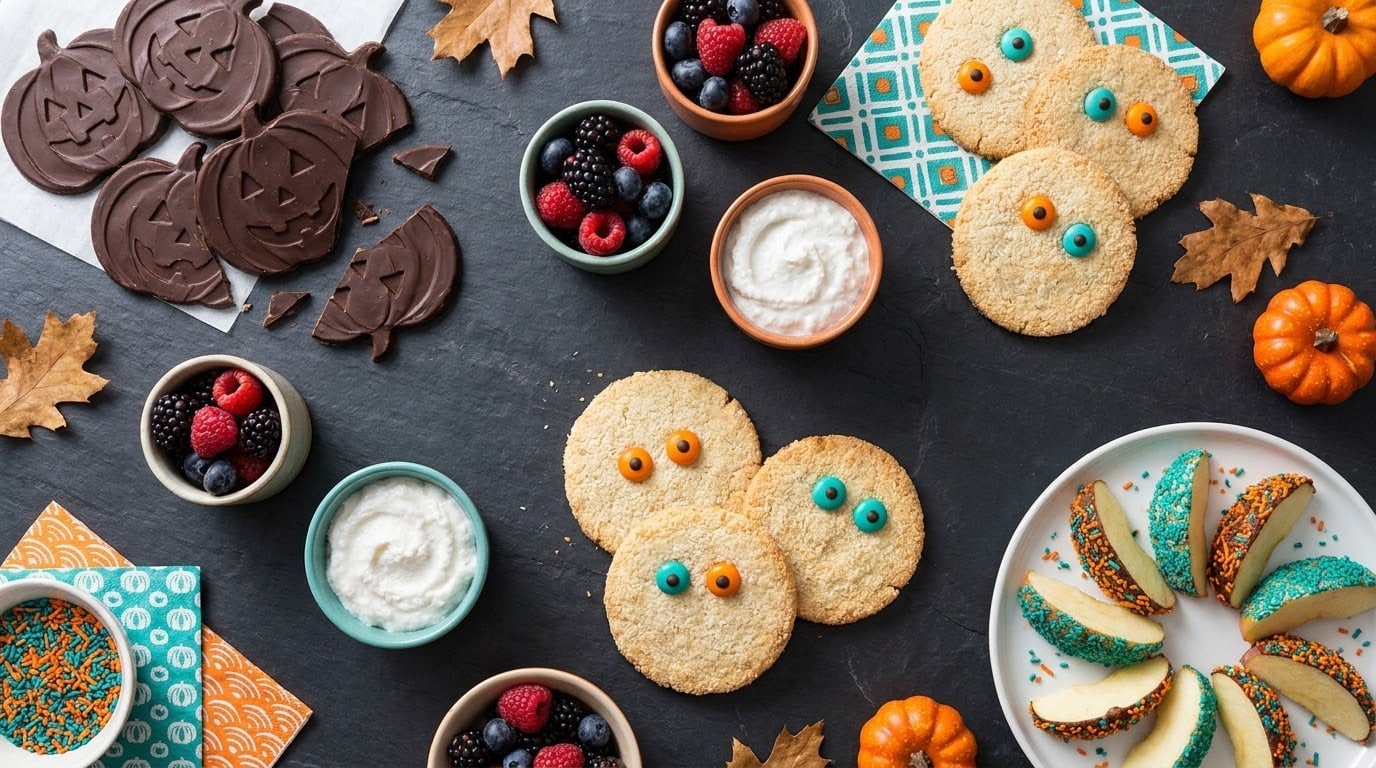
Halloween gets easier when you plan the treats instead of reacting to them. Good allergen free Halloween treat ideas let a child join in without a label check every single door, and most of them take 20 minutes or less. This roundup covers ten options, from a two-ingredient chocolate dip to a candy mix you build at home from verified labels, with the allergens each one controls spelled out so you can match it to your own child’s list. Updated for 2026.
First, the vocabulary. In the US, the nine major food allergens that must be declared on a label are milk, egg, fish, crustacean shellfish, tree nuts, peanuts, wheat, soy and sesame. Sesame joined the list in January 2023, which means a lot of Halloween advice published before then quietly leaves out one of the nine. A treat only counts as allergen free when two things are both true: the ingredient list names none of those nine, and the product was not made on shared equipment with them.
That second half is the part most roundups skip. A “may contain peanuts” statement is a cross-contact warning, and it is voluntary, so its absence does not promise anything. FARE (Food Allergy Research and Education) reports that food allergies affect roughly 1 in 13 US children, and Halloween is the one night of the year when a child is handed unknown food by strangers. Planning ahead is the whole game.
Table of Contents
- Allergen Free Halloween Treat Ideas at a Glance
- 1. Chocolate Pumpkin Bark
- 2. Applesauce Pumpkin Cookies
- 3. Coconut Monster Cookies
- 4. Fruit Rice Cereal Treats
- 5. Unicorn Fruit Dip Cups
- 6. Pumpkin Hummus Snack Cups
- 7. Label-Checked Halloween Candy Mix
- 8. Chocolate-Dipped Halloween Strawberries
- 9. Frozen Pumpkin Lollipops
- 10. Dairy-Free, Egg-Free Caramel Apple Monsters
- Frequently Asked Questions
- What are the most common major allergens in Halloween candy?
- Is coconut safe for a child with a tree-nut allergy?
- How should homemade treats be packaged for a school allergy-aware event?
- How long can homemade allergen-free Halloween treats be stored?
- What choking precautions matter for candy and small Halloween treats?
- Start With the Child’s Confirmed Allergy List
Allergen Free Halloween Treat Ideas at a Glance
| Treat | Allergens controlled | Prep time | Best used for |
|---|---|---|---|
| Chocolate pumpkin bark | Milk, peanuts, tree nuts, wheat, soy, sesame (label-dependent) | 10 min plus 2 hours to set | Halloween night, cut into small squares |
| Applesauce pumpkin cookies | Wheat, milk, egg, peanuts, tree nuts | 15 min plus 30 min bake | School party plate, bake-ahead |
| Coconut monster cookies | Milk, egg, wheat, peanuts, tree nuts | 20 min plus 25 min bake | Classroom snack, decorated with kids |
| Fruit rice cereal treats | Milk, peanuts, tree nuts, gluten (if you pick a verified cereal) | 10 min plus cooling | Cutout shapes, lunchboxes |
| Unicorn fruit dip cups | Milk, egg, soy, peanuts, tree nuts, sesame | 15 min plus 1 hour chill | Portable party contribution |
| Pumpkin hummus snack cups | Sesame, wheat, milk (swap the cracker) | 10 min | Savory table, not a candy dish |
| Label-checked candy mix | Whatever your verified products clear | 25 min | Hands out to trick-or-treaters |
| Chocolate-dipped strawberries | Milk, soy, peanuts, tree nuts | 10 min plus 20 min set | Fresh option, eaten same day |
| Frozen pumpkin lollipops | Milk, soy, wheat, peanuts, tree nuts, sesame | 10 min plus 4 hours freeze | Make a week ahead |
| Caramel apple monsters | Milk, egg, wheat, peanuts, tree nuts | 15 min | Party centerpiece, served chilled |
One caution before you pick from this table. Every row lists the allergens a well-made version can control, not the ones any random version will. Recipes shift, and product lines get reformulated between September and October, so read the label on the exact package in your hand every single time. If a child has a diagnosed allergy, their pediatrician or a registered dietitian is the right person to confirm any of these choices for them.
1. Chocolate Pumpkin Bark
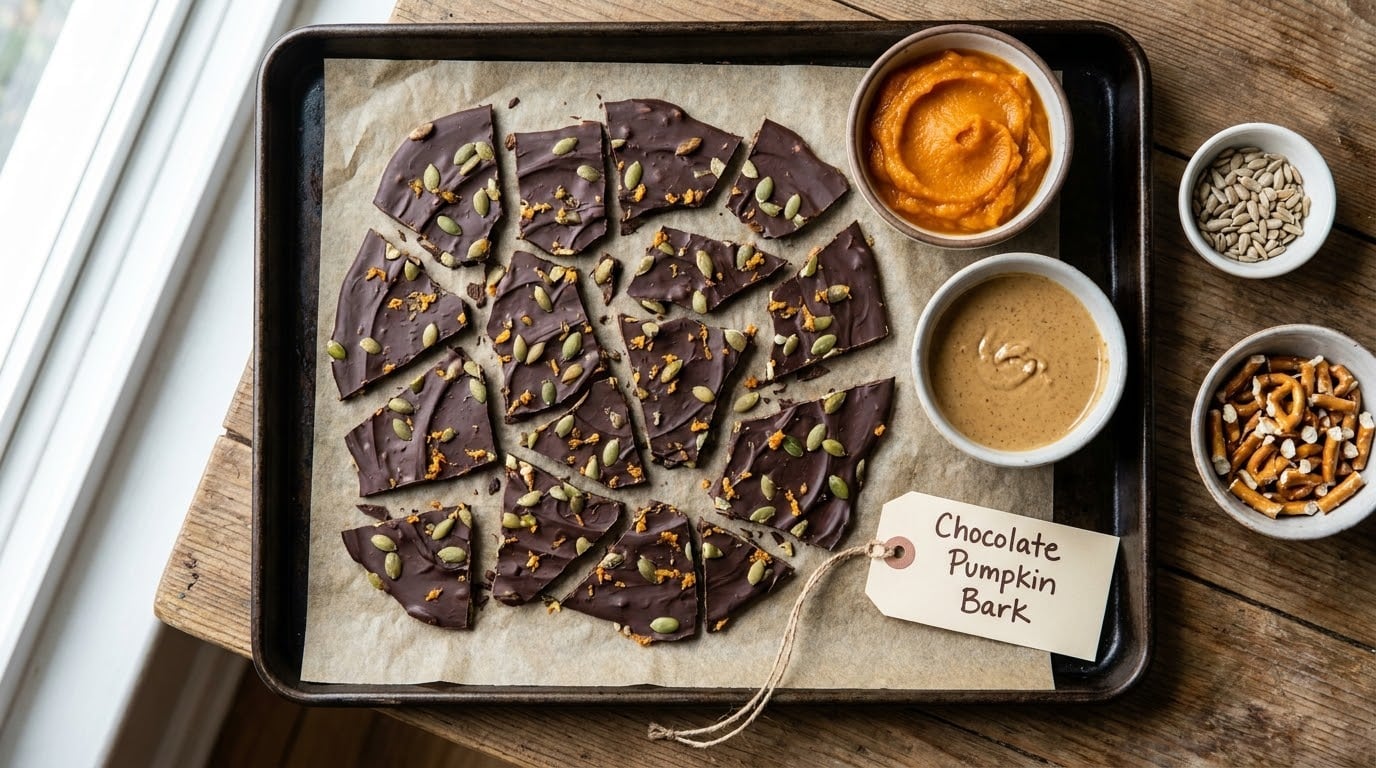
This is the fastest of the ten and the one that disappears first. You melt dairy-free chocolate, stir in pumpkin purée and a seed butter, pour it onto a lined tray, and scatter whatever toppings you have verified. Then you snap it into shards.
Melt 8 ounces of dairy-free chocolate in a microwave-safe bowl in 30-second bursts, stirring between each one. Stir in a third of a cup of pumpkin purée, a third of a cup of sunflower seed butter or pumpkin seed butter, and a teaspoon of pumpkin pie spice. A quarter teaspoon of salt keeps it from being too sweet. Spread it about a quarter inch thick on parchment and chill until firm, roughly two hours. Break it into pieces with your hands rather than cutting it, which gives you uneven edges that feel more like a broken bar.
Toppings do the allergen work, so check each one separately. Pretzels are usually wheat-free but often made near wheat. Pumpkin and sunflower seeds are seed allergens in their own right, and seed butter plants make the same. Pumpkin purée from a can is simple and carries nothing you did not put there, which makes it the safest base in this whole article.
Chocolate is the part people get wrong. Dark chocolate bars commonly list milk as an ingredient, and many are processed on equipment that also handles tree nuts and peanuts. A dairy-free brand made in a dedicated facility is the version to look for, and even then the label is what decides, not the packaging color.
2. Applesauce Pumpkin Cookies
These are a soft, one-bowl cookie that needs no mixer, and pumpkin plus applesauce does the lifting that butter, eggs and sugar normally do. That is what makes them adaptable to several allergies at once instead of just one.
Preheat the oven to 350°F. Stir together a third of a cup of pumpkin purée, a quarter cup of unsweetened applesauce and a quarter cup of a neutral oil your child tolerates. Add a cup of an approved gluten-free baking blend or oat flour, a third of a cup of brown sugar, a teaspoon of cinnamon, a half teaspoon of baking soda, and a quarter teaspoon of salt. Roll into tablespoon-size balls, flatten to about a half inch, and bake 10 to 12 minutes. They should look barely set at the edges. Cool on the pan five minutes before moving them.
Substitutions run one allergen at a time. For wheat, swap in a certified gluten-free blend rather than flour, because cross-contact is the issue rather than the gluten molecule. For milk and egg, this base already handles both once you confirm your baking blend is free of milk powder and egg. For peanut and tree nut allergies, the danger is the baking blend itself, since many are made in facilities that handle nuts, so check the blend’s own label every time you buy a new bag.
Texture is the giveaway. If they come out crunchy around the edge and dense in the middle, they were baked too long. Pull them at 10 minutes and check one.
3. Coconut Monster Cookies
A small round coconut cookie with green icing and two candy eyes reads as a monster to a five-year-old and takes about 25 minutes from pan to plate. It is a useful recipe because the green icing can be made without dairy, egg or artificial dyes.
Whisk a cup of unsweetened shredded coconut, a quarter cup of a gluten-free baking blend, a quarter cup of maple syrup or brown sugar, and three tablespoons of melted coconut oil. Add a quarter teaspoon of vanilla and a pinch of salt. Chill the dough 15 minutes so it firms up, then roll into balls about the size of a quarter, flatten to a third of an inch, and bake at 325°F for 20 to 25 minutes until golden at the edges. Cool completely before icing, or the icing slides off.
For the icing, stir together a quarter cup of a powdered sugar alternative or confectioners sugar with a tablespoon or two of water and a drop of green food coloring. Candy eyes are widely made without top allergens, though the value pack versions sometimes differ from the bags, so read the one you are actually using.
Here is the labeling wrinkle worth understanding. Under US labeling law, coconut is not one of the nine major allergens and is not classified as a tree nut, which is why it does not have to be declared as one. That is a legal fact, not a safety verdict. Some children still react to coconut, and some schools treat it as a tree nut in their own policies. Ask the school directly, and if the answer is unclear, swap the coconut for a certified nut-free mini cookie from the same recipe family.
4. Fruit Rice Cereal Treats
Cereal treats are the cheapest shapeable treat in this list and the one that travels well in a cutout cutter. The trick is that the safety lives entirely in three purchased ingredients, not in the technique.
Melt 3 tablespoons of a butter you have verified, or a dairy-free butter alternative, in a large pan over low heat. Add 3 cups of a plain cereal with a short ingredient list, then 3 cups of mini marshmallows you have also checked, stirring until the marshmallow turns glossy. Press into a buttered or oiled pan, let it cool fully, then cut squares, ghosts or bats with a metal cutter. Warmed to room temperature, it stays soft for several days in an airtight container.
Check three labels. Many cereals list wheat or a barley malt, and gluten-free versions are not automatically free of the other eight. Marshmallows are frequently processed on shared lines with gelatin and nut products, and a “natural” or vegan marshmallow is not a guarantee of anything else. The butter or spread is the third one, and dairy-free spreads are where soy often enters, since many are made with soybean oil.
Cut them small. Cutout shapes and round cereal pieces are a genuine choking shape for toddlers, and a bat cutout is not softer than a square.
5. Unicorn Fruit Dip Cups
These are the easiest contribution to a party because they travel cold in a cooler and need no plate. Individual fruit pieces sit in a free-from dip, and the whole thing looks festive without a single candy wrapper.
Choose fruit that holds up in a cup: strawberries, blueberries, raspberries, banana slices tossed with a little lemon juice, and seedless grapes cut in half lengthwise. Grapes cut lengthwise is the safe cut, not across.
For a dip clear of milk, egg, soy, peanuts, tree nuts and sesame, blend a quarter cup of a milk-free yogurt, two tablespoons of a milk-free spread, a tablespoon of honey or maple syrup, and a splash of vanilla. Divide into small clear cups and top with fruit. If milk and soy are allowed in your household, a dollop of plain Greek yogurt with a spoon of vanilla yogurt on top is the version kids actually prefer, and it is the one most people hand out.
Chill for at least an hour so the fruit sets into the dip rather than floating on it. Keep them cold the entire time they are out, and carry them in an insulated bag with an ice pack rather than a basket.
6. Pumpkin Hummus Snack Cups
Not every Halloween treat has to be sweet, and a savory option gives an allergic child something to eat when the candy dish is entirely off limits. This one is also the fastest on the list.
Blend half a cup of drained white beans or chickpeas with a third of a cup of pumpkin purée, two tablespoons of olive oil, the juice of half a lemon, a clove of garlic, and salt and pepper to taste. Thin with water until it is scoopable. Spoon into small cups with cut cucumber, bell pepper, carrot and sugar snap peas, and add crackers only if you have verified them.
Two checks matter. Most commercial hummus uses sesame tahini, and sesame is a declared major allergen, so read the label on any jar you buy or make from a mix. Some seed and nut butters use chickpeas as a filler, and a chickpea base can show up in products marketed as nut-free or seed-free, so scan the full ingredient list rather than trusting the front of the package.
For the crackers, look for a dedicated gluten-free brand made without sesame seeds, or skip them and use extra vegetables. Kids eat this one happily at the savory table and it disappears without a negotiation.
7. Label-Checked Halloween Candy Mix
Buying safe candy is a treat idea, and it is the only one on this list where a single mistake affects people other than your own child. A mix you assemble yourself is the strongest version of this idea, because you control every item that goes in the bucket.
Compare four categories side by side: individually wrapped gluten-free fruit snacks, free-from gummies and jelly beans, allergen-free chocolate minis made in a dedicated facility, and seed or sunflower-based candies. For each package, read four things. The ingredient list tells you what is in it. The Contains statement tells you what the manufacturer confirms is in it. The facility or advisory line tells you about shared equipment. And the packaging tells you whether each piece is individually wrapped, which is what makes a treat shareable on a doorstep.
Two shopping habits reduce the work. Buy the fun sizes and seasonal pumpkin or bat shapes only after reading that specific package, because novelty items are often produced on a different line from the standard version and can carry a different warning. And check the same brand two years in a row, because formulations get updated to simplify production and the change is rarely announced.
How to Choose Among Allergen Free Halloween Treat Ideas
Six questions narrow this list down fast. What are your child’s confirmed allergens, exactly, and which of the ten ideas control all of them? Can your child swallow the texture and shape safely at their age, which rules out whole grapes, hard cutouts and thick bark for a toddler? What does the school or host actually permit, since a recipe that is safe at home can still break a nut-free classroom rule? How much time do you have, because bark and cookies need an oven or a freezer and a candy mix does not? Does anything need refrigeration, which rules out the dip cups and dipped strawberries for an outdoor door? And last, will your child actually eat it, since the most allergen-safe treat in the world is the one that gets left in the bucket.
That last question deserves more weight than it usually gets. Parents often buy two free-from brands and have both refused on taste grounds, which is a common and expensive experience. Pick one or two ideas your child already likes eating, and build the rest of the Halloween plan around those.
8. Chocolate-Dipped Halloween Strawberries
Two ingredients, one tray, and a result that looks like it took far more work than it did. This is the treat to make the morning of October 31.
Line a tray with parchment. Melt 6 ounces of a verified dairy-free, soy-free chocolate, peanut-free and tree-nut-free chocolate in 30-second microwave bursts, stirring between each burst. Wash and fully dry 20 to 24 large strawberries, leaving the stems on as a handle. Swirl each one two-thirds of the way into the chocolate, set the tray in the fridge for 20 minutes, and add sprinkles or a white chocolate drizzle in the last five minutes if the chocolate has only just set.
Moisture is the one thing that ruins this. A single wet strawberry will seize the whole bowl of chocolate, so dry them thoroughly and dip them one at a time. Eat them the same day or the next, refrigerated, because strawberries weep and the coating gets soft and slides. Skip the wax paper, which wicks moisture straight into the fruit.
On shared equipment: a chocolate brand can list no peanuts in its ingredients and still be made on a line that handles them. For a child with a severe allergy, look for a brand that states a dedicated facility, and if the label does not address cross-contact at all, treat that silence as unanswered rather than as clearance.
9. Frozen Pumpkin Lollipops
These need the most lead time and are the best make-ahead option on the list. Four hours in the freezer buys you a whole week of breathing room.
Blend half a cup of pumpkin purée, one ripe banana, a quarter cup of a milk-free yogurt or coconut milk, and a spoonful of maple syrup until smooth. Pour into silicone pop molds, leaving a little room at the top, and insert a stick. Freeze upright for at least 4 hours, then pop them out and store in a freezer bag between layers of parchment.
Stick safety is the part that varies by age. A lollipop stick is a firm, hard object, so these are not for babies or toddlers who are still developing a chewing grip. Check the mold and stick size against what your pediatrician has already said about your child, and for anyone under four, skip the stick and serve the same mixture in a small cup with a spoon.
For the allergens, the pumpkin, banana and syrup bring none of the nine. The yogurt alternative is where dairy and soy usually enter, and coconut milk is a coconut question, which is not a declared major allergen but may still matter to your child or your school. Read the base you buy rather than assuming the word plant-based covers it.
10. Dairy-Free, Egg-Free Caramel Apple Monsters
A date-sweetened caramel apple with green apple and sprinkles is the piece that ends up on the centerpiece plate, and the dates sidestep the ingredient that rules most caramel apples out. Conventional caramel is typically milk-based, so a package labeled caramel is not a dairy-free product until you have read it.
Melt about a cup of pitted Medjool dates with a quarter cup of water in a small pan over low heat, stirring until it thickens into a paste, about 8 to 10 minutes. Let it cool for 5 minutes so it is warm rather than hot. Slice two green apples into wedges, leave the peel on for a grip, and dip the cut side only. Lay them on parchment, decorate with green sanding sugar or a small amount of dark chocolate drizzle, and chill for 20 minutes before moving.
Handle safety matters more here than in most of this list. Sticks skewers, wooden utensils, anything a child can put their weight on. Insert each stick before the coating sets so it stays firm, and hand the apple to the child rather than letting them carry it by the stick around the house. The coating should be tacky, not fully hard, if you are serving a young child, and the wedges should be cut small enough to finish in a few bites.
Set these on a tray lined with parchment and refrigerate them if you are serving more than a couple of hours after decorating. Dates get tacky at room temperature, and sticky apples in a bowl at a party are a mess and a choking risk for the little ones who always want what everyone else has.
Frequently Asked Questions
What are the most common major allergens in Halloween candy?
Milk, peanuts, tree nuts, wheat, soy, egg, fish, crustacean shellfish and sesame are the nine allergens that must be declared on a US label. In Halloween candy specifically, milk and wheat lead by a wide margin, followed by peanuts and tree nuts, with soy appearing in coatings and seed butter spreads. Sesame shows up in tahini-based and seed products. For individual questions about a specific label, your child’s pediatrician or a registered dietitian is the right person to ask.
Is coconut safe for a child with a tree-nut allergy?
Under US labeling law coconut is not one of the nine major allergens and is not classified as a tree nut, so it does not have to be declared as one. That is a labeling rule rather than a medical judgment. Some children with a tree-nut allergy do react to coconut, and individual schools sometimes treat it as a nut. Ask the school, then ask your child’s allergist before serving it.
How should homemade treats be packaged for a school allergy-aware event?
Package each treat individually, list every ingredient on the outside of the container, and label it clearly for the allergens it does not contain and any that may be present. Send the full ingredient list to the teacher or room parent ahead of time so nobody has to guess at a label at the door. Keep treats in sealed containers rather than an open platter, and avoid anything loose or unpackaged near other foods.
How long can homemade allergen-free Halloween treats be stored?
Most homemade treats keep three to five days at room temperature in an airtight container, which covers the week around Halloween. Anything with fresh fruit, like dipped strawberries or fruit dip cups, should be eaten within a day and kept refrigerated the whole time it is out. Frozen pumpkin lollipops keep a month or more in the freezer, sealed in a bag between layers of parchment. When in doubt, freeze it and let it thaw in the fridge rather than gambling on a week on a counter.
What choking precautions matter for candy and small Halloween treats?
Cut grapes lengthwise, quarter any round candy and cutlet, and skip whole nuts and hard round sweets for young children. Cereal treat cutouts, bark shards, lollipop sticks and small candy pieces are all shapes and sizes that choking risk guidance treats as higher risk for toddlers. Seat an adult with any child who eats slowly or has a swallowing difference, and go over the specifics with your own pediatrician, since age and individual history matter more than any list.
For a fuller look at how free-from labels actually work, how shared lines differ from dedicated facilities, and what FARE recommends for allergy-aware events, start with the child’s own clinician before you start with a recipe. Everything above is general information, not a substitute for medical advice or for the label on the product in your hand.
Start With the Child’s Confirmed Allergy List
Write down every confirmed allergen on one piece of paper, including the ones that are not among the nine. Then match it against the label on the actual product, not the brand’s website or a previous year’s box, because recipes and formulations both change. Make the easiest suitable treat on the list first, which for most households is chocolate pumpkin bark or the label-checked candy mix, and keep one backup ready for a school event or an unexpected party.
That is the whole method behind these allergen free Halloween treat ideas: a short list, a label in your hand, and a treat your child will actually eat. Food Allergy Research and Education, or FARE, keeps practical resources for families, teachers and party hosts, and your child’s pediatrician or a registered dietitian can answer anything specific to their confirmed allergies.