
Sending a written request is what starts the clock. Under the Individuals with Disabilities Education Act (IDEA), a school is not required to act on your child’s evaluation request until it receives one in writing, so a verbal ask to a teacher leaves you with no deadline and no record.
The whole job takes about an hour once you have your notes together: gather a few dated observations, name the right recipient, copy a letter, and send it somewhere you can prove it landed. This guide walks through each step and ends with a template you can fill in tonight.
Table of Contents
- What You Need
- Step-by-Step: How to Request a Special Education Evaluation in Writing
- 1. Identify the Right Person to Contact
- 2. Write the Evaluation Request
- 3. Describe the Child’s Needs and Educational Impact
- 4. Include Useful Supporting Information
- 5. Submit and Document the Request
- 6. Ask for Written Confirmation and Follow Up
- How to Request a Special Education Evaluation in Writing: A Copyable Template
- Common Mistakes
- Frequently Asked Questions
- Who can request a special education evaluation for my child?
- What should I include in a written request for an evaluation?
- How long does the school have to respond to an evaluation request?
- Can I request an evaluation if the school says my child does not need one?
- Can I pay for an independent evaluation if the school delays the process?
- What should I do if I cannot identify the special education contact?
- Conclusion
What You Need
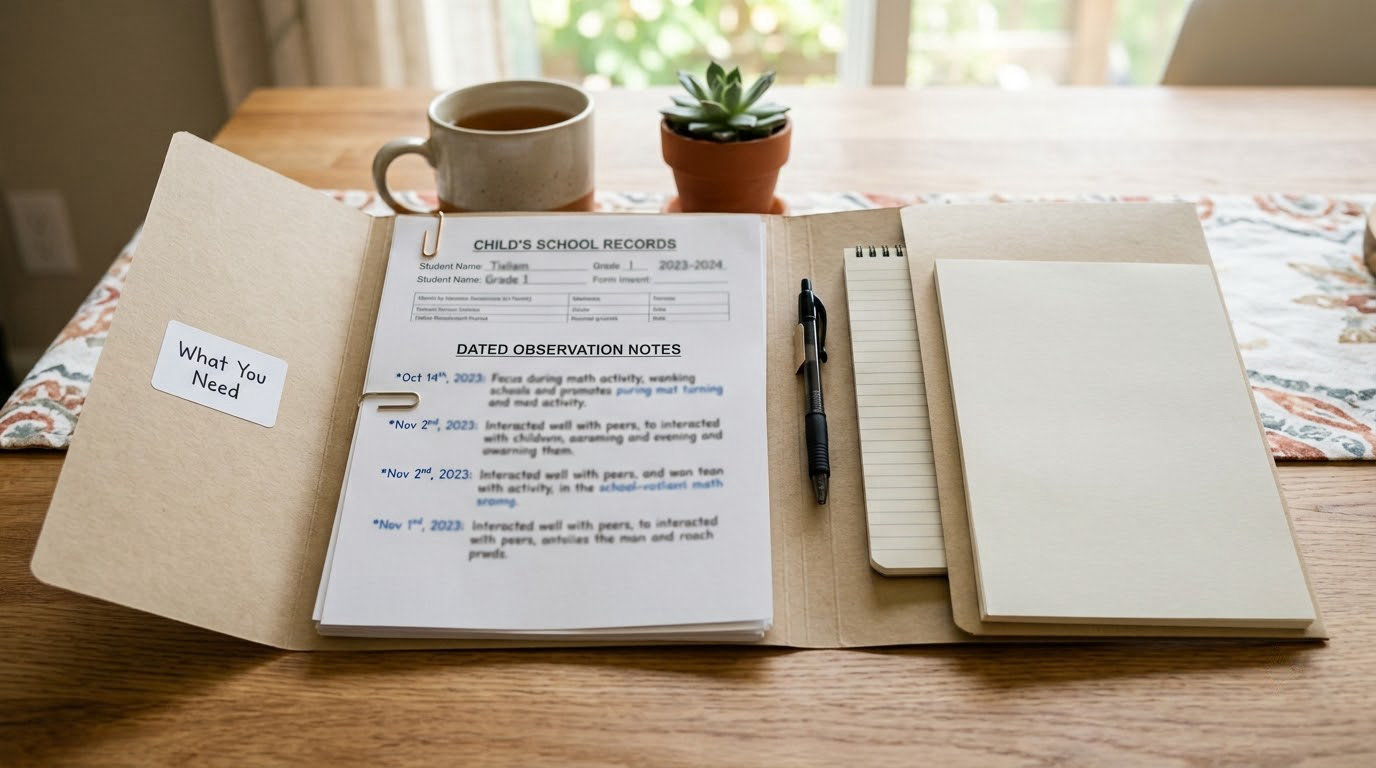
Grab these before you type a single sentence. A request with specifics gets a faster, more serious response than one that says only that something seems wrong.
- Child’s identifying details — full name, date of birth, grade level, school, teacher, student ID if you have it.
- A dated concern log — two to six weeks of short, dated notes on what you actually saw. Specific beats emotional.
- Academic records — report cards, benchmark scores, work samples, attendance records, and any prior intervention or support documents the school already tried.
- Teacher emails — screenshots or printed copies of anything you have already written to staff.
- Contact details — your phone, email, and mailing address, plus the child’s other parent if they are part of the decision.
- A copy machine and a scanner — you will want a paper copy and a PDF you can attach to an email.
If you have a private assessment, an IEP, or a prior 504 plan, pull it too. You do not have to attach medical records, and attaching them often adds nothing, but you can mention that a private report exists and say the school may request it directly.
Step-by-Step: How to Request a Special Education Evaluation in Writing

1. Identify the Right Person to Contact
Address the request to the building principal with a copy to the district’s director of special education. Parents on parent forums consistently point each other to that split: the principal is the person accountable at your child’s school, and the copy line puts it on the district’s desk too.
If your child’s school is uncertain, has closed, or you are across state lines, skip straight to the special education office in the district where the child is or was enrolled. School websites list it under Student Support Services or Special Education, and a district office number in the local phone book will get you there just as fast.
You will know you found the right person when you get an acknowledgement naming a school psychologist or a special education coordinator. Save it. That person becomes your contact for every later step.
2. Write the Evaluation Request
Keep it to one page. Say in your first sentence that you are formally requesting a special education evaluation for your child under IDEA, then identify yourself as the parent or caregiver and name the child.
Do not diagnose your child. Schools cannot accept a parent’s label as a finding, and a request that argues for autism or ADHD instead of describing what happens in class reads as advocacy rather than evidence. Describe the behavior and the impact, and let the school evaluate.
When you reach the sentence that asks for a response, ask for it in writing and name the step you want acknowledged. A line asking the district to confirm receipt and explain next steps in writing gives you something concrete to follow up on.
3. Describe the Child’s Needs and Educational Impact
This is the part that does the work. Group your dated observations into the areas you want assessed: reading or literacy, written expression, math, speech and language, attention or executive function, behavior, social skills, or attendance and school refusal.
For each area, write what you observed, when, and how often. Not “he has dyslexia” but “since September, decoding single-syllable words takes him twenty minutes on a page and he cries before reading aloud.” Not “she is anxious” but “four absences in October, all mornings, and she asks to go home at least once a week.”
Then name the educational impact. Why does this matter for access to instruction? If reading fluency is the barrier, say that it blocks her from participating in science and social studies, not just reading class.
4. Include Useful Supporting Information
Attach the work samples and report cards that show the pattern. A single piece of evidence proves little; a dated run of them proves a trend, and trend is what an evaluation team needs.
Be selective about medical details. You do not need to hand over a full medical history, and you are not required to. Mention a diagnosis only if it explains an access issue, and offer to have the provider send relevant documentation directly to the school.
One thing worth knowing from parent discussions: a consent for evaluation form the school hands you is not the same document as your request. Your letter states the concerns. That form only gives permission to test. Send yours first, or at least attach it.
5. Submit and Document the Request
Email is writing, and for most parents it is the fastest route because it produces a timestamp the same minute. Use a subject line that cannot be filed under something vague, something like “Written request for special education evaluation — child name — date of birth.”
Attach the letter as a PDF rather than pasting it into the body, so the formatting survives. If your district has a family portal for special education requests, submit there too and screenshot the confirmation page.
For paper, hand delivery is the option with the least ambiguity. Ask the front office to date-stamp a copy and write the name of the person who took it. Certified mail works, but it adds days.
Now prove delivery. Save the sent email with its full header, the PDF you sent, and any portal screenshot or stamped copy. Put all three in the same folder. When the school later says nothing came through, that folder is your answer.
6. Ask for Written Confirmation and Follow Up
Ask for confirmation of receipt within a few school days, then set your own follow-up date about two weeks out. Write it in your calendar the day you send the letter, because silence in the second week is common and easy to ignore.
At that follow-up, send a short note: the date of your original request, the date you sent it, and a request to know the status and the expected timeline. Short and factual. It goes in the same thread so the whole history stays together.
Keep a one-page log of every contact — date, who you spoke to, what was said. Parents who eventually file a due process complaint tell you the log is what carries their case.
How to Request a Special Education Evaluation in Writing: A Copyable Template
Replace the bracketed text and delete the brackets. Paste this into your word processor, fill it in, and send it as a PDF.
[Date]
[Your full name]
[Your address, email, phone]
Building Principal, [School Name]
[School street address]
cc: Director of Special Education, [District Name]
Re: Formal written request for a special education evaluation — [Child’s full name], DOB [date of birth], Grade [grade level]
Dear [Principal’s name],
I am the [parent/legal guardian] of [Child’s full name], a student in [teacher’s name]’s [grade] class at [school]. I am formally requesting a special education evaluation for my child under the Individuals with Disabilities Education Act, to determine whether [he/she] is eligible for special education services and, if eligible, an Individualized Education Program.
My concerns are as follows:
1. Area of concern, for example reading fluency: [describe what you observed, when it started, and how often it happens].
2. Second area of concern: [describe, with dates].
3. Third area of concern: [describe, with dates].
These concerns affect [child’s name]’s ability to access instruction by [describe the educational impact — which subjects, tasks, or activities are blocked]. The grade [child’s name] is receiving is [current performance description].
Attached to this letter are [report cards, dated observation notes, work samples, teacher emails] documenting these concerns over the period from [start date] to [end date].
I request that the district evaluate my child in the areas described above, and I ask that the district confirm receipt of this request and tell me in writing what the next steps and the expected timeline will be. I am available to sign a consent for evaluation form once I receive it.
Please direct all correspondence to me at the contact information above.
Sincerely,
[Your signature]
[Your printed name]
If you are a grandparent, relative caregiver, or a non-custodial parent, add one line before the closing: “I am [relationship] and I have [guardianship / educational decision-making authority / daily care of the child], and I am requesting this evaluation in that capacity.” If you have no formal authority, send it anyway and ask the district what documentation they need to recognize you as the requester.
Common Mistakes
Asking the teacher and stopping there. A teacher has no authority to start an IDEA evaluation and may never forward it. Fix: address the principal, copy the special education director, and send it yourself.
Writing a letter with no specifics. “My child is struggling” gives an evaluation team nothing to test. Fix: one dated observation per concern area, plus the educational impact.
Waiting for grades to collapse. Plenty of children with real needs hold passing grades by masking, using extra time, or being carried by a strong teacher. Fix: request based on access to instruction, not on a number.
No proof of delivery. If the letter went to a shared inbox and nobody logged it, you have no starting date. Fix: email the PDF, save the sent message, and ask for written confirmation.
Handing over your whole medical file. It rarely helps and it hands over more than the question requires. Fix: describe the access issue, name the diagnosis only if it matters, and let the school request what it needs.
Treating silence as a denial. Parents often assume the worst during the second week. Fix: check the date on your follow-up note, send it, and ask for a status in writing. If the answer is no, ask for the reason in writing and for the procedural safeguards notice that goes with a refusal.
Two more that come up: sending the same letter repeatedly without a new date or a new ask, which just resets nothing; and asking the district to “do something” instead of naming the step you want. Always name the step — evaluation, consent form, status, or confirmation of receipt.
Frequently Asked Questions
Who can request a special education evaluation for my child?
Parents, legal guardians, and in many states a non-custodial parent, grandparent, or relative caregiver can request an evaluation. A child may also be referred by a teacher or other school staff. If you lack formal authority, write the request anyway and ask the district what documentation it needs to recognize you as the requester. Schools must evaluate on request, not only on their own referral.
What should I include in a written request for an evaluation?
Name your child and your relationship, state clearly that you request a special education evaluation under IDEA, describe specific dated concerns, explain the educational impact of those concerns, list the areas you want assessed, attach relevant work samples and records, and ask the district to confirm receipt in writing. Describe what you observed rather than diagnosing your child.
How long does the school have to respond to an evaluation request?
Federal IDEA rules set the outer framework, but deadlines are counted in school days and vary by state. A common pattern is a response with consent or a written refusal within roughly 15 to 30 school days of receiving the request, and completion of the evaluation within a further window that often runs up to 60 days. Check your state department of education’s special education rules for the exact numbers.
Can I request an evaluation if the school says my child does not need one?
Yes. You can submit a written request at any time, including after a verbal ask was declined, and you can send it to the special education director rather than the person who turned you down. If the district then refuses in writing, ask for the reason in writing and for the procedural safeguards notice. That refusal is what opens dispute-resolution options.
Can I pay for an independent evaluation if the school delays the process?
You can, but pay for it yourself only with eyes open. A privately obtained evaluation may not be adopted by the district, and you may be billed for it if the school finds it should have waited. A stronger route is to ask in writing for an independent educational evaluation at public expense, which applies when you disagree with the district’s evaluation results or the district missed its timeline.
What should I do if I cannot identify the special education contact?
Send it to the building principal and copy the district special education office, which you can find on the district website under Student Support Services or Special Education. If the school itself is unclear, address the request to the district where your child is or was enrolled. Ask in the letter for the school to identify the person assigned to your child’s evaluation.
Conclusion
Write the request tonight. One page, dated concerns, the areas you want assessed, and a line asking for written confirmation. Then send it to the principal with the special education director copied, save the proof of delivery, and put a follow-up date in your calendar two weeks out. That is the whole first step, and it is the one that starts the clock.
Timelines and procedural rules vary by state, so check your state department of education’s special education pages for the exact deadlines that apply to you.