
To introduce a compression vest to a sensitive child, you plan it as a slow, child-led desensitization rather than a single fitting: talk about it, let your child handle it untouched, wear it for seconds first, and build up only while they stay comfortable. Expect the first two weeks to be about trust, not about the vest doing anything.
That matters more than it sounds. A sensitive child’s nervous system reads an unfamiliar snug garment as a threat, so putting it on without warning usually escalates things instead of calming them. The parents who get the most out of compression describe weeks of small, boring, repeatable wins — and a child who removes it themselves when they are done.
Compression is a support tool, not a treatment and not a cure. Some children get a great deal from it, some get nothing, and a few find it overwhelming. Keep that expectation honest from day one, and check in with your child’s pediatrician or occupational therapist before you start.
Table of Contents
- What You Need Before You Start
- Step-by-Step: How to Introduce the Vest to a Sensitive Child
- Common Mistakes to Skip
- Frequently Asked Questions
- How long should a child wear a compression vest at first?
- Can a child wear a compression vest all day?
- How do I know the compression vest fits properly?
- What if my child refuses to wear the vest?
- Can a child wear a compression vest to school or therapy?
- When should I ask a pediatrician or occupational therapist?
What You Need Before You Start
A good introduction runs on a few prepared pieces, not on the vest alone.
The vest, sized and soft
Buy or borrow the smallest weight you can, and skip anything with tags, thick seams, or scratchy fastenings. Tag-free construction and flatlock seams make an enormous difference in the first week. If the vest has removable weight inserts or beanbag pockets, start with the empties or the lightest setting.
Follow the manufacturer’s sizing chart rather than eyeballing it, and check the care label before the first wash. A vest that has been through a dryer three times shrinks into a different garment, which is a confusing way to lose your child’s trust.
Soft clothing underneath
Have a breathable undershirt or a smooth long-sleeve base layer ready. Whether the vest goes on under or over clothes is a child preference, not a rule, and many kids start more willing with the vest over a familiar shirt.
A calm practice space and a short time window
Pick a low-demand time of day — after snack, before a preferred activity — and a spot where nothing is scheduled next. Ten quiet minutes on the sofa beats twenty rushed minutes before the school run.
A visual or verbal introduction
Draw a simple three-panel schedule: touch it, try it on, take it off. A social story that ends with your child choosing to stop is even better, because it teaches the off switch before they need it.
A comfort scale and a stop signal
Agree on a simple way to say “too much” — a hand signal, a word, taking it off, walking to a specific chair. Put a visual timer where both of you can see it, so time is visible and not something you have to enforce out loud.
A trusted adult, and ideally an OT
Your child’s occupational therapist can tell you whether deep pressure is appropriate for them and which amount to start with. Ask before you buy anything if you can, and definitely ask if your child has low muscle tone, respiratory issues, or a history of skin sensitivity.
Step-by-Step: How to Introduce the Vest to a Sensitive Child
Step 1: Talk About Why the Vest May Help
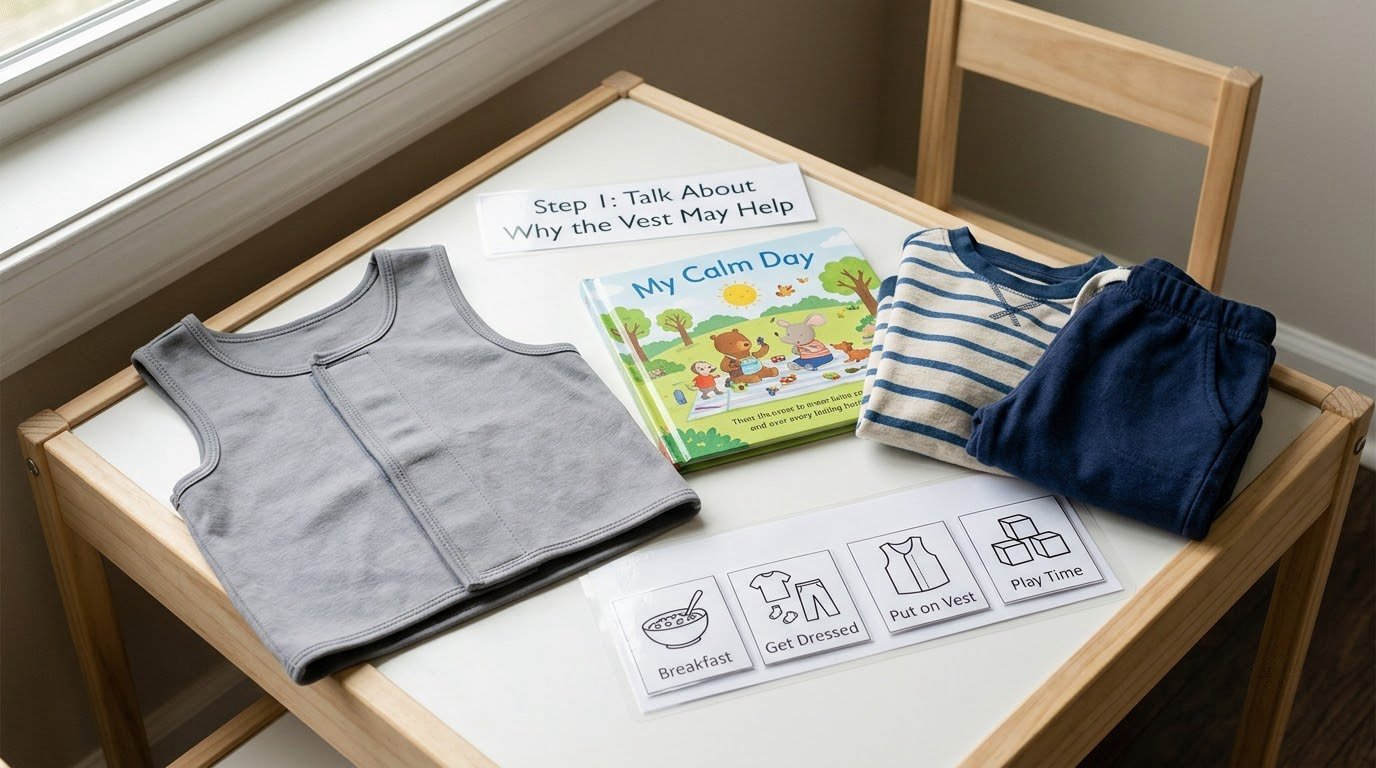
Explain it in plain, honest language, using your child’s preferred way of communicating. “This is a vest that squeezes your shoulders and chest, kind of like a hug that stays put. Some kids like how that feels. You can take it off any time you want.”
Do not present it as something that will fix them or something they are supposed to need. That framing turns the vest into a test of compliance instead of a choice they get to make.
Leave room for the questions that will come later, and answer them the same way each time, so your answers become predictable rather than surprising.
Step 2: Let the Child Touch and Explore the Vest
Put the vest where they can reach it and walk away. Some kids will grab it immediately; most will ignore it for days, which is fine. Let them rub the fabric, pull the fasteners, hold it against their arm, or wear it as a hat. All of that counts as progress.
Keep it in the same spot every day rather than offering it as a surprise. Familiarity is what builds the association, and an object that is simply always there stops being a negotiation.
Stop and reset if touching it brings distress. Two minutes of calm handling beats twenty minutes of bargaining, and you can go back to touching-only tomorrow.
Step 3: Practice Wearing It Without Pressure
When your child is calm and absorbed in something they enjoy — blocks, a book, a screen — offer the vest. Start in seconds, not minutes. Fifteen seconds, then remove it while they are still having a good time.
That is the whole trick. The pairing matters more than the duration: compression plus a pleasant activity teaches the nervous system that the garment predicts something good.
Never make removal hard. If the vest is hard to get off, the child learns that wearing it means being trapped, and you will be fighting that for months. Choose a garment your child can remove independently or that comes off in one movement.
Step 4: Adjust the Fit and the Clothing Underneath

The fit is snug, not tight. Check the shoulders, neck, arm openings, and torso, and make sure the fasteners close without tugging. You should be able to slide one or two fingers underneath the fabric at the chest, and breathing and reaching should feel entirely normal.
Use the manufacturer’s guidance, and if you are between sizes, go with the roomier one for a child who is new to compression. A too-small vest teaches avoidance, not regulation.
Adjust what is underneath instead of tightening the vest. A smooth base layer removes the tag and seam irritation that makes a vest unbearable, and layering over a loose shirt gives a small buffer of pressure the child can tolerate.
Step 5: Build Trust Through Tiny Successful Trials
Repeat short, predictable trials. Same time of day, same activity, same removal cue, for about a week before you change anything. Predictability is what makes the second trial easier than the first.
Increase time only when the last three sessions ended without distress. A common landing point is 15 to 40 minutes of comfortable wear, but the child’s pattern sets the pace, not the number.
Keep a short written log — date, duration, activity, how they took it off, anything you noticed. Three columns is enough. Without it, you will remember the good day and forget the bad ones, and your OT will have nothing to work from.
Decide the stop signal once and use it every single time, even mid-activity. A child who knows the vest always ends when they say so will relax into it rather than brace for it.
Step 6: Use the Vest in Everyday Routines
Once short sessions feel boring rather than difficult, move the vest into the specific moments that are hardest. Common useful windows are car rides and travel, the walk into school, therapy or ABA appointments, homework time, and crowded or noisy outings.
Anchor it to the moment rather than the clock. “Vest for the car ride, off when we arrive” is a rule a child can hold. “Vest on weekdays” is not.
Keep the off switch. Some days the vest comes off in four minutes and that is a successful day, not a failed one. Compression is a tool for specific hard stretches, not something a child should be expected to live in.
Common Mistakes to Skip
Forcing the vest on. This is the big one. A forced fitting produces a fight that is usually worse than the original problem and makes the next ten attempts harder. Fix: the child wears it or the attempt ends. If they will not put it on, the trial is simply over for today.
Starting too long. Ten minutes is a big ask for a first wearing. Fix: start at fifteen seconds and let repetition, not duration, do the work.
Using it as a tool of control. Any time the vest means “calm down because I said so,” it stops being regulation and becomes obedience with a garment. Fix: the child decides whether it comes on at all.
Picking the wrong fit or fabric. A tight vest, a scratchy one, or one with tags will fail no matter how good your intentions. Fix: follow the sizing chart, remove tags, wash it once before the first real wearing, and go one size up if you are unsure.
Ignoring the communication cues. A child who goes quiet, stiffens, holds their breath, or starts picking at seams is telling you something. Fix: treat the first sign as the end, not the moment to push through.
Assuming it works the same for every child. Some kids are tactile avoiders and need a long, gentle build; sensory seekers often take to compression far faster than parents expect. Fix: run the same steps at your child’s pace and stop if four weeks of steady trials change nothing.
On safety: no compression during sleep, none during strenuous activity or running, and never as a consequence. Take it off immediately if breathing feels restricted, if the child goes pale, dizzy, or unusually tired, or if there is numbness, skin marking that does not fade quickly, or a rash under the fabric. Bring those to your pediatrician or OT rather than working through them. If your child has low muscle tone or respiratory concerns, get the all-clear before the first wearing.
Frequently Asked Questions
How long should a child wear a compression vest at first?
For the first several sessions, aim for seconds rather than minutes. Fifteen seconds while your child is enjoying a calm activity is a genuinely successful first wearing. Over a few weeks of consistent, low-pressure trials, many children build up to 15 to 40 minutes of comfortable wear. The pace belongs to your child, so only extend a session when the previous few ended without any sign of distress.
Can a child wear a compression vest all day?
Usually not, and most therapists recommend against continuous wear. Long sessions leave no recovery time and can make a child associate the garment with feeling trapped. Work in on and off cycles instead, using a visible timer, and aim to take the vest off well before the child is tired of it. Sleep is never an appropriate time to wear compression clothing.
How do I know the compression vest fits properly?
The fit should feel snug but never restrictive. You should be able to slide one or two fingers under the fabric at the chest, breathing and reaching should feel completely normal, and nothing should pinch at the neck, shoulders, or arm openings. Use the manufacturer’s sizing chart rather than guessing, and choose the roomier size if you are between two. A tight vest teaches a child to avoid the garment.
What if my child refuses to wear the vest?
Put it back where they can reach it and stop asking. A refusal is information, not a battle to win. Leave the vest visible and available, pair it with a preferred activity, and try again another day at the same calm time. If refusal continues after several weeks of gentle, consistent exposure, mention it to your occupational therapist and consider a different tool or format instead of adding pressure.
Can a child wear a compression vest to school or therapy?
Yes, once short sessions feel boring rather than difficult, and if your child’s occupational therapist agrees it fits the plan. Many families use it for arrival, transitions, car rides, and therapy appointments rather than a full school day. Talk to the teacher first, agree on the exact times it comes on and off, and make sure your child can remove it themselves without needing permission.
When should I ask a pediatrician or occupational therapist?
Ask before you start whenever you can, and always if your child has low muscle tone, respiratory or heart conditions, skin sensitivity, a history of pain or illness, or is very young. Go back to them if your child shows restricted breathing, dizziness, unusual fatigue, skin marking that lingers, or numbness. An OT can also set a sensible starting weight and tell you whether compression is the right tool at all.
Start smaller than feels useful. Leave the vest where your child can reach it, put it beside something they already enjoy, and let a few uneventful days pass before you suggest anything. The introduction only works if the child stays in charge of it — that is what makes the whole approach to introducing a compression vest to a sensitive child hold together instead of turning into a fight.