Learning how to handle holiday meals with a special diet comes down to four things you control before anyone sits down: what the person can safely eat, what the kitchen will touch, how the food gets served, and how the plan gets explained. Get those right and the rest of the day is mostly logistics.
A special diet here means any medically necessary or sensory-required restriction. That covers celiac disease and gluten-free eating, diabetes, food allergies, ARFID, autism-related sensory food selectivity, low-sodium, and vegetarian or vegan meals. The stakes are different for each one, and the plan that keeps a celiac child safe is not the same plan that keeps a child who only eats five foods from shutting down at the table.
Most holiday problems trace back to two gaps. Nobody told the host about the cross-contact risk, or the safe meal was planned in a panic on the driveway the afternoon before. Ten focused minutes of prep a week ahead prevents nearly all of it.
This guide walks through the process in order, from confirming the exact requirements to cleaning up afterward. A registered dietitian and your child’s doctor should confirm anything medically necessary. What follows is general information, not medical advice.
Table of Contents
- What You Need
- How to Handle Holiday Meals With a Special Diet: Step by Step
- 1. Confirm the exact diet and cross-contact needs
- 2. Plan the full holiday menu before shopping
- 3. Check labels and contact the host early
- 4. Prepare a safe meal and a familiar backup
- 5. Handle serving, temperature, and cross-contact risks
- 6. Make the meal inclusive at the table
- 7. Reheat, store, and clean up safely
- Common Mistakes
- Frequently Asked Questions
- How can I make a holiday meal safe for a child with a food allergy?
- What foods should I bring to a holiday gathering for a gluten-free child?
- Is a gluten-free label enough for someone with celiac disease or severe allergy?
- How do I handle special-diet meals when the host is cooking?
- What should I do if my child with sensory sensitivities refuses the holiday food?
- Can I prepare holiday meals ahead of time for a child with a special diet?
- Conclusion
What You Need
Before you plan a single dish, gather the raw information. Most holiday mishaps start as a vague assumption and end at an emergency-room visit or a full shutdown at the dinner table, the kind that ends earlier when you already know how to handle autism meltdowns at home.
The written requirements. Get the actual diagnosis and the actual instructions from the healthcare provider. Write down the specific ingredients to avoid, the specific cross-contact level required, and whether an emergency medication is prescribed and where it travels. “Gluten-free” and “celiac disease” are not the same requirement, and neither is “avoiding dairy” versus a diagnosed milk allergy.
A record of reactions. Note what has caused a problem before and how severe it was. A vague memory of “a bad night in March” leads to over-restricting; an accurate log keeps the diet from shrinking every season. Include texture reactions too, because a perfectly safe food can still be refused for sensory reasons.
The safe foods that already work. List ten to fifteen foods that are reliably eaten and reliably safe. This list becomes your core, your backup, and your emergency option, and it saves you from inventing something new during the busiest week of the year.
A complete backup meal. Decide what arrives in your bag if the kitchen turns out to be unusable. A boxed safe entree, familiar crackers, fruit, and a sealed dessert is enough to carry someone through a long afternoon without the safe plate becoming a lecture.
The holiday menu. Get the menu in writing from the host, not a verbal guess on the phone. You are checking for ingredients, not approving the cooking.
Label research. Check the packaging on every packaged item before the day, including broth, gravy, seasoning blends, canned items, and dessert frosting. Note the brand name and size so you can find the same product quickly later.
Cross-contact tools. A food thermometer, separate utensils and a cutting board you can identify at a glance, sealed containers for your own food, a bag of ice or a small cooler for travel, and clear labels or a marker for containers.
Communication tools. A short written summary for the host, a one-sentence script for relatives who ask questions, and a visual schedule or first-then board for the person eating. The visuals matter as much as the food for anyone who relies on predictability.
How to Handle Holiday Meals With a Special Diet: Step by Step
1. Confirm the exact diet and cross-contact needs
Start with the difference between an allergy, an intolerance, and a preference, because each one carries a different level of urgency and a different level of caution.
A food allergy involves an immune reaction, and cross-contact matters because a trace amount can trigger it. An intolerance usually produces discomfort rather than a reaction that needs emergency medication. A sensory restriction is neurological: the food is safe, but the texture, smell, temperature, or color makes it unacceptable. Preference sits at the other end and carries no medical risk.
Ask the family or the healthcare provider three questions in writing: which ingredients are excluded, is cross-contact a medical concern or a preference, and what happens if exposure happens by accident. You also want the safe substitutes already in the household’s rotation, so the plan works with what the family actually cooks.
2. Plan the full holiday menu before shopping
Once you know the restrictions, plan the whole meal rather than the main dish. Most safe-food problems at the table are side-dish problems: the gravy, the stuffing, the butter on the rolls, the frosting on the cake.
Choose a main that is safe as written or needs one small change, add two or three sides that need nothing, then plan the dessert separately. Adults managing their own diabetes will want to plan portions and carbohydrates across the whole plate rather than at one dish.
Test the menu against texture, taste, and temperature too. A safe dish served cold when it was expected hot will be refused just as firmly as an unsafe one. Most families solve this by cooking their own portion early, which takes the pressure off the main cook and keeps the menu intact.
Do not introduce a brand-new food during a holiday gathering. Trying something unfamiliar in a room with new smells, noise, and twenty relatives is a rough first exposure, and a refusal there can sour the whole meal. Save experimentation for a calm week at home.
Run the menu through a short checklist before you shop:
- Main dish: safe as written, or one change we control
- Sides: at least two that need no modification
- Dessert: a safe version we bring, or a confirmed safe option
- Drinks: water, juice, and one option everyone likes
- Texture and temperature: what gets served cold, and what that changes
- Backup meal: complete, familiar, and travelable
3. Check labels and contact the host early
Labels answer the ingredient question, not the kitchen question, and the gap between those two is where holiday exposures happen.
Read the ingredient list and the allergen statement on every packaged item that will be at the table. Then look for the hidden sources that catch people out: a shared fryer used for breaded fish and fries, a toaster used for regular bread, the butter knife that spreads peanut butter and then the jam, gravy thickened with flour, stuffing mixed in the same pan as the bird, stock, bouillon cubes, soy sauce, barbecue sauce, marinades, croutons, salad dressing, and frosting.
Some products change their suppliers without changing the front of the label, so recheck anything you have not bought in the last few months. If a label has ever been hard to read, or a product says it may contain traces, treat that as information rather than a technicality.
Message the host before the day, not the morning of. Tell them what the restriction is, ask whether anything in the menu is a concern, and ask the two practical questions that matter most: what is used in the oven or fryer, and which utensils handle the food. Offer to bring a dish so the meal does not shrink for everyone else.
Ask siblings and other relatives to spread the word. Celiac families in particular repeat that the education matters as much as the substitution, because it moves the burden off the person who has to police every dish.
4. Prepare a safe meal and a familiar backup
Build two meals, not one. The first is the one you hope to eat at the table; the second is the one that travels in the car and needs no cooking, no reheating, and no questions.
A practical safe plate includes the familiar main, one or two reliable sides in portions your person will actually eat, a drink they like, and one sealed dessert. Portion it yourself before you leave. A whole plate of turkey that will go cold and untouched is not a plan, and it is a lot of wasted food.
The backup should be boring and complete. A sealed entree, fruit, crackers, a cheese or protein item, and a shelf-stable treat covers the long afternoon between arrival and dinner. Keep it out of sight until it is needed, and put it somewhere other than the shared snack bowl where cross-contact is likely.
Freezer portions work well here. Freeze single servings of a meal that already works, thaw them overnight in the refrigerator, and carry them in an insulated bag with an ice pack. It adds a thawing step to your plan and removes the entire problem of relying on someone else’s kitchen.
5. Handle serving, temperature, and cross-contact risks
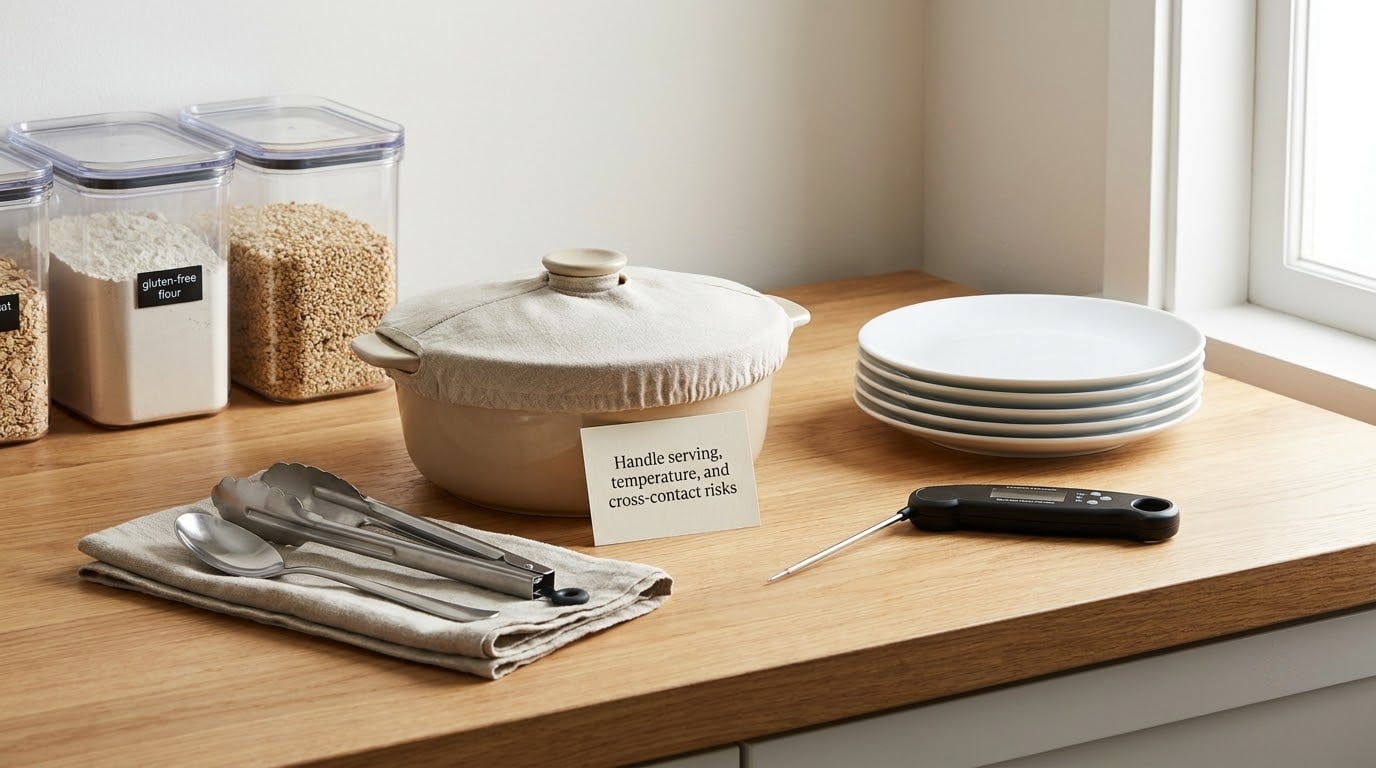
Serving is where a safe meal becomes unsafe, and the fixes are mostly free. Use your own utensils and plates, take your portion before anyone else is served, and keep food covered when it is not being eaten.
At a buffet line, go early when the utensils are clean. Have someone plate your food before the rush, or go straight to the safe dishes and fill your own plate first. Sitting at the end of a crowded line means your food gets handled by everyone ahead of you.
Watch the temperature side too. Perishable food should not sit out for more than two hours, and one hour when the room is warmer than 90°F, according to USDA guidance. Safe minimum internal temperatures are 165°F for poultry, 160°F for ground meat, and 145°F for whole cuts of meat and fish. A food thermometer is the only reliable way to check, and it takes ten seconds.
For children managing insulin or medication schedules, build the timeline backward from serving time and tell one adult on the table who is helping. Holiday delays are common, and the plan should absorb a late dinner without scrambling.
When cross-contact cannot be controlled, that is exactly when the backup meal earns its place in the bag.
6. Make the meal inclusive at the table
The goal is a dinner where the special plate looks like everyone else’s plate. Serve it in the same dish, on the same tablecloth, at the same time, with the same seating if the person can handle it. Difference shows up in the contents, not in a separate corner of the room.
Let the person serve themselves or hand you their plate before the meal starts, when your hands and theirs are both clean. That single change removes most cross-contact risk at the table and it takes ten seconds.
Offer choices in pairs rather than open questions. Two acceptable options get a decision made; a whole buffet of possibilities gets a shutdown. Say what is available, let them choose, and move on without commentary.
Script the explanation so the child is not the one defending the meal:
- To the table: “Alex eats this way because of his body, not because of fussiness.”
- To a curious child: “Some people’s bodies react to food. Mine is careful.”
- To a relative: “The doctor gave us a list. It is not a preference, so we do not bend it.”
- To the person eating: “This is your plate. You decide how much of it you want.”
Keep the framing practical rather than apologetic. A safe-food plate is medical equipment, not a reward and not a concession.
7. Reheat, store, and clean up safely
Leftovers are where good intentions quietly get risky. Refrigerate perishables within two hours, in shallow containers so they cool quickly, and label them with the dish name and the date.
Reheat only the portions you will actually eat. Reheat leftovers to 165°F for hot foods and keep hot food at 140°F or above until serving. Most of the time you will reheat a single serving rather than the whole tray, which protects both quality and safety.
Clean up in the right order. Wash your hands, then wash the cutting board, utensils, pot, and thermometer that touched the special meal before anyone handles general food. A sink full of holiday dishes is exactly where a shared surface sneaks in, and the person who cleans up last is usually not thinking about allergens at all.
For a medical diet, write down what happened while you are still in the kitchen. A note of what was served and what was eaten makes the next family doctor’s appointment far more useful.
Common Mistakes
Assuming a special diet is automatically allergy-safe. A gluten-free loaf baked in a regular oven on a shared pan can carry gluten through crumbs and shared surfaces. Cross-contact is a separate conversation from ingredients, and it needs its own question to the host.
Relying on ingredient labels alone. Labels describe one product in one factory. Shared fryers, toasters, spoons, and pans are where most holiday cross-contact actually happens.
Bringing a snack instead of a meal. A granola bar gets someone through the arrival and then they are hungry, distracted, and hungry again at 7 p.m. Bring a complete meal and a complete backup.
Changing several foods at once. If something goes wrong, you will not know which item caused it, and the safe list keeps shrinking without evidence. Add one new item at a time, at home, on a calm week.
Forgetting sensory preferences in a medically necessary diet. A safe food served too hot, too mushy, or mixed together gets refused. Texture and temperature preferences still apply, and they are easier to plan for than to negotiate at the table.
Using food as punishment or as a public reassurance. Withholding a safe food, or saying “if you sit through dinner you can have your safe food,” turns a medical tool into a bargaining chip. That message also teaches the wrong lesson about who gets to make medical decisions.
Waiting until the day of to mention the diet. A host who hears about a nut allergy on Thursday has already bought the wrong crackers and the wrong frosting. Contact them the week before and again on the day.
Planning for the meal but not the room. A safe plate in a loud, crowded room with twenty unfamiliar conversations still fails. Noise, smells, lighting, and a clear route to a quiet space are part of the safety plan, not extras.
Frequently Asked Questions
How can I make a holiday meal safe for a child with a food allergy?
Control three things: what goes in the dish, what touches it, and who handles it. Ask the host about shared fryers, ovens, toasters, and utensils, bring your own plate and serving spoon, and fill your plate early at a buffet. Keep your food covered, separate it from shared serving dishes, and carry a complete safe meal as a backup. Have any prescribed emergency medication accessible to a nearby adult.
What foods should I bring to a holiday gathering for a gluten-free child?
Pack a full meal, not a snack: a sealed gluten-free entree, a familiar side such as crackers, fruit, or a plain roll from a dedicated bakery, a drink they like, and one shelf-stable dessert. Portion it yourself before you leave so nothing goes to waste. Keep it covered and stored separately from shared dishes until it is served, and carry it chilled with an ice pack if the trip is long.
Is a gluten-free label enough for someone with celiac disease or severe allergy?
Not on its own. A gluten-free label describes ingredients in one product, not the kitchen it was made in. People with celiac disease and severe allergies also need to know about shared fryers, toasters, ovens, cutting boards, colanders, and serving spoons. Ask the host directly, and when the answer is unclear, bring your own food prepared at home. Your gastroenterologist can confirm the level of cross-contact caution your family needs.
How do I handle special-diet meals when the host is cooking?
Message the host a week ahead with the specific restriction and ask the practical questions: what touches the oven and fryer, which utensils handle the food, and whether gravy, stuffing, or frosting contains the ingredient you avoid. Offer to bring a dish so the meal stays generous for everyone. On the day, arrive with your own utensils and plate, take your portion first, and keep a complete backup meal in the car.
What should I do if my child with sensory sensitivities refuses the holiday food?
Treat refusal as information about sensory safety, not as behavior. Do not push a bite, comment on the amount eaten, or trade it for something else at the table. Offer two acceptable options from the safe list, let them serve themselves if they can, and make sure a complete familiar meal is available. Keep noise and conversation down at the same time, since the food is rarely the only load on them that day.
Can I prepare holiday meals ahead of time for a child with a special diet?
Yes, and it is usually the calmest option. Many family favorites freeze well as single portions. Cool them quickly, refrigerate or freeze in shallow containers, label each one, and thaw overnight in the refrigerator rather than on the counter. Travel with an insulated bag and an ice pack, and plan to reheat only the servings you will actually eat, to 165°F for hot food. Avoid leaving perishables out longer than two hours.
Conclusion
Start with one thing this week: confirm the exact requirements with the healthcare provider, write down the foods that reliably work, and pack one complete backup meal. Everything else on this list builds on those three answers.
Handling holiday meals with a special diet gets easier each season because you are not improvising in a crowded kitchen. You are following a plan you wrote down when you had time to think. Send questions to your doctor or registered dietitian, keep the backup meal in the car, and let the plate look like everyone else’s.