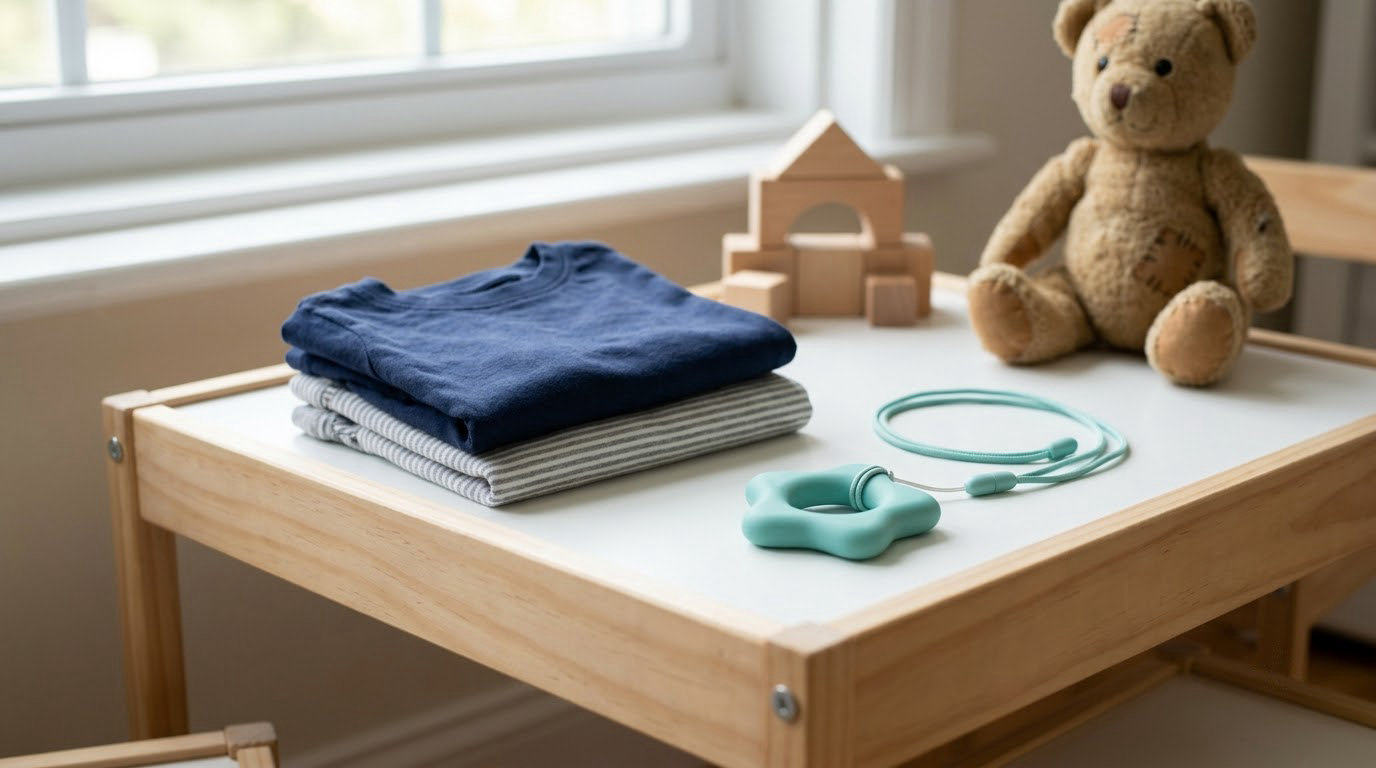
If your child chews sleeves, collars, cuffs or hoodie strings, telling them to stop has probably failed you by now. Chewing on clothes is nearly always a self-regulation behaviour: the jaw gives deep pressure, and the mouth work settles a nervous system that is anxious, bored, overloaded or concentrating hard.
So how to stop a child from chewing on clothes? In practice it means redirecting rather than eliminating, and expecting weeks rather than days. The plan below is five steps you can start tonight, plus what to say instead of “stop chewing”, what never goes near a child’s mouth, and when a doctor or an occupational therapist should be involved.
The short answer: note when the chewing happens, make the chewed garment harder to reach, offer one chew alternative the child actually chooses, teach a single calm signal to replace the habit, and praise the calm moments. Most children keep the sensory need and lose the ruined jumper.
Table of Contents
What You Need
You need less than you would expect, and none of it needs buying tonight.
- A pen and notebook, or the notes app on your phone. For three days, log the time, what happened just before, and what your child was doing.
- Two or three spare garments that match the ones being chewed, so a swap never becomes a battle. School uniform pieces count twice here.
- Two chew options, not ten. One you buy and one you already own. Parents who order a drawer full of chews usually end up with a drawer full of ignored chews.
- One written sentence to say when it happens. Decide it in advance, something like: “Your sleeve is wet. Do you want your chew or the cushion?”
- A simple tally. A sticker chart, a calendar, or a note on your phone. You are counting calm requests, not incidents.
- A route to a professional. Your pediatrician or GP, your dentist, and an occupational therapist (OT) if you can get a referral. Do this if teeth look worn or the chin is raw.
Everything in that list is free or already in the house, which matters, because the parents who burn out on this are usually the ones buying a new solution every fortnight and starting again from zero.
Step-by-Step: How to Stop a Child from Chewing on Clothes
Work through these in order, then loop back. Expect the first sign of change at around two weeks and a real reduction closer to six, which is why step 5 tells you how to measure it properly.
Step 1: Identify When and Why the Chewing Happens
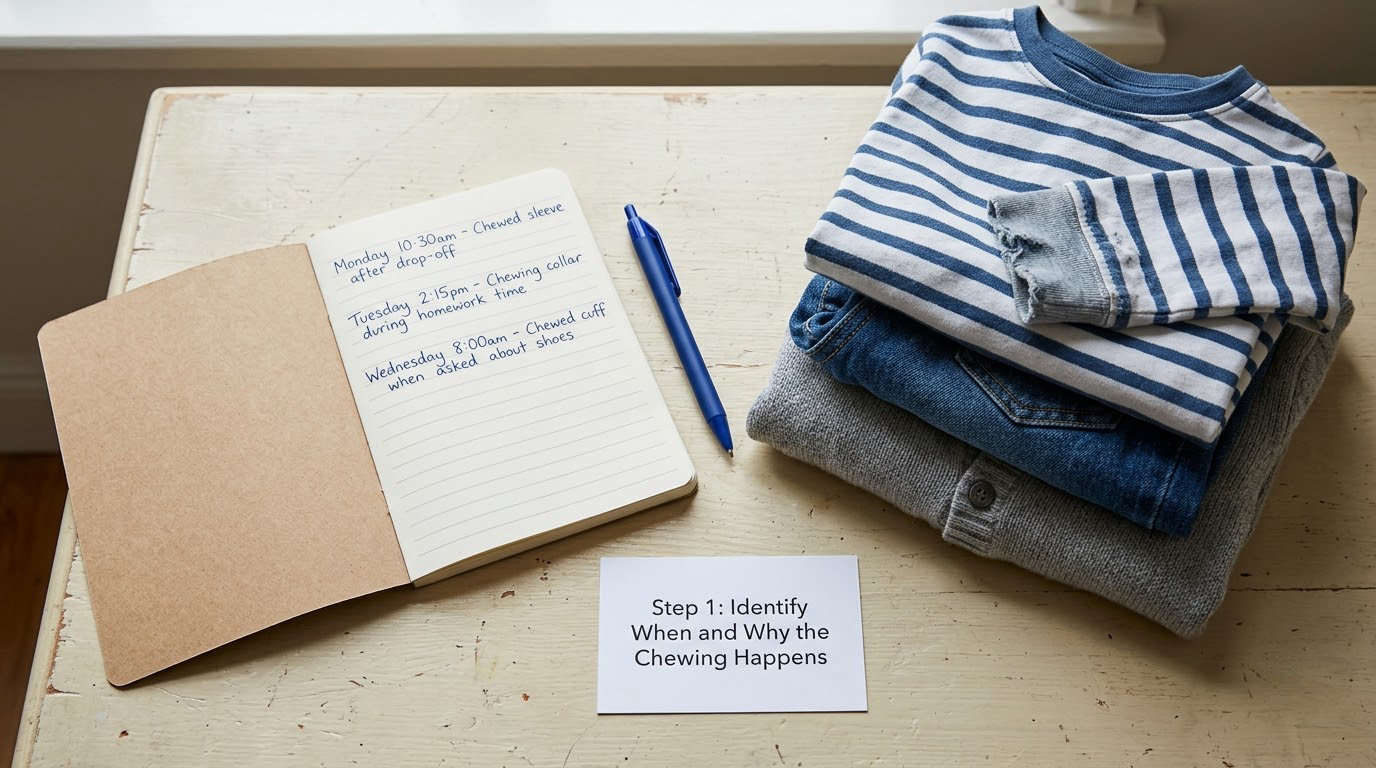
Three days of notes will tell you more than a month of guessing. Every time you see it, write three things: the time, what happened in the minute before, and what your child was doing. Patterns jump out fast, and patterns are what you plan against.
| Trigger | What it looks like | What to change |
|---|---|---|
| Boredom or under-stimulation | Constant shirt chewing in the back of the car, during long waits, or whenever nothing is happening | Give the jaw a job: a chew in the pocket, a crunchy snack, a window game on the journey |
| Anxiety or big feelings | Starts after an argument, a change of plan, news about something, or as the day winds down | Offer the chew before the melt, not after; build a predictable calm-down routine |
| Sensory overload | Noisy room, bright lights, several people talking, a busy supermarket | Plan an exit, carry a fiddle and a chew, agree a quiet base with the venue |
| Concentrating | Homework, reading, a long puzzle, a screen; chewing stops the moment the task stops | Treat it as a focus aid: permit it, make it discreet, praise concentration |
| Mouth pain or teething | Chewing one side only, refusing chewy food, rubbing the jaw, broken sleep, a loose tooth | Dentist first, not a new chew. Tooth wear and cracked fillings are the real risk here |
| Texture preference | One specific garment, sleeve or drawstring; labels cut out of everything; seams rubbed raw | Change the clothing, not the child: tagless and soft seams, cover or swap the offender |
Parents on Mumsnet and Mamapedia keep raising the same point, and it changes how you speak to your child: a lot of them genuinely do not notice they are doing it. Scolding a behaviour your child cannot see is not a discipline problem, it is just noise.
Step 2: Cover or Remove the Chewed Clothing
This is the part most guides skip, and it is the half of the problem that is actually in your control today.
- Bitter-tasting nail polish made for children is the closest thing to the spray people ask forum threads about. Paint it on cuffs and collars, let it dry fully, follow the label, and stop if skin is irritated. It works by taste, not by pain.
- Keep irritants away from the mouth. Chilli powder, vinegar, soapy water and similar ideas circulate online. They can burn a mouth, and a burned mouth makes chewing worse, not better.
- Sort the wardrobe. Tagless and soft-seam garments, seam tape over an irritating label, a high-neck base layer under a collar, a cardigan that hides a chewed top.
- Change the cut, not the outfit. Swap long sleeves for short at home when you are not going out, shorten or remove hood and draw strings, and replace one ruined coat rather than fighting it for a month.
- Deal with the drool at night. A bandana bib or a dribble bib protects the chin and the bedding, and a fresh shirt in the morning ends a battle you would otherwise lose at 6am.
Swap the garment calmly and early, never as a punishment and never by pulling it off mid-meltdown. A shirt yanked off in a supermarket is a public humiliation with no lesson attached to it.
Step 3: Offer a Safe Alternative to Chewing on Clothes
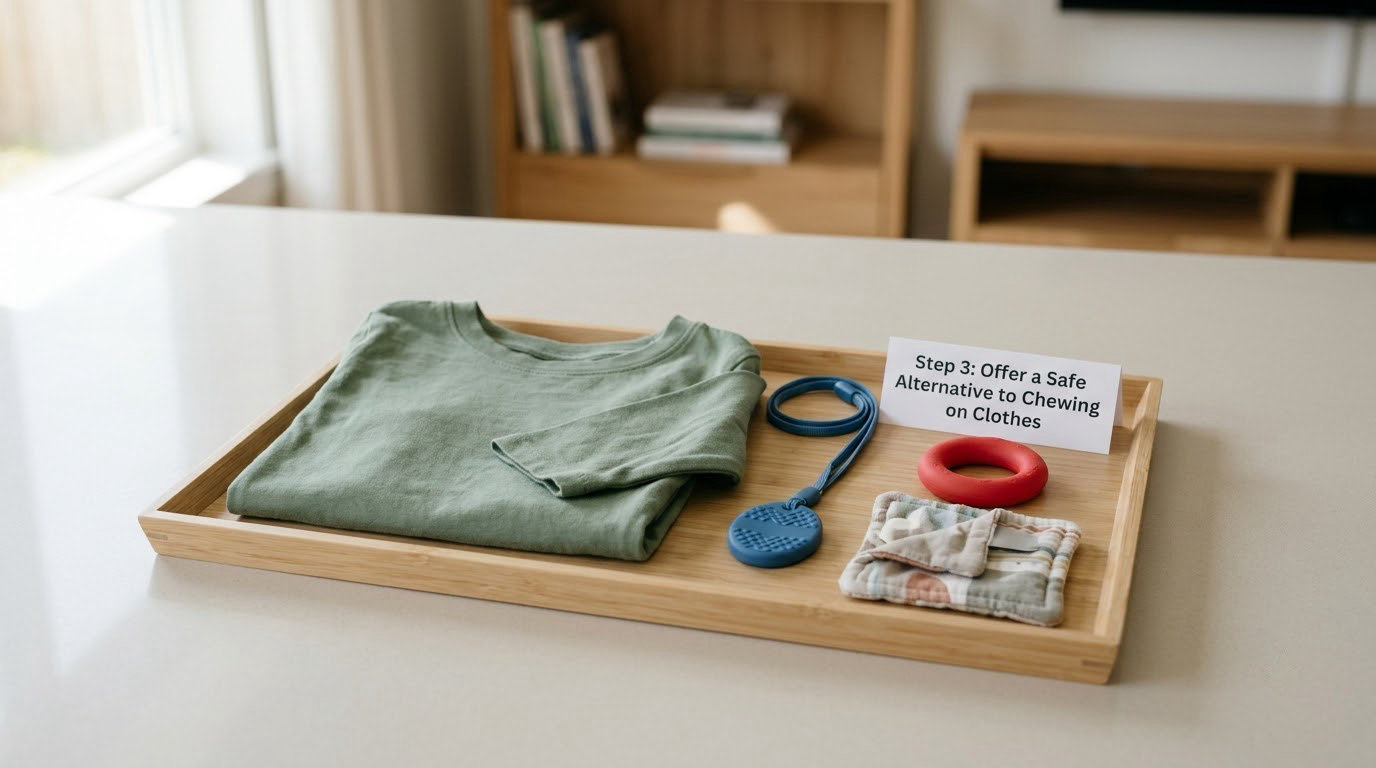
Give the jaw something to do that is safe, quiet and acceptable to other people. For most children that is a chew tube, a chew necklace, a silicone chew, a pencil topper, or, for anyone old enough, sugar-free gum.
- Chew tubes come in soft, medium and firm strengths. Getting the strength right matters more than the brand, and a chew that is too hard leads to broken teeth and a chewed-up tube.
- Chewable jewelry is discreet enough for a classroom or a restaurant, and parents report it lasting far better than fabric alternatives.
- Chew lanyards and dog-tag chews are hard-wearing and survive being dropped, which matters when the alternative is in a coat pocket.
- Pencil toppers are the quiet answer for school-age children and teenagers, who usually reject anything that looks babyish.
- Food-based input works if your child refuses plastic: crunchy carrot, apple slices, sugar cane, a long straw, or blowing bubbles.
On safety: check the age rating, keep anything small away from under-threes, and never give a child under three a necklace, lanyard or cord that can loop. Check chews for tears or missing pieces, wash them as the label says, and replace them rather than reusing something that is coming apart. Supervise under-threes, and remember that gum is a choking risk for young children.
Most parents report that the chew gets ignored, so make it easier to use. Offer two options and let your child pick, never press it into their mouth, keep it in a pocket or on the table within sight, and pair it with the exact moment from your trigger log. Two calm minutes at a desk beats an hour of a chew in a drawer.
Step 4: Teach a Simple Replacement Behavior
One signal, one phrase, practised when nothing is wrong. Not six rules and a lecture.
- Give a visual cue. A photo of the chew on a card in the wallet, a small sign on the desk, a visual schedule for school. Cue it the same way every time.
- Rehearse the phrase. Practise at home when your child is calm: “Chew, then breathe.” Once it is familiar, it works mid-meltdown.
- Name the feeling, not the fault. “You look cross. Do you want the cushion, the chew, or a walk?” Then wait a few seconds. The pause does most of the work.
- Notice it out loud when your child notices. “You caught yourself before chewing.” Praising the awareness teaches the skill faster than praising the absence.
- Agree a plan with school. Parents who battle staff over a chew item burn out fastest. Write to the class teacher, ask for one named chew to be allowed at the desk, and ask what happens if it is chewed in class. A discreet pencil topper gets a yes far more often than a bright necklace does.
Step 5: Reinforce What Works and Adjust the Plan
Reinforce the replacement, not the silence. The second your child asks for the chew, pauses, or uses the cushion, say something specific and immediate: “Good asking.” A sticker goes on for asking, never for “not chewing”, because you cannot reward an absence.
Then fade, deliberately. Prompt every time for a week, prompt once the next, hold the cue card without a prompt, then put it away. Supports that never fade become the reason nothing changes later.
Review at two weeks with your tally, counting four things: how many times, how long each one lasted, how much drooling, and how many garments survived. Fewer incidents that each last longer is still progress. No change at all after four weeks means the trigger map was wrong, so go back to step 1 and look at transitions and boredom rather than adding more tools.
Move to a professional if chewing is paired with anything new, if teeth show flattened biting edges or sensitivity, if the chin stays raw, or if you are replacing clothes weekly. Ask your pediatrician or GP what to say. A good opening question is: “My child chews clothing constantly. Could we look at dental health, iron and zinc, and whether an occupational therapy referral makes sense?”
Common Mistakes
Shouting, sighing, or narrating the damage
“Stop chewing that” and “look at that shirt, money does not grow on trees” both fail for one reason: they remove the coping tool without replacing it. The jaw still needs input, so the chewing goes underground or gets louder. Replace the command with a description plus a choice.
Yanking the garment away mid-meltdown
Removing a shirt by force adds distress to a moment that was already too much, and the item usually ends up chewed anyway. Warn once, offer a swap, and use the spare you prepared in “What You Need”.
Treating it as discipline
Most of these children cannot see the behaviour, which parents on parent forums say repeatedly. Punishment teaches a child to hide chewing, not to stop it, and it teaches them not to tell you when they are struggling. This is not a defiance problem, so treat it as a physical need.
Using irritants or unsafe chew items
Chilli, vinegar, soapy sprays and homemade deterrent mixtures can burn a mouth and pull a child further into oral seeking. A child-safe bitter-tasting nail polish used exactly as its label says is the sensible version of this idea. Plastic chews also need checking: no small parts, no long cords for under-threes, and nothing cracked or torn.
Changing five things in one week
A new chew, a new bedtime routine, bitter polish, a different school, and a sticker chart is chaos. You will never know which change worked. Make one change, watch for two weeks, then add the next one.
Frequently Asked Questions
What causes a child to chew on clothes?
Most often it is self-regulation: chewing gives deep pressure through the jaw and calms a nervous system that is anxious, bored, overloaded or concentrating hard. Teething, an itchy tag, a loose tooth and, rarely, a zinc or iron deficiency can also drive it. The behaviour is usually not deliberate, which is why telling the child to stop rarely works.
Is chewing on clothes a sign of autism?
It can be one sign, but on its own it proves very little. Many autistic children seek oral sensory input and chewing is a common way to get it, yet plenty of children chew because they are anxious, bored or overstimulated. If you also see hand flapping, lining up of toys, sensitivity to sound or food, or delayed language, raise it with your pediatrician rather than deciding alone.
Do ADHD kids chew on things?
Yes, and often during homework, reading or anything that asks for sustained attention. The mouth work provides a steady stream of movement and sensory input that supports focus. One parent reported their son saying that chewing helps him concentrate. A discreet chew that fits over a pencil usually works better at a desk than a noisy necklace does.
What deficiency causes chewing clothes?
Zinc and iron deficiency are the two most commonly raised when a child chews non-food items. One parent on Mumsnet reported that her four-year-old’s chewing stopped completely once a zinc deficiency was treated. That is a single account, not proof, so ask your pediatrician or GP about testing rather than buying a supplement yourself.
Will my child grow out of chewing clothes?
Many toddlers do, usually somewhere between two and four. Past that, persistent chewing tends to be a sensory or self-regulation habit that fades slowly rather than vanishing on its own. A Mumsnet poster who still chews clothing as an adult put it bluntly: you can rarely stop it, but you can change what gets chewed.
Can chewing clothes damage my child’s teeth?
Fabric is not built to be chewed, so repeated chewing can wear enamel, chip front teeth and crack fillings. Rough seams also abrade the chin, and swallowed threads or lint can cause stomach trouble. Book a dentist if you notice flattened biting edges, sensitivity to cold drinks, or a red or raw chin.
Conclusion
Start tonight with three days of notes, because knowing whether this is boredom, anxiety, focus or mouth pain decides everything else. Then make the chewed garment harder to reach, put one chosen chew where your child can reach it, and reward the calm request rather than the quiet moment.
You are not failing if the chewing does not vanish. Redirecting it, protecting the teeth and the chin, and giving the classroom a workable plan is the actual win, and that is achievable within a fortnight.