You can shop organic on a tight budget, but not by turning everything organic — the budget only works when you pick a short list of foods to buy organic and go conventional on the rest. Set a weekly number, keep three or four produce items organic, and put the money you were going to spend on milk and meat into more of the foods that matter. It takes about twenty minutes of planning a week.
The honest version is simpler than most budget guides make it sound. Buy organic where the exposure stakes and the animal welfare stakes are highest, shop conventional everywhere else without feeling bad about it, and spend the difference on more produce and less packaged food. The first week feels awkward. By week five it just feels like shopping.
Food prices in this article are realistic ranges for US shoppers and they move around by region and season, so treat the tables as a starting template to edit, not a rulebook. If your household has a child with allergies, sensory sensitivities, or a gluten-free diet, that constraint outranks every tip below — get the specific list from your child’s pediatrician or a registered dietitian first, then shop around it.
Table of Contents
- What You Need
- Step-by-Step: How to Shop Organic on a Tight Budget
- 1. Set a Weekly Food Budget
- 2. Plan Meals Around Seasonal and Flexible Ingredients
- 3. Build a Pantry Before You Shop
- 4. Compare Unit Prices Instead of Package Prices
- 5. Choose Organic for the Foods That Matter Most
- 6. Shop Sales, Store Brands, and Smaller Formats
- 7. Preserve What You Buy and Prevent Waste
- Common Mistakes
- Frequently Asked Questions
- Is organic food really more expensive?
- What should I buy organic first when I have a limited budget?
- How can I tell whether a product is genuinely organic?
- Are frozen or canned organic foods a budget-friendly option?
- How can I reduce organic grocery costs without buying cheaper conventional foods?
- How do I shop organic for a child with food allergies or a special diet?
- Conclusion
What You Need
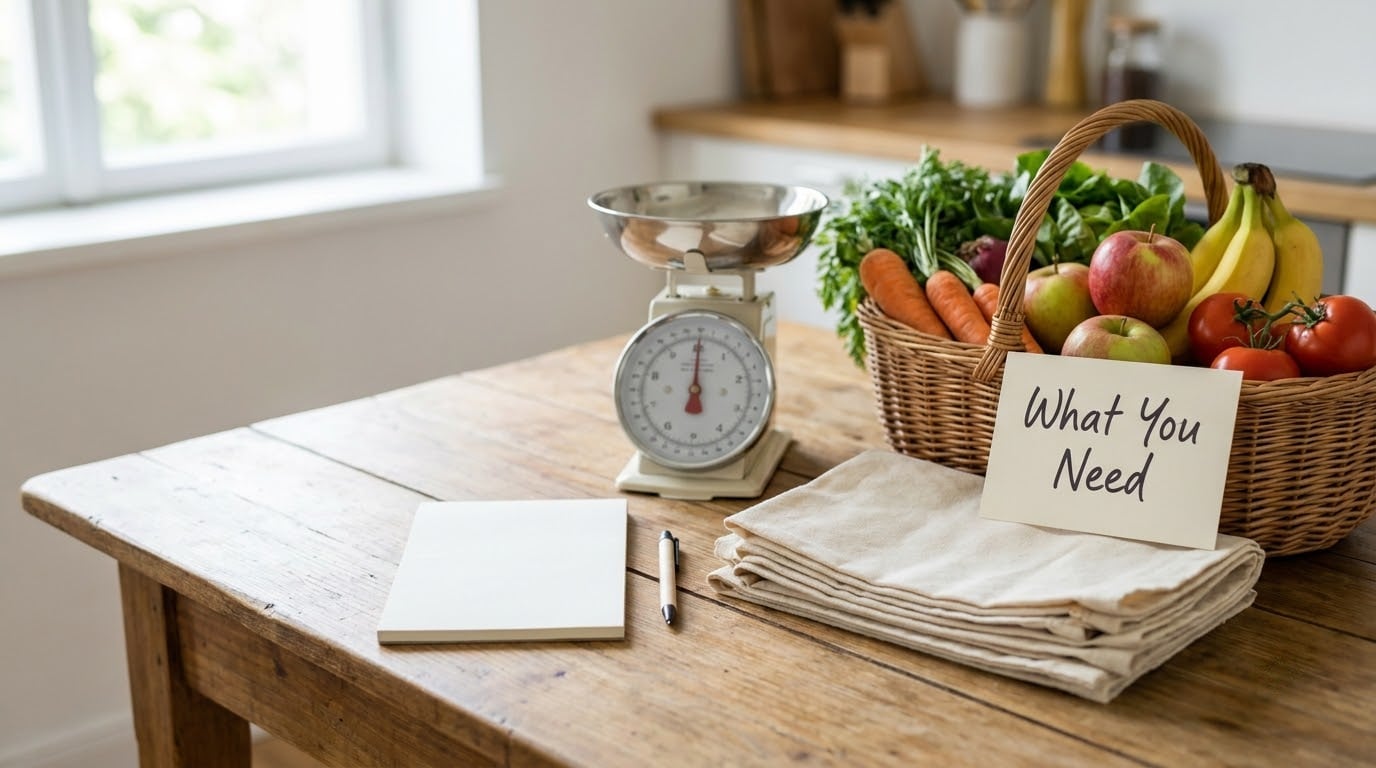
None of this needs an app or a paid membership. Six things get you started, and four of them cost nothing but attention.
- A weekly grocery number. A single figure you can check the receipt against. If you do not have one yet, work it out from your last three statements rather than a guess.
- A loose meal plan. Two or three anchor meals for the week, not seven. The rest fills in around them.
- A written list you actually bring. Phone notes count. Impulse aisles do not.
- Reusable bags. Bags plus a hand basket for produce. It makes unit prices visible and speeds up the trip.
- A pantry and freezer inventory. Ten minutes on a Sunday, or a photo of the shelves, so you know what you already own.
- A per-pound habit. You are going to divide the price by the weight every time you pick something up.
Two optional extras are worth adding later, not now. A rewards app such as Ibotta or Fetch Rewards takes a week of clipping offers before it returns anything, so let it run in the background. A freezer with an actual inventory, whether that is a labeled bin or a notebook by the door, is what lets you buy a whole case of organic without panic.
Step-by-Step: How to Shop Organic on a Tight Budget
Seven steps, same order every week. Skipping to step five first and trying to be clever at the checkout is how budgets blow, so give the first two a real try for a month before you change anything.
1. Set a Weekly Food Budget
Divide your monthly grocery number by four, then divide that weekly figure by the number of people eating at your table. A single adult on 100 dollars a week and a family of four on 300 dollars a week are both working with 100 dollars per person per week, and they can spend it very differently.
Next, split your budget into two lines. A total food budget covers everything. An organic budget sits inside it — say 25 to 30 percent — and that line is what gets protected when something goes wrong. Households that keep one blended number tend to drift toward conventional on everything by month three.
| Household | Weekly grocery limit | Suggested organic share | Monthly view |
|---|---|---|---|
| One person | 90 to 110 dollars | 25 to 35 dollars | 360 to 440 dollars |
| Couple | 160 to 190 dollars | 45 to 60 dollars | 640 to 760 dollars |
| Family of four | 280 to 330 dollars | 75 to 100 dollars | 1120 to 1320 dollars |
| Family of five | 330 to 390 dollars | 90 to 125 dollars | 1320 to 1560 dollars |
A single adult landing near 200 dollars a month sits at the low end of that first row once coffee and household staples come out of it. What works is writing the number down before the trip and comparing the receipt after, not counting during. A family of four can hit these targets comfortably if meat and dairy stay conventional.
2. Plan Meals Around Seasonal and Flexible Ingredients
Plan the meals after you look at what is cheap, not before. Seasonal produce arrives in volume, prices drop, and the shelf life is long enough that you can still finish it. In autumn that means apples, pears, squash, sweet potatoes, Brussels sprouts, kale, and root vegetables — all of them cheap enough to buy organic in small quantities without hurting.
Build two kinds of meals. Fixed meals use the same five or six ingredients each time, so leftovers stretch into the next lunch. Flexible meals take whatever is in the crisper, which is where bulk organic buying stops being wasteful.
Keep a short list of flexible staples that you buy regardless of season: rice, dried beans, pasta, tortillas, oats, canned tomatoes, frozen vegetables. These are the ingredients that turn a pile of cheap produce into dinner, and they cost the same whether the produce beside them is organic or not.
3. Build a Pantry Before You Shop
Check the pantry before you check the store list. Most waste is duplicate spending — a second bag of rice, a third container of the same seed oil, the cereal you bought at full price last week and never finished.
Organic pantry staples are where the price gap barely exists. Dried beans, rice, oats, pasta, canned tomatoes, and spices from bulk bins cost nearly the same as the conventional versions, and some of them only exist in organic form in stores that carry them at all. Stock these generously, since they are the backbone of low-cost meals.
If anyone in the house has an allergy or a gluten-free diet, keep those ingredients in a separate shelf that everybody can reach without a second thought. Duplicating a small bag of allergen-free flour for one person is a real cost, and it is cheaper than a second doctor visit. Ask a registered dietitian whether the swap needs to be organic at all, because for many people it does not.
4. Compare Unit Prices Instead of Package Prices
Pick up the item, find the price per pound or per ounce on the shelf edge, and compare it to the same item two aisles over. The package price lies constantly: a bigger bag looks like a bargain until you divide by weight.
Unit price is not automatically the winner, though. A 20 pound bag of rice at a great per-pound price is a loss if you have four people and a small cupboard. The rule that works for most households is simple: buy the larger size when the item keeps, buy the smaller size when it will not.
Bulk bins are the clearest version of this. Spices, rice, beans, oats, and nuts dropped a pound at a time cost a fraction of the packaged price once you weigh them. Buy them by the quarter pound, take only what the next two weeks need, and keep the jars labeled so nothing turns into a science project.
5. Choose Organic for the Foods That Matter Most
Prioritize, then stop. The Environmental Working Group updates its Dirty Dozen list every year, and the categories that show up most often are strawberries, spinach, kale and collard greens, apples, peaches, grapes, bell peppers, tomatoes, blueberries, raspberries, blackberries, and pears. Pick four of those you actually eat, and buy those organic.
Everything on the Clean Fifteen side of the list — the items with little or no detectable pesticide residue conventionally grown — is where you save the most by skipping organic. Sweet corn, avocados, onions, sweet potatoes, cabbage, and frozen peas are the ones I buy conventional without hesitating.
The real budget killers are meat and dairy, not produce. Organic milk and grass-fed meat carry the widest price gap of anything in the store, and a family that switches both at once can wipe out a produce budget four times over. Keep those conventional, use meat as a condiment instead of the centerpiece, and let beans and rice do the heavy lifting in a few meals each week.
Eggs are a special case. Certified organic and pasture-raised eggs are frequently the same animal sold under two labels, and a local farm often charges less for pasture-raised eggs than a grocery chain does for the organic carton. Do the price-per-dozen math yourself rather than trusting the front of the box.
Finally, skip organic where it buys nothing: candy, crackers, chips, snack cakes, and specialty granola. Those cost more and none of them become better. Make the household version instead, which is cheaper, faster, and you control the ingredients for a sensory-sensitive eater.
6. Shop Sales, Store Brands, and Smaller Formats
Store brands are the single biggest lever most budget shoppers never pull. The same farm, the same mill, a different label. Nobody on a tight budget should be paying a marketing premium for a name they do not care about.
| Where to shop | What it is good for | Watch out for |
|---|---|---|
| Aldi | Low-cost store-brand organic produce, milk, eggs, and pantry basics | Limited selection; produce quality varies by week |
| Costco | Large cases of eggs, chicken, and pantry staples at low per-unit cost | Membership fee, case sizes, storage space |
| Trader Joe’s | Private-label organic at everyday low prices | Sales are genuine but brief |
| Sprouts Farmers Market | Low per-pound prices on a wide organic produce range | Not everywhere; prices climb near closing |
| Farmers market | Peak-season produce, sometimes grown to organic practices without certification | Hours, weather, and cash-only stalls |
| CSA share | Fixed weekly box, often split with another household | You may get produce you do not eat |
| Misfits Market or Thrive Market | Misfit produce boxes and pantry staples delivered | Subscription terms and delivery minimums |
Two more channels are worth knowing. Splitting a CSA share with another family halves the cost and halves the risk of a box full of squash. Buying a full case of an item you use weekly is where the per-unit savings show up — some natural grocers run full-case pricing on yogurt and eggs that beats the shelf price by a good margin.
Read labels properly and the savings get easier. This chart is the whole cheat sheet:
| Label | What it actually means | Budget implication |
|---|---|---|
| USDA Organic | Crop production and handling rules, plus annual certification and inspection | The real thing; the cost you budgeted for |
| Certified Naturally Grown | Non-profit alternative with the same core practices, no government seal | Often cheaper, often local |
| Makes organic claim | 95 percent organic ingredients for a certified product | Fine and often good value |
| Non-GMO | No genetically modified ingredients, nothing about pesticides | Often cheap and often conventional |
| Natural | No legal standard at all; a marketing word | Treat as conventional |
| Cage-free or free-range | Housing conditions for eggs and poultry, unrelated to feed or pesticides | Cheaper than organic, worth a compromise |
| Grass-fed | Diet for a period of the animal’s life; organic is a separate claim | Expensive; decide case by case |
Smaller formats are the other half of this step. A half bag of organic spinach that gets eaten beats a full bag that turns to slime in the crisper drawer. Halves and singles cost more per pound and frequently cost less in the week.
7. Preserve What You Buy and Prevent Waste
Buying a case of organic only pays off if you capture it. Blanch and freeze vegetables the day you get them, in single-meal portions, and write the date on the bag. Frozen broccoli from a bulk organic lot keeps its value for months and costs nothing extra to store.
Give produce realistic storage times so you use it while it is still good: leafy greens three to five days in the fridge, berries three to seven, peppers and onions one to two weeks, apples and hard squash a month or more. Store herbs in a jar of water in the fridge rather than a bag, and buy them less often.
Cook safely at the temperatures mainstream guidance recommends: poultry to 165°F, ground meat to 160°F, and whole cuts and fish to 145°F. Take leftovers out within two hours, and eat them within three to four days or freeze them.
The cheapest way to waste less is to plan the second meal at purchase time. If you are buying a big organic cauliflower, decide on one of the recipes before you pay. If no second meal comes to mind, buy the smaller head.
Common Mistakes
Trying to go fully organic in month one. The all-or-nothing approach is the single most reliable way to quit. Fix it by choosing four organic produce items this month and adding more only once the habit holds for three months.
Shopping without a written list. Every unplanned item is a per-pound price you did not compare. Keep the list in your phone and check it in the aisle, not at the register.
Assuming every organic item costs more. Store-brand organic, frozen organic, bulk-bin grains, and seasonal produce frequently cost the same as or less than the conventional national brand. Prices move, so check rather than assume.
Buying bulk without a use plan. Cheap per pound, wasted in the drawer. Buy a case only for an item you already eat weekly, and only if you have freezer space and a label system.
Treating labels as interchangeable. Natural means nothing, non-GMO says nothing about pesticides, and cage-free says nothing about feed. Look for the USDA Organic seal or Certified Naturally Grown, and stop paying for words that are not regulated.
Buying organic snack food. The premium is real and the food does not improve. Make the popcorn, crackers, and dip yourself, where you can also control the texture and ingredients.
Two smaller habits pay off all year. Buy meat less often and stretch it with beans or rice, which cuts the total food volume and frees real money. And shop your local farm market at closing time, when vendors discount what they cannot carry home — ask whether they grow to organic practices even when they cannot afford certification.
Frequently Asked Questions
Is organic food really more expensive?
Sometimes, and not where people expect. Organic produce, dairy, and meat usually carry a premium, but store brands, frozen produce, bulk grains, and seasonal items often cost the same as the conventional version. Most of the price gap comes from switching milk and meat, not from switching produce. Buying organic for four Dirty Dozen items and going conventional on dairy and meat is the version most tight budgets can sustain.
What should I buy organic first when I have a limited budget?
Start with produce you already eat from the Dirty Dozen list, such as strawberries, spinach, apples, grapes, tomatoes, and berries. Choose four and stay with them. Meat and dairy are the most expensive categories to switch and give the biggest budget hit, so keep those conventional until your produce habit is steady and you have room in the number.
How can I tell whether a product is genuinely organic?
Look for the USDA Organic seal, or Certified Naturally Grown for a non-profit alternative. Words like natural, non-GMO, cage-free, free-range, and grass-fed are unregulated or cover something other than organic production, so treat them as conventional unless a seal is present. In a farm-direct or farmers market setting, ask the grower directly whether they avoid synthetic pesticides, because small farms often cannot carry certification.
Are frozen or canned organic foods a budget-friendly option?
Frozen is often the best value in the store, because produce is picked and frozen at peak, costs less per pound than fresh, and lasts for months without spoiling. Canned organic tomatoes, beans, and fruit are cheap and shelf-stable. Both are easier to buy in bulk than fresh, which makes them ideal when you have limited storage and a tight budget.
How can I reduce organic grocery costs without buying cheaper conventional foods?
Change where and when you shop instead of what you buy. Buy seasonal produce, use store-brand organic lines, shop closing time at farmers markets, split a CSA share, buy frozen instead of fresh, and buy on sale when your regular organic items drop. Rewards apps and digital coupons add up quietly over a month. You keep every item organic and still lower the total.
How do I shop organic for a child with food allergies or a special diet?
Get the exact list of foods to avoid from your child’s pediatrician or a registered dietitian, then build the plan around it rather than bending the plan around the diet. Many allergen-friendly products do not need to be organic, which frees budget for the produce and protein your child actually eats. Buying the one brand your child accepts, in the smallest format that works, beats a cheaper substitute that gets refused.
Conclusion
Start with one number this week. Write down what your grocery budget actually is, divide it by the people at your table, and pick four Dirty Dozen produce items to buy organic. Everything else stays conventional, and the milk and meat stay where they are.
Partial organic, chosen on purpose, is not a compromise to feel bad about. It is the version of eating organic that most families still keep running a year later — and it is far better than going fully organic for three weeks and giving up. Take the list, walk the aisle, and compare the per-pound price before anything else.