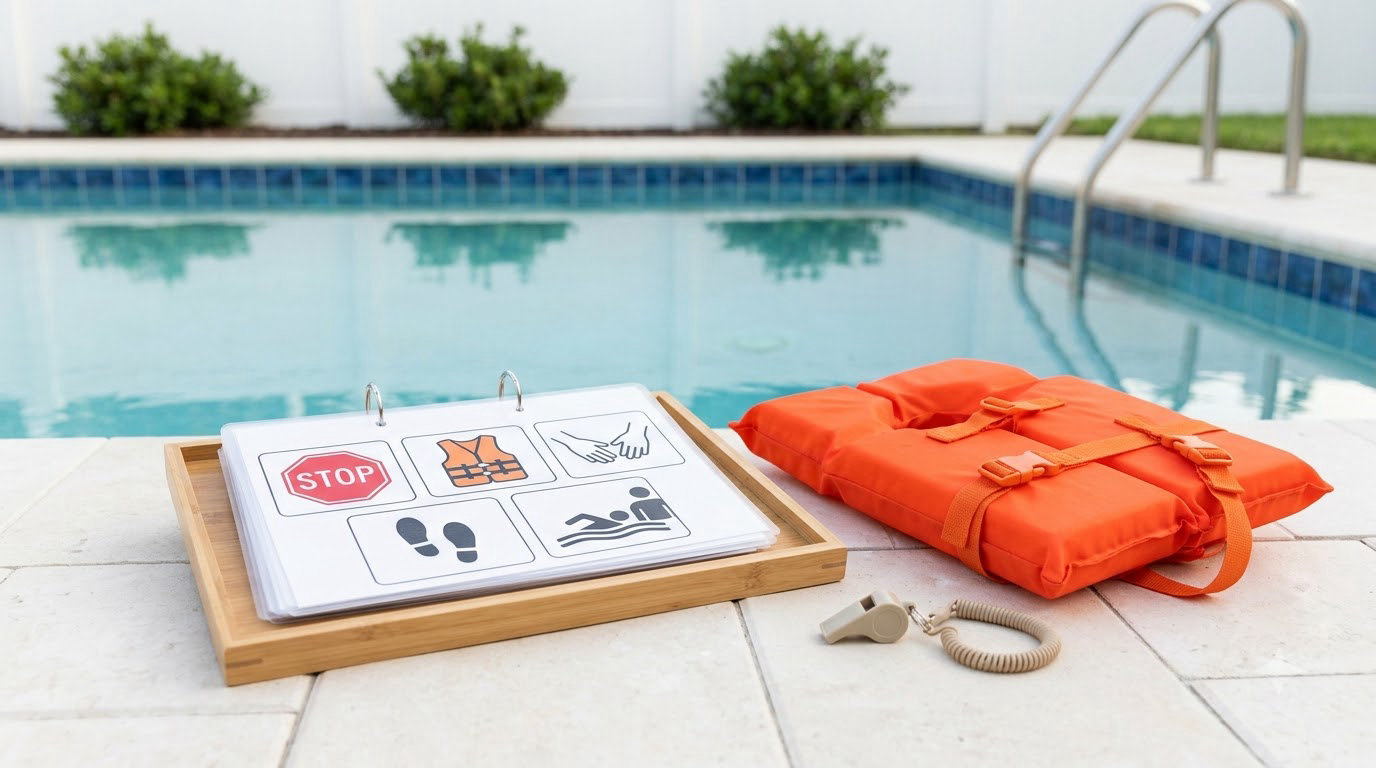
The short version: teach it as a fixed, low-pressure routine, one skill at a time, and never without an adult within arm’s reach. Learning how to teach water safety to a child with autism is less about drills and more about predictability — the same sequence, the same three rules, the same words every single time.
The stakes are unusually high. Autistic children are reported to be about 160 times more likely to die from drowning than neurotypical peers, and of the drowning cases researchers have examined, a large share involved a child who had wandered or eloped to the water, often at home. Drowning is also silent and fast. A child can be in trouble in under a minute without making a sound, which is why every layer of protection has to hold on its own.
Parents in autism parenting groups report the same pattern over and over: swim lessons helped more than anything else, but lessons alone did not make their child safe. Barriers, supervision, and a written plan were what actually lowered the risk. The steps below take about 20 to 30 minutes of focused practice to work through, and you can start at the bathtub.
Table of Contents
- What You Need
- Step-by-Step: How to Teach Water Safety to a Child With Autism
- Common Mistakes That Put Autistic Children at Risk Near Water
- Safety Tips for Everyday Water Situations
- Frequently Asked Questions
- Can autistic kids take swim lessons?
- What is the drowning risk for autistic children?
- How do I get past a child being afraid of water on his face?
- How do I teach a child who does not speak to call for help?
- Do autistic children need life jackets on lakes and boats?
- What age should an autistic child start water safety practice?
- Conclusion
What You Need
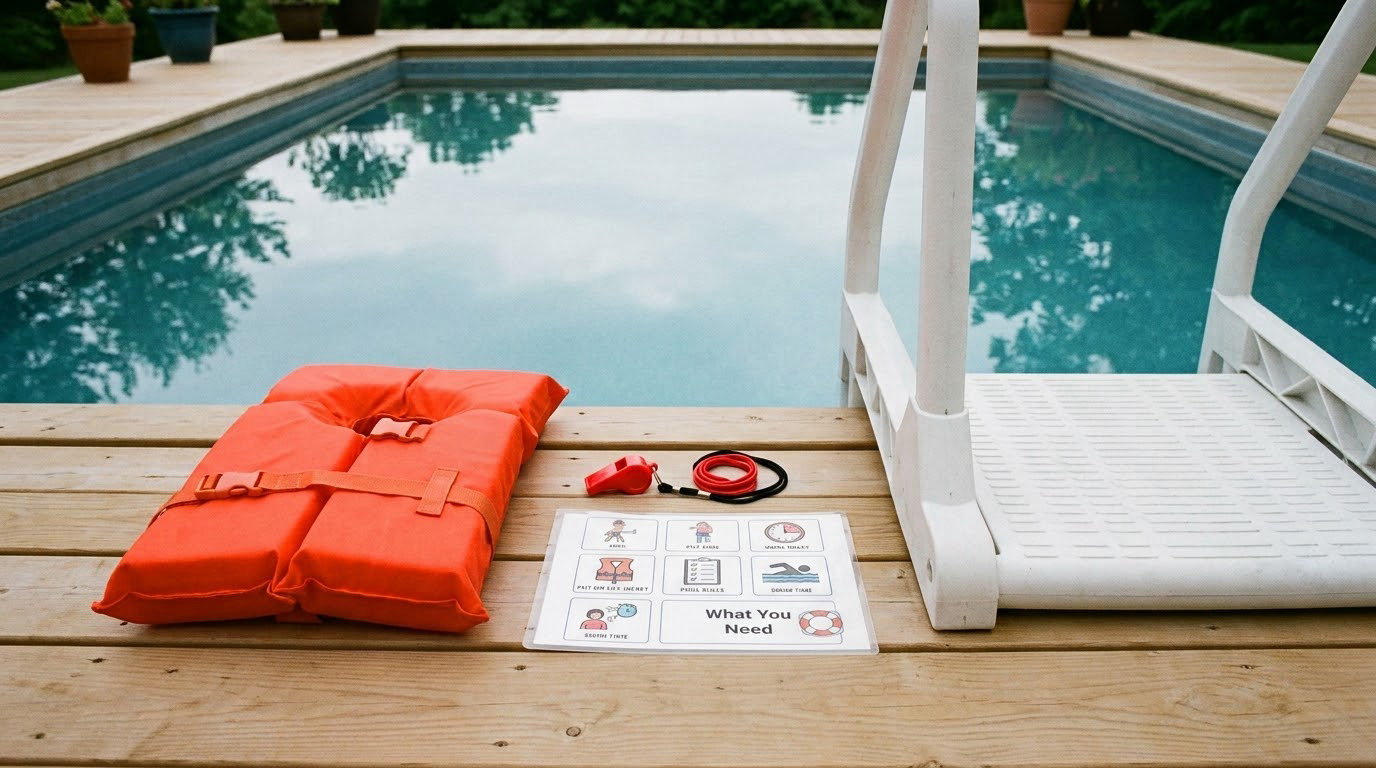
You do not need a swimming pool to begin. Most of the equipment list works in a bathtub or a shallow kiddie pool, and the communication supports matter more than most families expect on day one.
- A properly fitted life jacket. A U.S. Coast Guard-approved PFD, sized by weight, not age. Check the fit every few months as your child grows — a jacket that rides up over the chin is not doing its job.
- Reach-and-rescue gear for any water deeper than a foot. A long pole with a hook, a throw rope, and a phone that is charged and within reach. Adults rescue by reaching or throwing first, not by going in.
- A whistle. Cheaper than any lesson, and it carries farther than your voice across a yard.
- Sensory comfort items. Swim goggles that fit well, a swim cap, water shoes, and a second set of dry clothes. Bright, solid-color swimwear also makes your child easier to track in murky water.
- Visual supports. A laminated visual schedule, a first-then board, and three or four picture cards showing the rules. Keep them in one folder so setup takes a minute, not twenty.
- A communication method your child already uses. That might be an AAC device, a picture card, a sign, or one agreed hand signal. Rehearse the help signal where you will not need to speak loudly, such as underwater.
- A designated water guardian. One sober, undistracted adult, with a phone in another room and a rotation if there are several adults present.
- A qualified instructor when you can get one. An adaptive swim program, a special educator, or a swim instructor with autism experience. Ask your child’s occupational therapist for a referral, since they often know which local programs work.
- A one-page written plan. Your child’s cues, what triggers a melt-down, the help signal, what to do if they cannot be found. This is for sitters, relatives, and camp counselors.
If cost is the barrier, ask about state swim-lesson vouchers, YMCA adaptive programs, and the scholarship funds that some swim schools set aside each season. Many therapists also have a small discretionary budget for exactly this kind of training.
Step-by-Step: How to Teach Water Safety to a Child With Autism
Work in this order and stay at each step until the behavior holds on three separate days. Going back a step is normal, not a setback.
1. Build a predictable routine before water play
Put the visual schedule up before the child enters the room, not after they ask a question. Five frames is plenty: shoes on, walk to water, hold the wall, practice, dry off, done.
Say the same thing in the same words every session — “hold the wall with two hands” beats a fresh explanation each time. Give a two-minute warning and a one-minute warning before any transition, and mark them on the schedule so the warning is not just an adult’s voice.
Check readiness before starting. If your child is already dysregulated from a hard morning, shorten the session to five minutes of the one step they know well. If you are not sure what triggered the dysregulation, our guide to how to handle autism meltdowns at home walks through the early signs. A short predictable win is worth more than a long session that ends in a melt-down.
2. Teach the three water-safety rules
Three rules is enough. Fewer rules get remembered; more rules turn into noise.
- Stay with your adult. Practise it on dry land first — hand in hand, walking to the gate.
- Wait before you get in or out. Practise stopping at the pool edge and the bathtub step.
- Tell an adult when something feels wrong. Practise with the help signal, in and out of the water.
Model each rule yourself. Sit down on the step and wait, so the child sees an adult doing exactly what you are asking. Then prompt, wait five seconds, and help physically if needed. Repeat the same routine across many sessions until the child acts before your prompt.
3. Practice entering and leaving water safely
Pick one location and one sequence. For a pool: stop at the edge, sit on the step, put both feet in, slide down holding the rail, and wait for your “go” before letting go of the rail. For a bath, the same idea minus the rail.
Break it down into steps the child can see, and let the child do the last step each time. That single-step finish keeps the routine forward-moving even on a bad day.
Address sensory issues at the entry point, because that is where most refusals happen. A child who is wary of the step, the temperature, or wet feet will not reach the wall. Test the water temperature yourself first, offer a towel for wet feet before the second step, and give the child a job — holding a cup, choosing the towel — so entering is something they are part of rather than something done to them.
4. Practice staying near the wall
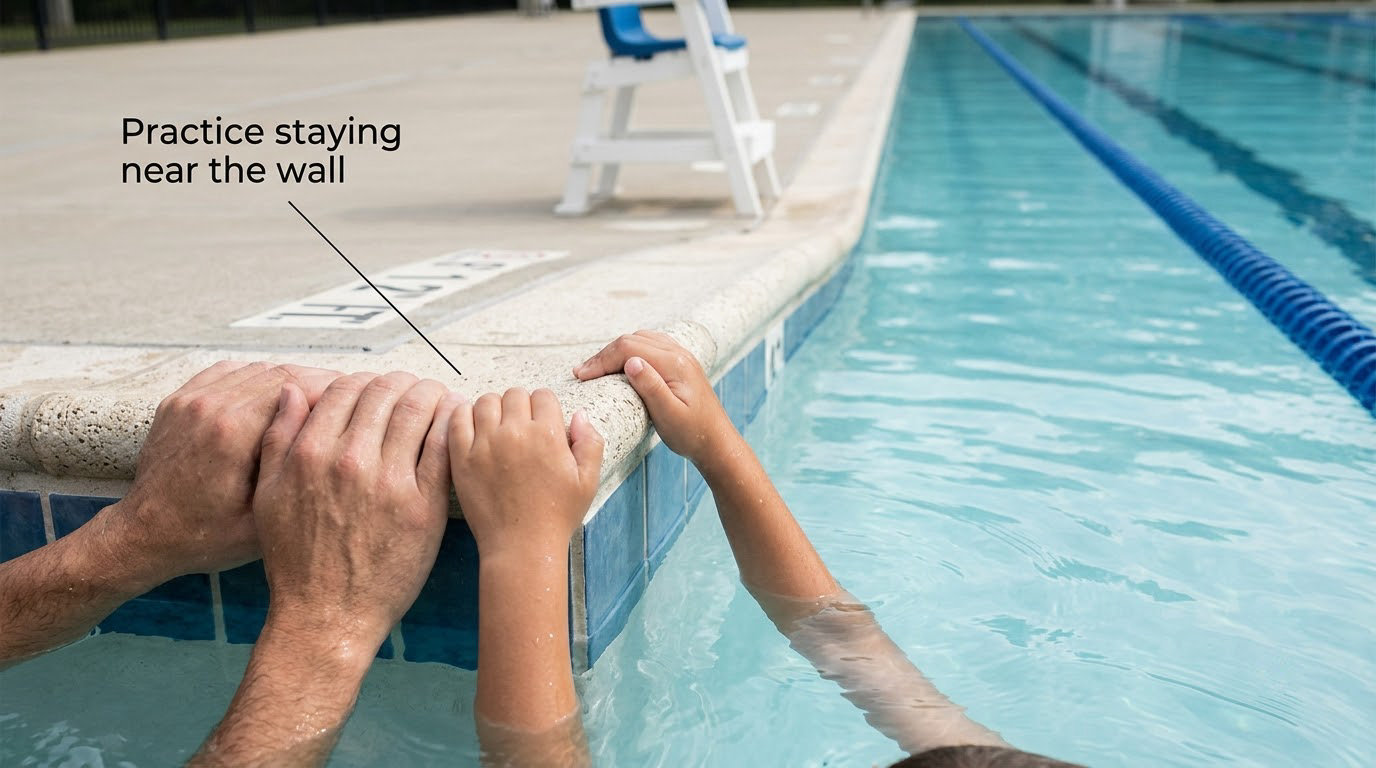
This is the core beginner activity. With your hands on the wall next to yours, practise the smallest versions of things: let go with two hands, hold with one, put your cheek in the water for one second, then two, then blow bubbles while holding on.
Body awareness comes before swimming strokes. Blowing bubbles while holding the wall is the single most useful early skill, because it teaches breath control in a supported position where nothing can go wrong.
Stay within arm’s reach the entire time. If your child panics, pulls away, or shuts down, end the practice on a neutral note rather than pushing through. You can pick up the exact same activity tomorrow, and the routine you keep is doing more work than the minutes you add.
5. Practice asking for help
A child who cannot call for help is relying entirely on you being close. Teach the signal, then make it easy and rewarding to use it. The simplest version: while the child is holding the wall, they squeeze your hand once and you say “you called me” and help immediately. Every time.
Then widen it. Try the signal in the shallow end, then at the deep end of the pool with you beside them, then in the bathtub with the door closed. Use the same response script every time so the outcome is predictable: “You called me. I am here. You are safe. Do you want out or do you want to keep holding?” That last question is a powerful autonomy move and it works well with minimally verbal children who can point or gesture.
Keep the response instant. A child who asks and gets silence once will not ask again.
6. Teach what to do after falling in
Talk about this in plain, non-scary language: if your feet lose the floor, open your eyes, turn toward the wall or the nearest safe spot, and call for help. Stay where you are and wait for an adult. Do not try to swim anywhere.
Rehearse it dry first — the motions on a mat, then in shallow water with you underneath. What matters is that falling in produces a sequence, not panic.
Be clear with yourself and with your child about what this is: a supervised practice habit, not emergency survival training. A child who has never been in real danger should not be asked to rehearse one.
7. Gradually increase independence
Move from hand-over-hand support to a finger on the wall, then to holding the wall alone, then to floating on the back with your hands under the shoulders, then to a side float. The usual order for teaching an autistic child to float is back float first, side float second, because the back float needs no decision-making and the side float does.
Track progress somewhere you can see it, like a chart on the fridge with one sticker per successful repetition. Do not turn it into a test. If your child stops progressing for a few sessions, go back two steps rather than pushing harder, and check whether something sensory is blocking them instead of skill.
Give instructions one at a time. A child who is holding the wall does not also need to hear about bubbles, kicking, and turning all in one sentence — that is the overload that derails an otherwise good session.
Common Mistakes That Put Autistic Children at Risk Near Water
Introducing several new skills in one session
Everything arrives at once, the child shuts down, and the adult concludes the pool is a bad idea. Teach one skill per session, record it, and move on only when it is solid.
Relying on verbal instructions alone
Many autistic children process spoken instructions poorly under stress, which is exactly the state they are in near water. Pair every spoken rule with a card, a gesture, or a demonstration — and practise the gesture, not just the word.
Treating sensory distress as defiance
Refusing to put a wet face in the water is a sensory response, not attitude. Back off, reduce the exposure, and rebuild. Therapists who work on feeding and bathing sensory issues can often suggest a desensitization plan that works far better than pushing.
Practising without active supervision
Touch supervision means a hand on the child or within an arm’s reach, eyes on them the whole time. For a non-swimmer this is the standard, and a lifeguard does not replace it. A child who looks calm in shallow water may be far less safe in the deep end than any adult assumes.
Making water play feel like a test
Repetition with a reward built in is teaching. Quizzing, hurrying, or saying “you can do it, what’s wrong” is not. A playful, low-pressure session gets more repetitions out of the child, and repetitions are what build a skill that works during a panic.
Assuming a confident swimmer is safe near water
Skill does not stop wandering, and it does not stop a child walking toward a pond to look at something. Keep the barriers, the alarms, and the guardian rotation in place even after your child is a solid swimmer.
Safety Tips for Everyday Water Situations
Bathtubs and the bathroom. Most childhood drownings in the home happen in the tub, and the water volume needed is far smaller than most people expect. Keep a hand on your child during the whole bath, set a timer you can hear in another room, and empty the tub immediately when you are done. Cover the toilet, keep buckets and watering cans empty, and put lids on anything holding water indoors. A kiddy pool needs the same attention as a full-size one, and a pool toy left holding water overnight becomes a hazard.
Home pools and hot tubs. Use four-sided fencing rather than a three-sided fence on a property line, with a self-closing, self-latching gate, and keep it latched. Add a door alarm on any door leading outside, window alarms on ground floors, and a pool alarm. Keep rescue equipment poolside — a hook, a throw rope — and rehearse what a family member would do in the first sixty seconds: shout for help, reach or throw, call emergency services, and never enter the water to reach a person, especially a child.
Lakes, ponds, and open water. Not every state requires a life jacket on a boat, so treat one as the default for a child who wanders or is not a confident swimmer. Check the fit, buckles, and crotch strap before every single trip. Choose a bright-colored jacket, and treat shallow water near a shoreline as deep, because most drownings happen in water that looks walkable.
Travel, rentals, and other people’s homes. Check a rental for fences, gates, and door alarms before the children arrive, and remember that a vacation house often has unfenced water nearby. Adults you do not manage may not know your child’s history. Give every sitter, relative, and camp counselor the one-page plan and go through it out loud.
Follow the guidance your local public-safety authority and your child’s pediatrician give you, and involve your child’s occupational or behavioral therapist in a written water safety plan. If a skill is not sticking, a therapist can set it up as a structured behavioral intervention, which is a well-established approach for teaching this kind of sequence.
After a wandering episode near water, write down what happened while it is fresh: where your child was found, how long the gap was, and which barrier was missing. Then fix that specific barrier rather than reacting with general worry.
Frequently Asked Questions
Can autistic kids take swim lessons?
Yes, and most autistic children benefit from them. A general class is often too fast, too loud, and too crowded, so look for an adaptive or one-to-one program. Parents report that the instructor matters more than the school, and that switching instructors can set a child back. Ask whether the instructor is trained in autism, uses visual supports, and keeps groups small.
What is the drowning risk for autistic children?
Autistic children are reported to be about 160 times more likely to die from drowning than neurotypical peers, based on research widely cited by groups including the National Autism Association. A diagnosis alone does not predict risk, but wandering or elopement, a strong pull toward water, limited awareness of danger, and difficulty leaving water all raise it. Layers of protection, not one layer, are what reduce it.
How do I get past a child being afraid of water on his face?
Treat it as exposure, not defiance, and slow the pace. Start with a damp cloth on the hands, then the shoulders, then the chin, taking a break after every step the child tolerates. Add well-fitting goggles early so water hitting the face is not a surprise. Practice blowing bubbles while holding a wall, with your hand right there. Never dunk, never hold the head back, never force it.
How do I teach a child who does not speak to call for help?
Use whatever system your child already has: an AAC device, a picture card, a sign, or one agreed hand signal. Rehearse it where you do not need to shout, such as while the child holds the wall with both hands. Respond within a second every single time and say the same words: you called me, I am here, you are safe. Instant, consistent response is what makes the signal stick.
Do autistic children need life jackets on lakes and boats?
Treat a U.S. Coast Guard-approved PFD as the default on open water, especially for a child who wanders or is not a confident swimmer, because legal requirements vary by state. Buy by weight, then check the fit: the jacket should not ride up over the chin or ears when you lift the shoulders. Buckle every strap, including the crotch strap, and check the fit again as your child grows.
What age should an autistic child start water safety practice?
Start as soon as your child is comfortable in a bathtub, and do not wait for lessons to be available. Readiness looks like holding a caregiver’s hand in the bath, tolerating a damp face, and following a two-step routine, not a birthday. Bathtub practice buys months of readiness, and a comfortable early start beats a reluctant start at seven. Ask your pediatrician and therapist about individual readiness.
Conclusion
Start with one safe water location, one five-step visual schedule, and one rule: stay with your adult. Teach the routine in the order above, one skill at a time, and let each one hold for three sessions before you move on.
Consistent, low-pressure practice is what builds a skill that survives a panic. If the steps are not sticking, or your child wanders to water regularly, ask your child’s therapist to help you build a written plan and to point you toward an adaptive swim program or a qualified instructor who works with autistic learners.