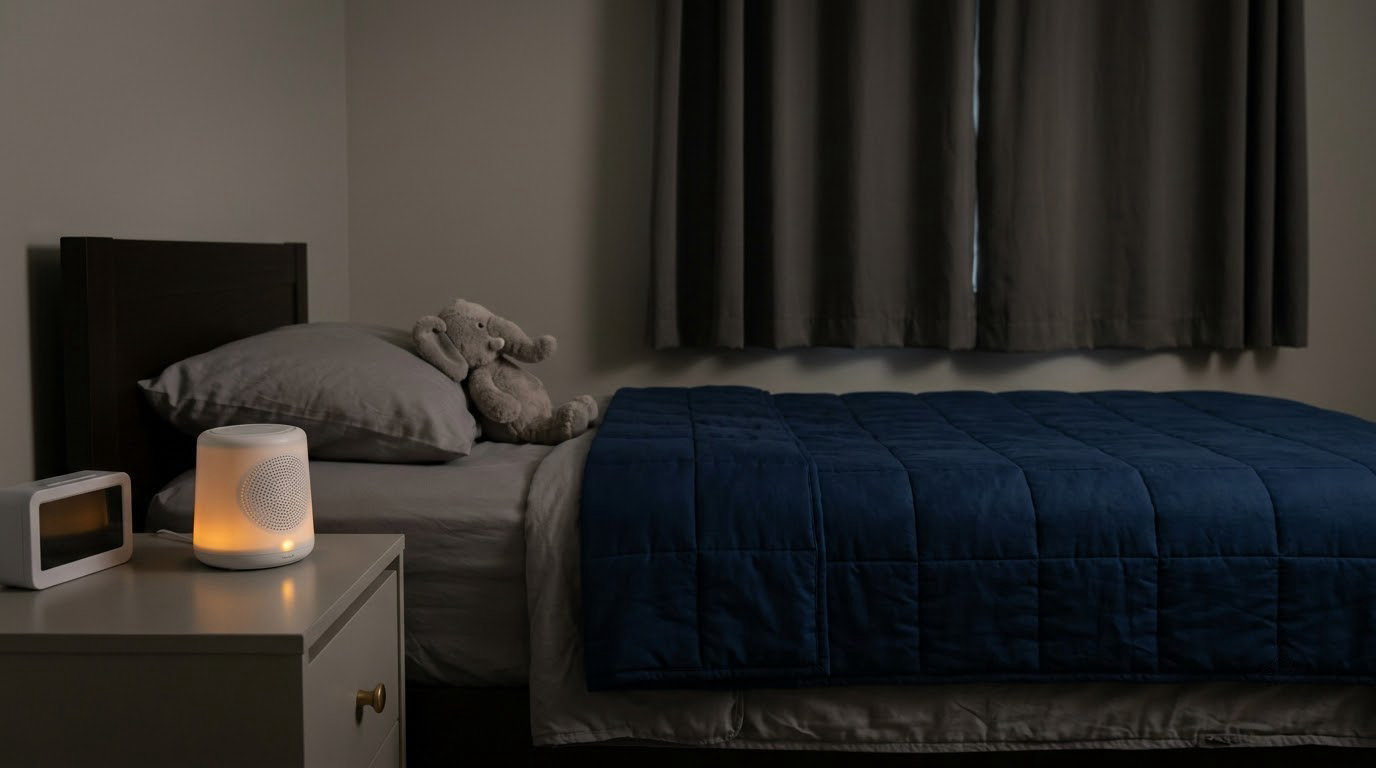
Learning how to help an autistic child sleep through the night comes down to two things: a bedtime routine your child can predict every single evening, and a sleep environment that works with their sensory needs instead of against them. Most families see the first small improvement within a week and steadier nights somewhere between three and six weeks, once the routine has settled.
That timeline matters, because the hardest part of this is not the strategy. It is the weeks of doing the same unremarkable thing over and over while your child fights every step of it. Nobody warns you that a routine which looks effortless to an adult can take a month to become automatic for a nervous system that reads unpredictability as a threat.
Around two-thirds of autistic children experience sleep difficulties, and that figure has been repeated for years by organisations including Autism Speaks and the National Autistic Society. The reasons stack: many autistic children do not pick up the unwritten social cues that signal bedtime for other children, sensory discomfort or a noisy body clock keeps them switched on after lights out, and some carry co-occurring ADHD or anxiety that makes the transition from activity to rest genuinely hard.
If you want the short version while you read the rest, these are the five moves that carry most of the result:
- Pick one wake time and one bedtime. Hold both every day, including weekends.
- Run the same wind-down sequence nightly, in the same order, for 30 to 60 minutes.
- Cut screens off 60 to 90 minutes before bed and cap daytime naps near 60 minutes.
- Make the bedroom dark, cool and quiet, and keep comfort objects unless they cause harm.
- Respond to night waking with the same short, calm response every single time.
Table of Contents
- What You Need
- Step-by-Step
- 1. Build a Predictable Bedtime Routine
- 2. Keep the Same Schedule Every Day
- 3. Make the Bedroom Calm and Sleep-Friendly
- 4. Use Clear Sleep Cues the Child Understands
- 5. Practice Falling Asleep Without a Caregiver Present
- 6. Respond Calmly to Nighttime Waking
- 7. Track Changes and Adjust Slowly
- 8. Know When Sleep Problems Need Medical Help
- Common Mistakes
- Frequently Asked Questions
- Start With One Week of Consistency
What You Need
You do not need a special room, a particular budget or a stack of gadgets. You need five things, and four of them are free.
- A fixed wake time. Choose the time your child has to be up, and protect it hardest. Everything else in the plan hangs off the morning.
- A bedtime window of 30 to 60 minutes before your child’s actual sleep time, for the wind-down.
- A visual or written schedule showing the bedtime steps. This can be a picture strip, a first-then board or a laminated checklist on the door.
- A sleep space tuned to sensory needs rather than to what a showroom thinks a bedroom should look like.
- A simple sleep log, even three columns on paper. Without it you are guessing whether anything is changing.
White noise, a weighted blanket or a nightlight can help, but only if your child’s pediatrician is comfortable with them. Weighted items in particular carry real safety guidance about fit, weight and supervised use, and that is a conversation to have, not something to buy on a Tuesday evening.
Step-by-Step
1. Build a Predictable Bedtime Routine
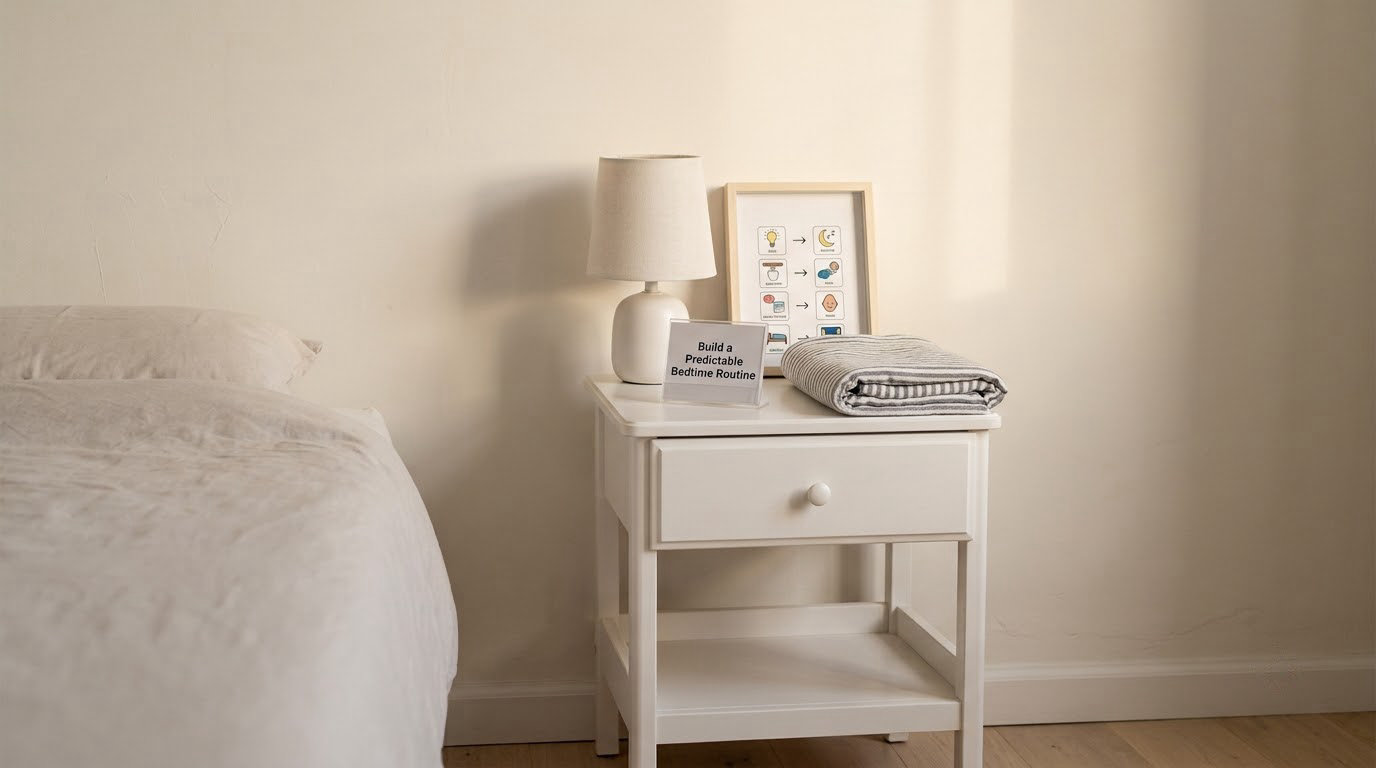
Consistency is the whole engine here. Choose a sequence that fits your family, then repeat the exact same order every night for as long as it takes.
A workable version runs like this: dim the lights, bath or wash, pyjamas, teeth, a book or a quiet audio story, then a clear cue that sleep is next. Keep each step short and predictable. If bath time is loud and aversive, move it earlier in the day and let reading take its place at bedtime.
You know it is working when the resistance drops. The same picture appears in your head each night: the bath gets faster without a fight, the book request arrives earlier, and the standing at the door gets shorter.
2. Keep the Same Schedule Every Day
The same schedule every day means the same wake time, roughly the same nap pattern, similar meal times and a bedtime that shifts by no more than about an hour. A stable body clock is built from repetition of light, food and sleep timing, not from how well the evening went.
Morning light matters more than most parents expect. Opening the curtains and blinds straight after waking, even in winter, helps set the clock that governs sleepiness at 8pm. Several parents in the Glowing community describe the same combination that helps their child: open blinds during the day, shutters and thick blackout curtains at night.
Unavoidable exceptions happen. A sibling needs help, someone is ill, a sports match runs late. Handle them the way you handle a broken window, calmly and without drama, then return to the schedule the next night. What damages the routine is not the single late night. It is deciding that the next night has to be different too.
3. Make the Bedroom Calm and Sleep-Friendly
This is where most gains are hiding. Work through darkness, noise, temperature, scent, clutter and texture one at a time, and change one thing each week so you know what helped.
On darkness, blackouts are the fix most often named by parents on r/Autism_Parenting and in the National Autistic Society community. If total darkness triggers fear rather than calm, a dimmable or colour-changing nightlight can work better than either extreme, which is what one parent on the National Autistic Society community forum found when a fully dark room sent their son back into the day.
On noise, a fan or a white noise machine is cheap, widely used and often enough on its own. It also masks the household sounds that wake a light sleeper, so a child who sleeps through an empty house can still wake in a busy one.
On comfort, do not remove a stuffed animal, blanket or dummy that helps your child feel safe, unless a professional has advised otherwise. Many parents on r/Autism_Parenting let their child have toys in the bed, because the goal is a bed the child can relax in, not a bed that meets an adult standard of tidiness.
On temperature, autistic children often run warm or cold and notice the difference more sharply. Keep the room cool, and make sure bedding matches what they actually chose rather than what matches the set.
4. Use Clear Sleep Cues the Child Understands
A verbal “it is bedtime now” carries almost no information if the child does not read social cues. Replace it with something explicit and visible.
Options that work in real homes include a picture schedule of the evening steps, a first-then board showing one more activity before the final one, a social story written in plain first-person language, or a checklist the child can tick themselves. For non-verbal children, a physical sequence works well: the same song, the same pyjama fabric, the same order, repeated until the sequence itself carries the meaning.
One popular hack from r/Autism_Parenting is a sleep timer on the television so the child can see and hear when it is about to end. It turns an arbitrary cutoff into something predictable and countable.
5. Practice Falling Asleep Without a Caregiver Present
Wherever your child currently falls asleep is where you have to work, because that becomes the new normal. If sleep only happens on a parent, the fix is a slow fade, not a cliff.
A three-stage plan keeps it manageable. In the first stage, keep the routine identical but sit in the room, quiet and still, until your child sleeps, then leave. In the second stage, sit outside the bedroom door, in sight or sound. In the third, move further away each few nights until you are only checking the room.
Move up one stage only after three or four settled nights. Going backwards is normal and does not mean you have broken something. If a stage is clearly distressed for your child, pause and talk to their pediatrician or team before advancing.
For non-verbal children, the same plan works, and you can add a simple check-in card or a picture signal they can use to call you back instead of crying. Giving them a way to ask for you often reduces the number of times they need to.
6. Respond Calmly to Nighttime Waking
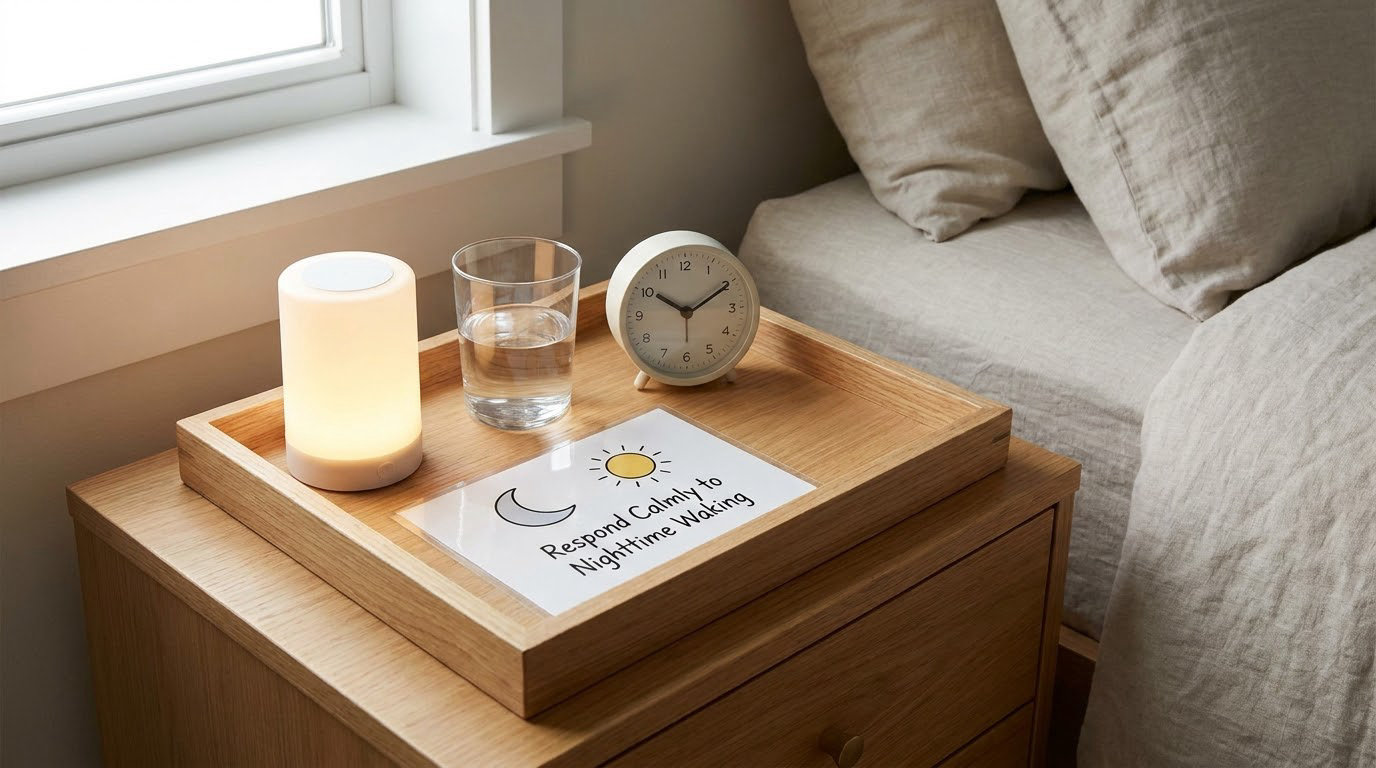
The morning is usually the easier half of the problem. A child who wakes at night and stays awake for hours is the loudest complaint across parent forums, and it needs its own response.
Keep it short, dim and undramatic. Say one line, such as “it is still night time, sleep is next”, guide your child back to bed, and leave. No chat, no lights on beyond a nightlight, no snacks unless you have already decided that is part of the routine for every night, not just the nights it is needed.
Redirect and reinforce is the phrase behaviour analysts use for this, and it works because the response never varies. A child who gets a warm, engaged parent at 3am has learned that 3am is when the good stuff happens.
Some families find this hard, and some nights involve a hundred repetitions. That is the honest reality of it. Consistency matters more than your reaction being perfect, and asking for support from a partner, grandparent or respite provider on the worst nights protects the plan better than white-knuckling it alone.
7. Track Changes and Adjust Slowly
Write down the bedtime, the estimated time to fall asleep, the number of awakenings, the final wake time, any nap, and anything unusual that day. Six columns on paper or a notes app is plenty.
Judge progress over one to two weeks, never single nights. Week one often looks worse before it looks better, because your child is protesting the change. Week two is usually where settle time shortens. Week four is where most families can tell whether the plan is working at all.
If nothing has shifted after three weeks, look first at what changed. A nap that crept longer, a screen cut-off that moved, a comfort object that disappeared, or a stage you advanced too fast are all more likely than a fundamentally wrong routine.
8. Know When Sleep Problems Need Medical Help
Some sleep problems are not routine problems, and these are the signs that warrant a call to your pediatrician rather than another week of consistency.
- Loud, persistent snoring, pauses in breathing, or a child who sleeps with their mouth open and looks tired all day
- Pain, ear infections, reflux or stomach trouble that wakes them, including unexplained distress in a non-verbal child
- Seizures or episodes in the night that you have not had explained
- Very limited sleep overall, or sleep loss severe enough to affect safety during the day
- Extreme resistance to sleep that lasts much longer than the first couple of weeks of your plan
- Daytime impairment that is affecting school, behaviour or the safety of the child or others
Snoring and suspected sleep apnea deserve particular attention in autistic children, because signs of sleepiness and difficulty settling can be read as behavioural rather than medical. An overnight sleep study is the standard way to look into it.
This article does not recommend melatonin, magnesium or any other supplement. Parents on r/Autism_Parenting report melatonin helped their children fall asleep and that some tapered it once a routine was established, but that is a conversation to have with your child’s doctor, who will weigh timing, dose, side effects and the child’s own history. The same goes for anything sedating. Never add a supplement on the strength of a forum post, including this one.
Common Mistakes
Most of the hard nights trace back to one of six avoidable moves. Knowing how to help an autistic child sleep through the night is mostly about which ones you stop doing.
Changing five things at once. You will not know which one worked. Fix one variable, hold it for a week, then add the next. Your sleep log exists for exactly this reason.
Waiting for the child to be exhausted. A wired nervous system does not calm down from tiredness. It escalates. The build of the day has to do that work, not the last hour of it.
Rewarding a long bedtime battle. Every extra minute of negotiation trains another ten. The routine holds even on the nights you wish it would not, or it teaches your child that persistence pays.
Making bedtime contingent on compliance. “Two more stories” or “one more toy” delays sleep tonight and makes tomorrow’s fight easier to start. Keep the number of steps fixed and the choices inside them.
Removing comfort objects abruptly. A stuffed animal or blanket that has been a sleep anchor for years is not a bad habit you can delete in a night. Tapering it while you strengthen the routine is far easier than removing it first.
Adding a supplement without medical advice. Parents describe both melatonin helping with falling asleep and magnesium helping with staying asleep. Both belong in a conversation with your pediatrician, not in a shopping basket.
A few things keep the plan alive once it works. Travel, sleepovers, holidays and illness all break the routine, so decide in advance which two anchors you keep no matter what. For most families those are the wake time and the wind-down order.
Protect the morning light and the evening screen cut-off first. Change the routine around a growing child’s needs rather than defending a fixed bedtime; teenagers usually need later bedtimes and a reduced sequence, not the same five steps forever.
Finally, look after the adult. Caregivers sleeping four or five hours a night for months will not hold any plan together, and asking for a night off, a sitter or a flexible arrangement is a legitimate part of the strategy rather than an admission of failure.
Frequently Asked Questions
How long does it take to help an autistic child sleep through the night?
Most families see the first improvement within seven to ten days, such as a shorter time to fall asleep or one fewer night waking. Steadier nights usually arrive between three and six weeks, once the sequence is genuinely automatic. Week one is often harder than week zero while your child protests the change, and progress often looks uneven. Judge the plan over two weeks of sleep log entries rather than single nights, and change only one thing at a time so you know what is working.
Can an autistic child take melatonin to improve sleep?
Some children do benefit from it, and it is one of the more commonly discussed options for autistic children with sleep difficulties, but it is a medical decision rather than a routine fix. Discuss timing, dose, side effects and your child’s history with their pediatrician before starting anything. Parents on parenting forums report it helped with falling asleep and that some tapered it later, once a routine was established. Never start or change a supplement without medical guidance.
How many hours of sleep does an autistic child need?
Sleep needs vary by age, and autistic children are not reliably different from other children in how many hours they require, though getting enough is often harder for them. As a rough guide, most children aged 3 to 5 need 10 to 13 hours including naps, school-age children 9 to 12 hours, and teenagers 8 to 10 hours. Persistent snoring, unusual breathing or unrefreshing sleep are reasons to ask for an assessment rather than to assume the child simply needs more.
Should I stop naps to help my autistic child sleep at night?
Afternoon naps often cause the problem rather than solving it, and many parents report that capping naps improved bedtime considerably. Keep naps for younger children who genuinely need them, but hold them to the morning or early afternoon and cap them near 60 minutes. Move naps later and later by small steps over several days so the change is gradual, and expect a few rough nights while the body clock shifts.
When should I ask a doctor about my child’s sleep problems?
Ask your pediatrician rather than continuing to troubleshoot alone when you notice loud or persistent snoring, pauses in breathing, pain or reflux waking your child, unexplained night-time episodes, or sleep loss that affects daytime safety, school or behaviour. A markedly limited amount of sleep is also worth raising, along with resistance to sleep that has not improved after a few weeks of a consistent routine. Your doctor can also refer you to a sleep specialist and discuss whether a sleep study would help.
Start With One Week of Consistency
If you take one action tonight, make it this: choose one wake time and one short bedtime sequence, write them down somewhere you will see them, and repeat them unchanged for seven days. Nothing else changes. Not the bedroom, not the naps, not the supplements.
A week of identical evenings gives you something no amount of guessing ever did, which is real information about what your child needs. Hold patience, safety and individual fit above any schedule you read online, including this one, and take your questions about medication, breathing or persistent pain to your pediatrician. That is how to help an autistic child sleep through the night, one predictable night at a time in 2026.