
It is 5:40 on a Wednesday, the supermarket checkout queue is slow, your child is stimming and echolalia-ing at the self-checkout screen, and a woman two aisles over has stopped to watch. Somebody at the front of the queue will turn around. That is the moment most parents of a disabled child dread, and knowing how to handle stares and comments in public with a disabled child is less about finding the perfect sentence than about deciding, before you are standing in that aisle, which moments you answer and which ones you do not.
Here is the honest version: most public attention is curiosity or plain inattention, not cruelty, and most of it needs nothing from you at all. The smaller set of situations that becomes a direct question, a pointed comment, or mockery needs one short prepared sentence and a decided way out. Both of those take under an hour to plan once.
This guide walks through what to bring, six repeatable steps for the moment itself, and what to do in the parking lot afterward. Nothing here asks your child to hide, perform, or apologize for existing in a shop.
Table of Contents
- What You Need
- Step-by-Step: How to Handle Stares and Comments in Public With a Disabled Child
- Common Mistakes
- Frequently Asked Questions
- Why do kids stare at people with disabilities?
- How do parents of disabled children feel about public stares?
- What should I do if someone says something ableist to my child?
- Should I make my child stop stimming or apologize in public?
- How do I handle a public meltdown while people are already staring?
- Is it rude to just ignore someone who stares?
- A Calm Plan for the Next Outing
What You Need
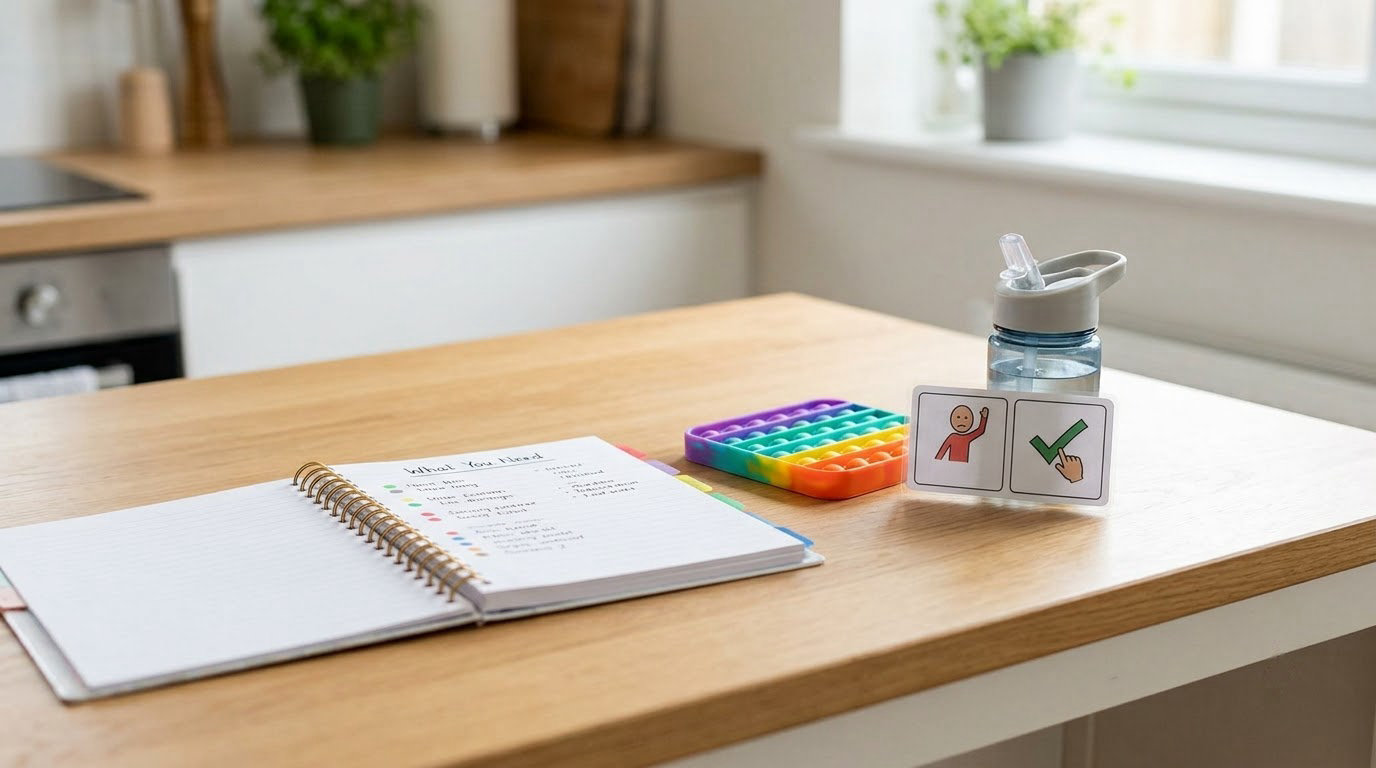
You need five things, and four of them fit in a single backpack pocket. The first is two or three short response sentences, written down and rehearsed out loud until they feel boring. The second is a sensory item that works: noise-reducing headphones, a fidget, a weighted blanket folded in a bag, or whatever your child’s team has already said helps.
The third is a visual or written cue, which can be as simple as a printed card that says he is autistic and not speaking today, or a phone note with the same wording. Families split sharply on this one, and that is fine. Some parents find it prevents the same conversation every week; others feel it advertises a diagnosis without the child’s consent. Try it, skip it, keep it.
The fourth is a support person, named in advance, who knows where you are and can step in with your child while you handle the interaction. It can be a partner, a grandparent, a trusted friend. The fifth is an exit plan, decided when you are calm: which door, which aisle, how long you can stay before you leave. Write it down too.
Bring your child’s own team into this. A BCBA, occupational therapist, or speech-language pathologist can tell you which behaviors are worth shaping for public settings and which are self-regulation that should be left alone, and they can write the specific social script for your child rather than a generic one.
Step-by-Step: How to Handle Stares and Comments in Public With a Disabled Child
1. Take a calm moment to assess the situation
Sort the attention into three buckets in the first five seconds, because the bucket decides what you do. Bucket one is a glance that passes by: a person looks, registers something unfamiliar, and moves on. This needs no response and none of your attention.
Bucket two is a question or a comment directed at you. This one gets one prepared sentence and then a move. Bucket three is mockery, repeated gawking, or anything that puts your child at risk, and it gets the exit plan plus, if it continues, a venue employee or staff member.
Ask yourself one more question: does my child need me right now, or are they fine? A child mid-meltdown cannot absorb you dealing with a stranger, and the answer to that is almost always the child. Most parents have it backwards out of politeness, and then spend the rest of the walk to the car apologizing to the wrong person.
2. Prepare a short response before you need it
Good scripts are neutral, boring, and impossible to argue with. Try: “My child has autism and is not speaking.” Or: “He is autistic, thank you for asking.” Or the shortest one that works: “Please do not stare.” If someone presses for a diagnosis, diagnosis details, or a prognosis, “That is private” ends the conversation without lying.
You do not owe a stranger your child’s chart. You are not obliged to explain, educate, or reassure, and a public aisle is genuinely the worst possible place to have a debate about whether a behavior is acceptable. A stranger who is curious deserves a sentence. A stranger who is arguing deserves nothing.
Keep sentences under fifteen words. Long answers give a follow-up question, and follow-up questions in a supermarket are how a two-minute errand turns into a forty-minute ordeal.
3. Redirect your child and reduce stimulation
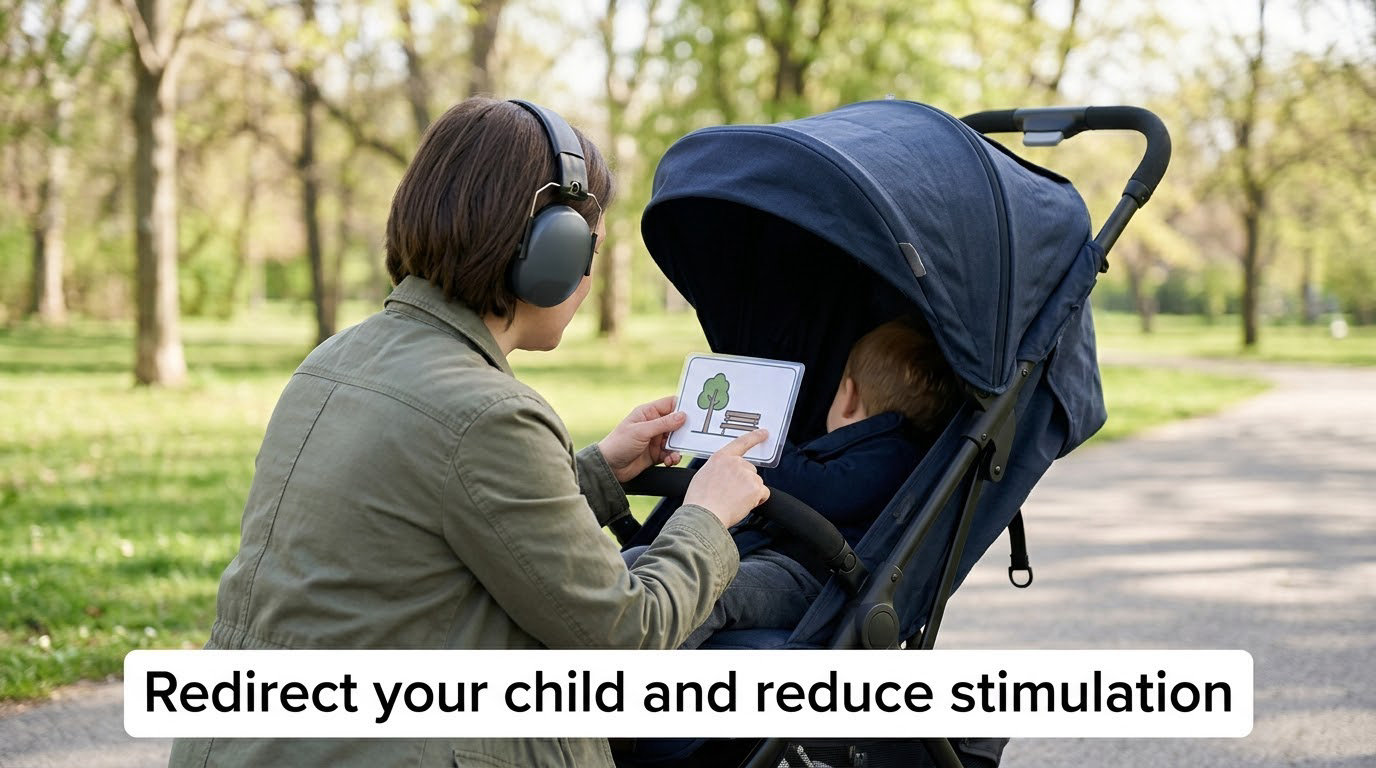
Stimulation is compounding. If your child is already loud in a noisy shop, attention from strangers is not the main event, it is the last straw on a stack that was already too tall. Lower it wherever you can: move to a quieter end of the aisle, step outside, go to the far wall, hand over the headphones, offer the fidget, change the activity.
Say something true and boring. “It is loud in here, that is a lot of noise.” Or point at your printed card and say “this is what the noise is about.” Do not say you are sorry your child is like this, and do not explain the stares to your child as though the child caused them, because the child did not and the words will land as though they did.
Co-regulation is the part nobody mentions. Your face is a signal your child reads faster than any sentence, so if your jaw is tight and you are scanning the room for the next watcher, step out of earshot and breathe for ten seconds before you walk back in. You are allowed to need a moment.
4. Set a boundary without starting a prolonged argument
To end a comment: “We are not going to discuss that,” then turn your body. To end repeated staring: move, because a person who has been looked at from six feet away for ninety seconds will read movement as dismissal even though it is just you going to the milk aisle. To involve staff: go to the counter and say, quietly and to the staff member only, “there is a person who has been saying things about my child, could you help me.” You are not making a scene, you are asking for assistance.
If your child is verbally able and wants to answer for themselves, back them. Kids who get to use their own words about their own disability tend to use them better the second time. If they are not verbal, you are their voice, and that is a job, not a failure.
Judgment from another parent lands harder than judgment from a stranger, because it implies you are failing. The same one-sentence rule applies, and you are allowed to feel the sting and still walk away without it.
5. Support your child after the interaction
Defer the debrief to the car. In the checkout line or the middle of a restaurant, the child is still mid-experience and will answer you from their own nervous system, not from memory. In the car, with the doors shut and nothing scheduled for five minutes, ask something open and low-stakes: “Was that okay?” or “What was the loudest part?”
Do not demand an explanation or a lesson. “Do you understand why that was rude” is a question most children cannot answer in that state, and it usually teaches them to hide reactions from you rather than share them. Instead, reflect it back: “You were having a hard time and people were watching. That is uncomfortable. It is not something you did wrong.”
Then a predictable recovery. Snack, music, a talk about something with no stakes in it, and the outing is over. If the same scenario keeps repeating, this is a good week to bring the debrief to your child’s team as data rather than as a problem.
6. Build a support system for public outings
Practice at home before you need it in public. Role-play the checkout queue with a sibling or a friend playing the watcher, and let your child practise the one line that works for them. Repetition is the mechanism here: parents who describe going out more often, not less, report that the anxiety decays for both the child and the adult, because the whole thing stops being new.
Name your second adult in advance, and tell them what job they have. “You take the trolley and the headphones, I handle questions” prevents the panic of two people improvising the same moment.
Know who to call. A local disability organization or a parent-led group can help you file a complaint about a business, and they will have done it before. If the problem is the venue rather than the stranger, the fix is an access request, not a confrontation.
Remember the rule of engagement: you are trying to make ordinary life ordinary again, not to change every mind you walk past. The plan for how to handle stares and comments in public with a disabled child works when it is boring and repeatable, and that means most days you will use about ten words.
Common Mistakes
Overexplaining. The instinct to defend your child to everyone is strong, and it is the mistake that costs the most time. A fifty-word answer becomes a conversation, and the conversation happens where nobody has a say in it. Fix: one sentence, then move.
Sarcasm or a comeback. “Good to know staring is your hobby” gives a stranger an invitation to escalate while your child watches. Fix: the flat, boring sentence. It takes the oxygen out of the moment and protects everyone.
Trying to make your child explain or apologize. A child who is stimming, overloaded, or overloaded on top of being watched is not in a state to perform a social script. Fix: nothing is required of your child, and that message is the one that matters long term.
Promising it will stop. It will not stop, and telling a child it will sets them up to believe they are failing every time someone looks. Fix: name it accurately. “People sometimes stare because it is unfamiliar. That is about them, not about you.”
Blaming your child or yourself afterward. Sitting in the car deciding whether it was the stimming, the noise, the bad day, or you is a loop with no exit. Fix: the attention belonged to an adult, and so did the handling of it. That is the whole adult job, done.
Trying to win. The goal of handling stares and comments in public with a disabled child is a safe trip home, not a stranger’s education. You will not convert anyone in an aisle, and you do not need to.
Frequently Asked Questions
Why do kids stare at people with disabilities?
Most staring is curiosity, not cruelty. A child sees something unfamiliar, a wheelchair, hand flapping, a person not speaking, a difference in appearance or movement, and looks because the difference is new to them. Adults stare for the same reason, plus a layer of social awkwardness about not knowing whether it is rude to look. That is why treating a glance as an attack usually backfires: most glances are just people noticing, and they end on their own.
How do parents of disabled children feel about public stares?
Most describe a specific mix of shame, grief, anger, and hypervigilance. You start scanning a room before you walk in, you rehearse explanations you never give, and you take a stranger’s glance personally because it lands on your child. On top of that sits a feeling of being judged as a parent, which hurts more than the stare itself. None of that is a character flaw. It is what repeated public exposure to judgment does to a person.
What should I do if someone says something ableist to my child?
Use one short sentence, then disengage. Something like we are not going to discuss that, or please do not comment on my child, works because it sets a limit without opening a debate. If it continues or becomes threatening, involve a venue employee or staff member and ask quietly for their help. If it is discriminatory rather than rude, write down what was said, when, and where while you remember it, and contact a disability organization about reporting it.
Should I make my child stop stimming or apologize in public?
Ask your child’s BCBA, OT, or speech-language pathologist before shaping anything, because stimming is often self-regulation and suppressing it can raise anxiety rather than lower it. Some behaviors are worth teaching in public settings, and some are not, and only someone who knows your child can tell the difference. Your child never owes an apology for a disability behavior. What you can absolutely expect is a short, calm response from you, prepared in advance.
How do I handle a public meltdown while people are already staring?
Triage the child, not the audience. Get to the lowest-stimulus spot you can reach, use the supports that already work, and treat the staring as background noise rather than a task. If the setting is genuinely part of what caused the overload, that is an accommodation failure, and it is worth naming to staff afterwards. Once you are home, debrief in the car, reflect the feeling back without demanding an explanation, and let the recovery be predictable.
Is it rude to just ignore someone who stares?
No, and it is often the correct call. A glance needs nothing from you. A question gets one short answer. An argument, mockery, or a person who will not stop gets your back turned, staff involvement, or an exit. You are allowed to end an interaction without explaining yourself, and you do not have to educate a stranger to justify your child being in a shop.
A Calm Plan for the Next Outing
Before the next trip out, do four small things. Pick one boundary and write it down. Rehearse one sentence, your child’s own words if they have them, until you can say it while unpacking the trolley. Pack the single sensory item that works best. Decide where the exit is before you walk in.
That is the whole plan. Most days, knowing how to handle stares and comments in public with a disabled child comes down to a ten-word sentence you have said a hundred times and a walk out that you chose in advance, which is a very different thing from being chased out by a stranger’s opinion. Updated for 2026, and worth re-reading when the next hard outing is over.