
Handling school refusal in an autistic child starts with one reframe: they are not refusing, they are struggling. If you are wondering how to handle school refusal in an autistic child, the answer is rarely a firmer hand at the door. What looks like defiance at the school gate is usually a response to something the adults around them have not spotted yet, and it usually shifts once that something changes. Below is a calm, staged plan you can start this week, whether your child is four or fifteen, speaking or non-speaking, diagnosed or still waiting.
This is educational guidance, not a clinical assessment. If your child is showing signs of pain, illness or a mental health crisis, that is a conversation for your doctor or a qualified professional, not something to work through at the school gate.
I have talked to a lot of parents who assumed they were the problem. Almost none of them were. The pattern behind most school refusal in autistic children is environmental, and the job for you is to find the environment, not to win the argument at the door. Everything below was last checked in 2026, and the school-level rules referenced here change, so check your own district or local authority guidance too.
Table of Contents
- What You Need
- Step-by-Step
- Step 7: Review Progress and Adjust the Plan
- Common Mistakes
- Frequently Asked Questions
- Is school refusal in an autistic child always caused by autism?
- How can I help my child feel less anxious about going to school?
- Should I force my autistic child to attend school when they refuse?
- How can I communicate school refusal concerns to teachers?
- When should a parent involve the school counselor, special education team, or doctor?
- Can school refusal be a sign of bullying or sensory overload?
- A Calm First Step When School Refusal Happens
What You Need
You do not need a diagnosis, a label for the behaviour, or a fight with the school before you start. You need five things, and gathering them usually takes an evening.
- The current routine, written out. Wake-up, breakfast, leaving the house, arrival time, what happens at the door. If you can photograph the front door on a normal morning, that tells you more than an hour of talking.
- A list of known triggers. Noise, crowds, a specific room, a specific adult, transitions, uniforms, toilets, being asked to do something in front of other people.
- How your child communicates no. Words, AAC device, sign, picture cards, written notes, bolting, going quiet, hitting out. Write down which one they reach for first.
- Relevant school records. Any support plan, education, health and care plan (EHCP) or equivalent, past behaviour notes, medical letters, and dates things changed.
- A short list of supportive contacts. Class teacher, SENDCo or special education coordinator, school counselor, pastoral lead, and your pediatrician or family doctor.
Keep it in one place, a notebook or a single note on your phone. When the school asks what you have tried, you will want facts rather than a memory under stress.
Step-by-Step
Seven steps, ordered lowest effort first. The early ones cost you an evening of writing things down. The later ones need a meeting, a plan and patience. Do them in order.
Step 1: Identify What the Refusal Means
School refusal in an autistic child usually means the environment has become more expensive than the child can pay, and the body opts out. The definition in the research is not consistent. A 2026 scoping review by Van der Werff, Bullen and Sharp, published in the Review Journal of Autism and Developmental Disorders, found definitions ranging from a single request to stay home to more than 30 days of absence per year.
So the day count tells you very little. What the same review did land on was bullying as the only variable that consistently reached statistical significance in the quantitative studies it examined, and it reframed avoidance as an act of self-advocacy rather than pathology. That is worth sitting with before you walk into any meeting.
Three different situations get filed under the same word, and each needs a different response:
- School refusal is a pattern driven by something in the environment that the child cannot tolerate or escape. The trigger is out there, and finding it is the work.
- School distress is what the child experiences internally: anxiety, shutdown, meltdown, physical symptoms, sometimes stomach aches that clear on a Friday afternoon. Emotionally based school avoidance, often called EBSNA, is the clinical term clinicians use.
- School can’t is a specific barrier: one member of staff, one room, one set of stairs, one activity. Narrow, fixable, and often the fastest win of all three.
Your child does not have to fit neatly into one of them. Plenty of children have a mix, and a mix changes each year.
Step 2: Ask Open-Ended Questions and Observe Patterns
Keep a diary of hard days for two to three weeks. Columns: date, what happened the day before, how the morning went, where it broke down, what helped, what school said. Three weeks is usually enough to see the shape.
Parents who do this consistently find the same kinds of thing. A particular class. A particular break time. A particular member of staff. A PE lesson or a loud assembly. Often the pattern is not the school at all but the hour after lunch.
Ask questions that do not demand an answer. What part of school feels hardest? What would you change first? What do you need before you can start? Then stop talking, because the useful information usually arrives about two days later, in a throwaway sentence.
For non-speaking or minimally verbal children, you are not without data. Watch the body: hand over ears, flinching at a sound, refusing to enter a room, distress that peaks at a predictable time, a change in sleep or appetite, and the school staff’s own notes about the same moments. School staff often see things they have never been asked to write down.
Step 3: Contact the School Team Collaboratively
Write to the teacher and the SENDCo, and copy the head teacher or pastoral lead if you can. Put it in writing rather than trying to hold the whole conversation at a gate handover, because written requests get answered and drop-off conversations do not.
Lead with facts, not conclusions. On Tuesday and Thursday mornings my child has not been able to enter the building since the change in break times on the ninth. Staff report distress at the same point each day. Here is what helped last week.
Then ask for specific supports rather than a general plea for help. Reasonable adjustments are things schools already have a duty to consider, and naming them makes the conversation concrete.
- A different entry point, so the child is not handed over in front of a crowd.
- A named key adult who meets them at reception every morning, or a place to sit quietly for ten minutes first.
- A predictable schedule with advance warning of every change and transition.
- A sensory break or quiet space the child can use without asking permission each time.
- A phased return on a part-time timetable if full days are not currently possible.
- Staff awareness of the trigger, plus a plan for what happens when it appears.
A note on jurisdiction, because the words change across borders. In the UK, the special educational needs and disabilities (SEND) framework and an EHCP set out the support a child is entitled to, and the National Autistic Society publishes specific guidance on school attendance. In the US, the equivalent is an IEP under IDEA, or a 504 plan, and attendance concerns route through the local attendance or truancy process rather than a local authority. Ask which framework applies to you before you quote any rule at anyone.
Step 4: Make the Morning and Return Easier
Attack the logistics before the behaviour. Most mornings are lost to avoidable friction: a uniform decision, a breakfast nobody could face, a rushed goodbye, an unannounced change of plan.
Choose clothes the night before and put them on the door. Serve the same predictable breakfast, or reduce it to what the child will reliably manage. Leave early enough that nobody is running. Agree a short goodbye in advance, keep it identical every day, and do not add a surprise demand at the door such as a question about homework or a rushed hug.
Use the six second rule. It comes from the work of Kym Verspuygen and is now widely used by autistic families: when you see the first sign of distress, you have roughly six seconds before full dysregulation takes over. Get in early, say the same short thing, hand over to the key adult, and leave. Do not negotiate, do not explain the whole situation, do not linger. Six seconds is enough if the script is the same every morning.
Then protect the afternoon and the evening. Autistic children often hold everything in during the school day and release it at home, so the evening meltdown you are seeing is a delayed consequence of yesterday, not a new problem. Decompression time before any homework, a low-demand evening, and no homework battles until the regulatory capacity is back. If your child refuses homework too, treat it as a capacity problem rather than a compliance one and agree reduced or delayed work with the school in writing.
Step 5: Create a Small, Predictable School Re-entry Plan
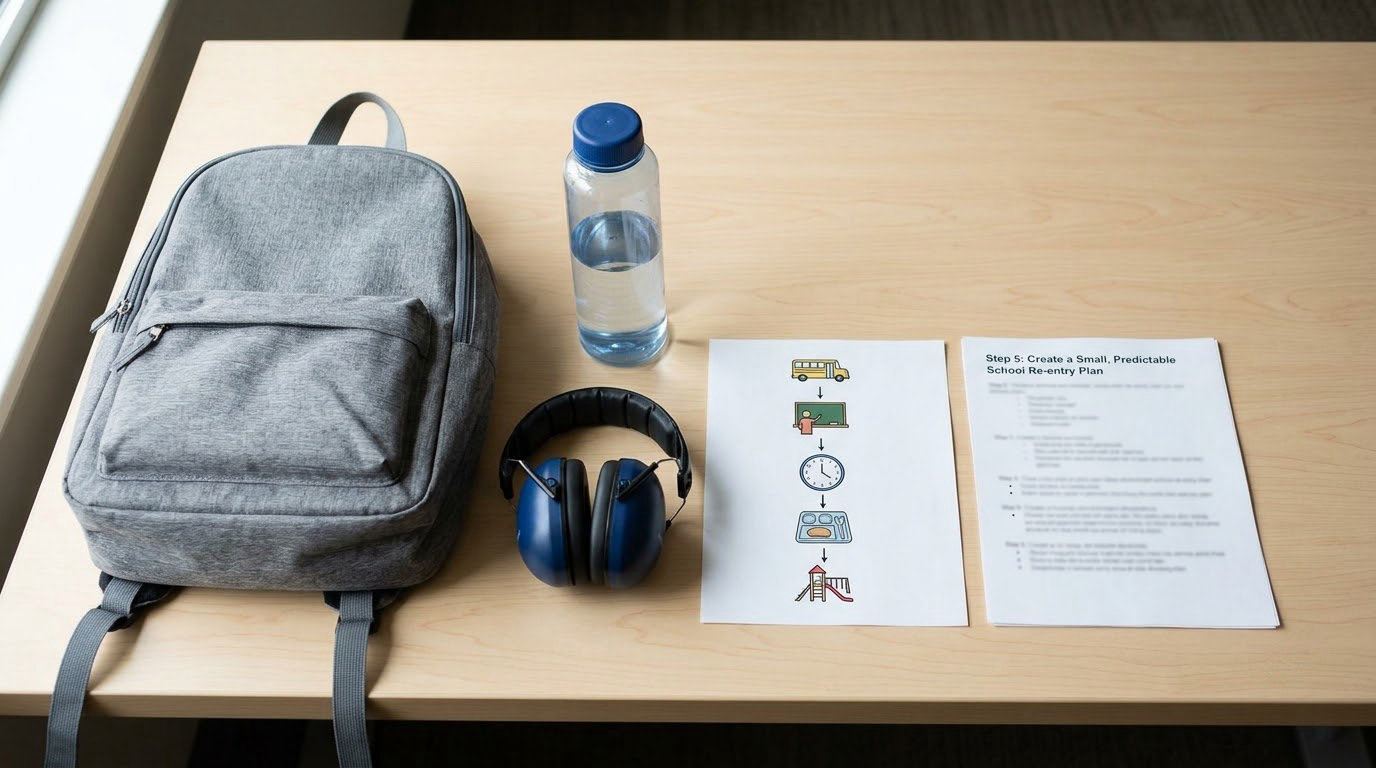
If the child is currently not attending, going back on a full timetable rarely works. Start smaller than feels useful. A phased return is a standard and legitimate adjustment, not a soft option and not a failure.
Pick one small goal. Arrive at the building and come home again. Enter through the quieter door and sit in the corridor for ten minutes with the key adult. Attend one preferred class. Each stage has a clear starting point, a defined break point and a simple definition of success.
Write it down, keep the copy at home, share it with the school, and review it every two weeks. If the stage holds for a fortnight without the morning collapsing, move up. If it does not hold, go back a step rather than forward, and change one thing at a time so you know what made the difference.
Step 6: Teach the Child a Way to Ask for Help
Most refusal at the door is not a failure of will. It is a child with no available way to say I need this to change. Give them one, in whatever system they already use.
Build a small help request around words, an AAC device, sign, picture cards, a written choice board or a break card the child can hand to an adult without speaking. Keep it to three or four options: too loud, too bright, break, help. Practise it at home in calm moments, and practise what an adult should do when it appears, so staff respond the same way every time.
Rehearse the dismissal too. A child who knows exactly how the day ends, who is waiting at the gate and what happens in the first ten minutes back home has something to hold on to during the hardest part of the morning.
Step 7: Review Progress and Adjust the Plan
Track small wins rather than attendance percentages. Getting through the door, staying for one break, having a good fifteen minutes in one lesson, no morning meltdown. These are the real indicators, and they move before the register does.
Note distress going up or down on a simple scale, and check in with your child when you can without turning the conversation into an interrogation. Two minutes before school is the wrong moment; a calm moment at the weekend is the right one.
Revise the written plan with the school team every four to six weeks. Support that worked in September often fails in January, because the year group, the timetable and the staff all change.
If an attendance warning letter arrives, read it once for what it is. Many are system-generated from attendance data rather than a personal judgement from a teacher about your child or your parenting. Respond in writing, keep a copy of everything you send and everything you receive, and deal with the process separately from the distress.
Look after yourself too. School refusal is relentless, and carer burnout is a real and predictable consequence. If you are sleeping badly and dreading the morning more than your child is, tell your doctor. That is not a weakness, it is the same environmental response happening in a different adult.
Common Mistakes
Treating refusal as defiance. Consequences teach a child that school is a place where they get in trouble for struggling. Replace the consequence with a change to the environment that caused the struggle.
Forcing physical compliance. Getting a child through the door by force can produce a full day of shutdown or panic, and it does not change what happens tomorrow morning. Gradual, supported and reversible works better over time, even when it is harder in the moment.
Threatening consequences the school will not follow through on. Empty threats teach your child that your words are unreliable. If you say a change will happen, make it happen, or do not say it.
Arguing during escalation. Once the nervous system is flooded, nobody is listening. Use the six second rule, hand over, and hold the conversation for later. The calm version of the same words lands better.
Comparing your child with other families at the gate. You are comparing your child’s insides to someone else’s outsides. Nobody else’s morning looks as bad from the other side of their car window.
Waiting for the school to notice on their own. Autistic children are often quietly compliant in class and fall apart at home, so the school genuinely may not know what you are seeing. Say it in writing.
Waiting it out while attendance consequences escalate. Doing nothing is a decision with consequences attached. A small written plan costs an evening and is easier to defend later than silence.
Frequently Asked Questions
Is school refusal in an autistic child always caused by autism?
No. Autism changes how a child processes sensory input, change and demand, which often makes school harder, but school refusal usually has an environmental trigger on top of that: bullying, a difficult staff member, an overwhelming break time, unmet support needs, or illness. A recent scoping review found bullying was the only factor consistently statistically significant. Treat autism as context, not as the cause, and look for the specific trigger.
How can I help my child feel less anxious about going to school?
Reduce uncertainty before you reduce anxiety. Keep the morning routine identical, warn about every change in advance, use a short and predictable goodbye, and give your child a way to ask for help that does not require speaking. Then reduce the demand itself: a quieter entry point, a key adult at reception, a sensory break, or a part-time timetable. Anxious behaviour usually means the environment is still too hard.
Should I force my autistic child to attend school when they refuse?
Physical force rarely helps. Getting a child through the door without changing anything tends to produce shutdown, panic or aggression and leaves tomorrow exactly as hard as today. Support a gradual, predictable return instead, agreed in writing with the school, including a phased return on a part-time timetable. If you feel forced into a physical decision at the door, contact your doctor or a local support service first.
How can I communicate school refusal concerns to teachers?
Write to the class teacher and the SENDCo rather than trying to hold the conversation at drop-off. Describe what you observe rather than what you assume: dates, times, what the morning looks like, what helped last week. Then name the specific adjustments you want and ask for a written response. Writing things down is what parents report changes how seriously a school takes the problem.
When should a parent involve the school counselor, special education team, or doctor?
Involve them early rather than late, and involve more than one. Bring in the school counselor when there is bullying or anxiety involved, the special education team when support needs are not being met, and your doctor when there are physical symptoms, sleep disruption, weight change or signs of autistic burnout. Any child who cannot get to school most days, or who is distressed beyond what you can manage at home, has earned a professional assessment rather than more patience.
Can school refusal be a sign of bullying or sensory overload?
Both are common, and they can look identical from outside the school gate: distress before arrival, relief once inside a safe space, physical complaints, shutdown or meltdown after school. Bullying was the only factor consistently reaching statistical significance in the quantitative studies in the scoping review by Van der Werff, Bullen and Sharp. Ask the school to record distress-linked lateness and absence separately so the pattern becomes visible.
A Calm First Step When School Refusal Happens
When the morning goes wrong, pause. Lower the demand, get somewhere quiet, and ask yourself one question: what did this child need that they did not get? Then write down what you saw today, note one thing that helped, and send the school one specific request in writing rather than a general cry for help.
That is the whole method. You are not trying to win your child over to the idea of school. You are trying to find the part of school that is costing too much, and change that first.