
How to read an IEP progress report takes about 30 to 45 minutes the first time, and the method is simple: line up every goal in the report against the goal written in your child’s current IEP, check the numbers and dates, then confirm the services were actually delivered. Most parents who find these documents confusing are not missing something obvious. They are reading the report as a grade instead of as a data record, and the two are not the same thing.
This guide walks through a progress report field by field, shows you the seven steps, and gives you the exact questions to ask your case manager when a goal has no numbers attached to it. It is general educational information, not legal advice, so treat it as a way to prepare rather than a substitute for advice about your specific situation.
Table of Contents
- What You Need Before You Start
- How to Read an IEP Progress Report Step by Step
- How to Read an IEP Progress Report From Top to Bottom
- Match Every Goal to Your Child’s Current IEP
- Understand the Data Before the Teacher’s Comments
- Check Whether the Progress and Plan Make Sense
- Confirm That Services and Supports Were Delivered
- Turn Findings Into Follow-Up Actions
- Prepare Questions for the IEP Meeting
- Common Mistakes Parents Make With Progress Reports
- Helpful Tips for Reviewing the Report With Your Child
- Frequently Asked Questions
- What should I do if the progress report is missing an IEP goal?
- Can I request the data or work samples used in my child’s progress report?
- What does it mean if my child made some progress but was not near the annual goal?
- What happens if the report shows that related services or supports were not provided?
- Can a progress report lead to a meeting about changing my child’s IEP?
- What to Do First
What You Need Before You Start
You need four documents side by side, and one notebook. Having them in one place turns a two-hour scavenger hunt into a single sitting.
- The current IEP — the signed version, including all amendments. Progress reports are written against a specific version, and the one in your folder is often out of date.
- The progress report itself, plus the date range it covers.
- Earlier progress reports or the original baseline data from the year the goal was written. A number means almost nothing without the one before it.
- The services page from the IEP — minutes, frequency, location, and provider for each service.
- A notebook or a note-taking app with four columns: goal, current number, target, my question.
Ask the school for a digital copy if the paper one is hard to read. If the language is dense, request the glossary or jargon list the district uses, and ask for a translated version when you need one. You are allowed to ask for the same information in a format you can actually use.
How to Read an IEP Progress Report Step by Step
Read it in a fixed order, top to bottom, and never skip ahead to the teacher’s comments. The comments are the least reliable part of the document. Here is the seven-step process I would walk any parent through.
How to Read an IEP Progress Report From Top to Bottom
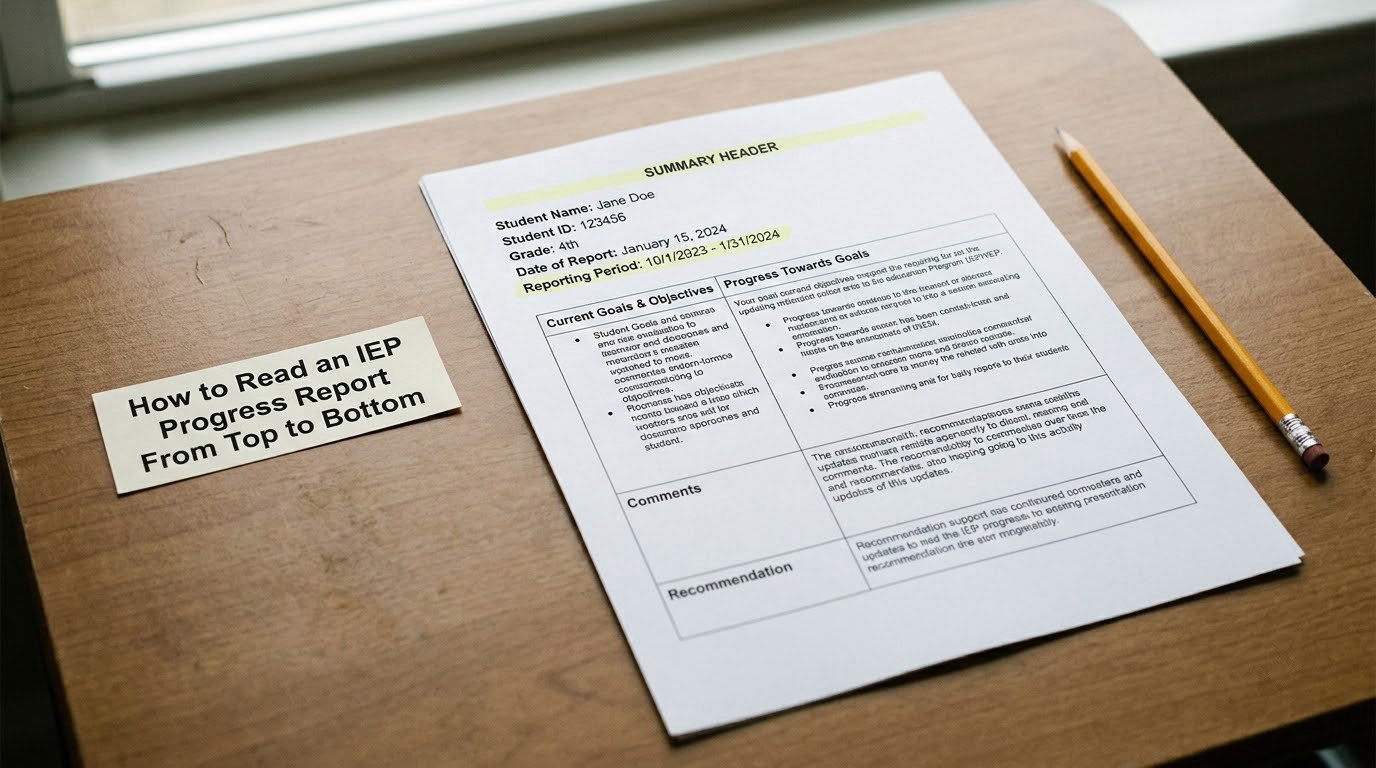
Start with the summary block before you look at a single goal. You are looking for the student name, the reporting period, the instructional setting, the related services listed, and any attendance or participation notes.
That block usually answers three questions in thirty seconds: which version of the IEP this report was written against, which services the school says are in place, and whether anything unusual happened during the period. If the reporting period is missing, or the report does not name the school year, that is your first note.
Once this block makes sense, individual goals are much easier to read, because you already know the frame. Parents tell me that skipping this section is what made the rest of the document look like noise.
Match Every Goal to Your Child’s Current IEP
Place the report next to the IEP and match each listed goal to its exact counterpart. You are checking the wording, the placement, the baseline, the target criterion, the service, and the accommodations that support it.
Flag anything that is missing or has shifted. A goal that appears in the report but not in the current IEP means the report may have been written against a superseded plan. A goal whose wording changed may have had its target quietly raised or lowered. A goal with a different measurement method is the one that causes the most confusion later, because the numbers stop being comparable.
Under the Individuals with Disabilities Education Act, the required components of an IEP are set out in 34 C.F.R. § 300.320. Goals are supposed to be measurable and tied to services. When the report shows a goal with no service attached, that mismatch is worth a question.
Understand the Data Before the Teacher’s Comments
Progress data should be objective: a number, a percentage, a score, or a countable behavior, tied to a date and a method. Read the measurement method first, then the current data, then the last data point before it.
Common academic measures include words correct per minute, accuracy percentage, rubric levels, and the number of prompts needed before a task is completed independently. Behavior goals are usually tracked on a daily log, with results reported as a percentage of opportunities or of time on task.
Words like emerging, progressing, and mastered describe a trajectory, not a measurement. One data point never proves progress on its own — it only tells you where your child was on a particular day. What matters is the line across three or more points, and the rate it moves at compared to the rate the goal assumed.
Check Whether the Progress and Plan Make Sense
Ask three things: is the current data moving at the rate the goal predicted, does the report explain why, and does the plan change in response?
A well-written report tells you the current number, what the team will change next, and what barriers were observed. A report that shows a number with no explanation and no plan is incomplete even when the number is fine. So is a report that says progress is on track with no criteria attached.
Useful questions here sound like: what changed after the last data point, which strategy is being tried now, and what would tell the team this approach is not working. Those are neutral questions, and they get better answers than anything that sounds like an accusation.
Confirm That Services and Supports Were Delivered
Academic progress and service compliance are two separate things, and a progress report usually only tells you about the first. Cross-check the services page yourself: minutes per week, frequency, location, who provides it, related services such as speech, occupational therapy, counseling or assistive technology, and accommodations tied to each goal.
Then ask how you can verify delivery. Service logs, attendance records, and provider notes are the documents that show what happened. In many districts you need to request them specifically, because the progress report itself will not tell you whether the sessions happened.
One practical example: a student can show a flat reading number while a speech or reading intervention was delivered only part of the year, or while absences were high. The number does not explain itself. This is the step parents most often skip, and it is the one that changes outcomes fastest.
Turn Findings Into Follow-Up Actions
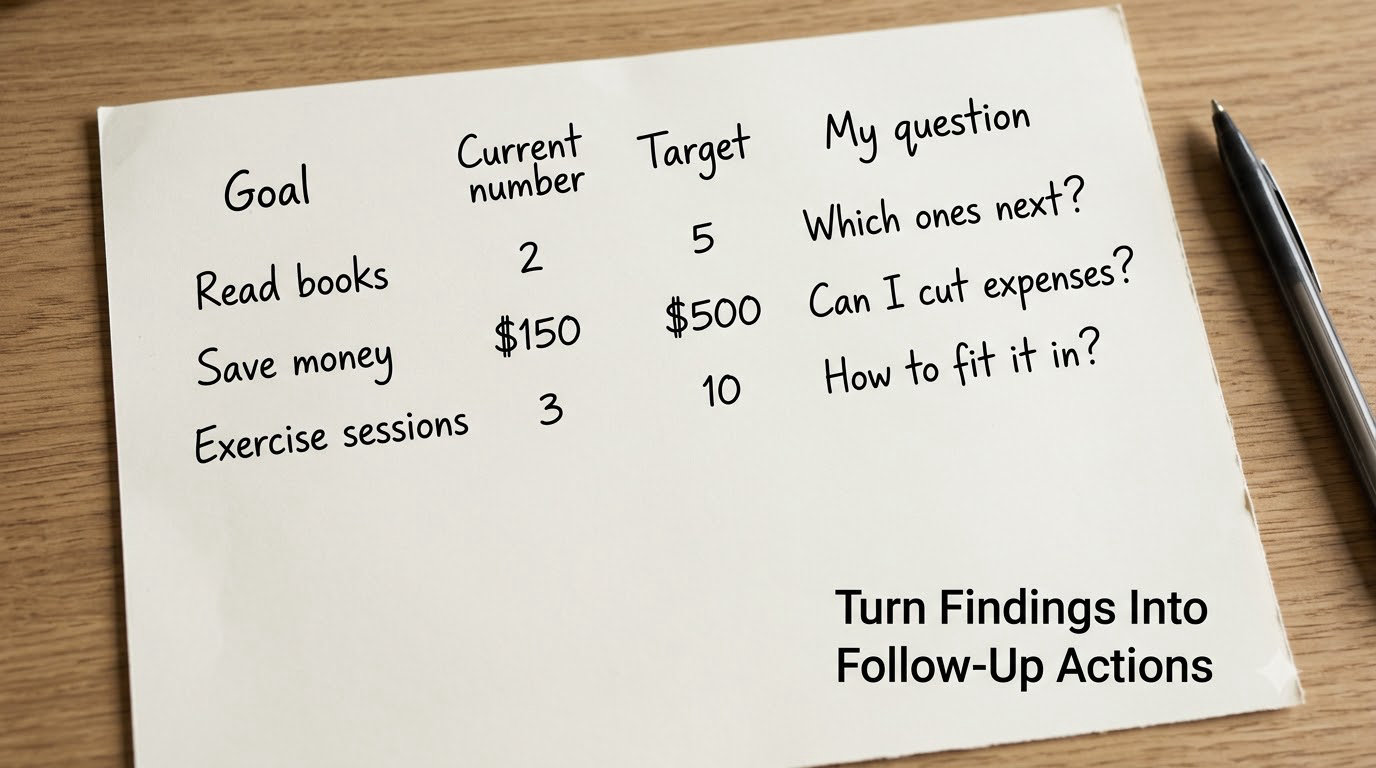
Sort every goal into one of four buckets: on track, needs more support, needs a closer look at the data, or needs a formal conversation. Then use a short template so nothing lives only in your head.
A four-column worksheet is enough. Write the goal, the current number, the target, and your question. Add a fifth line for the deadline and who owns the next step, so the item does not quietly die between meetings.
Worth writing down: who you emailed, the date, and what you asked for. Parent threads in r/specialed repeat the same pattern that works — ask the case manager first, keep the tone collaborative, and put the request in writing so there is a record.
Prepare Questions for the IEP Meeting
Turn each note into a neutral, specific question. Instead of asking why the numbers are bad, ask what has already been tried, what the data source is, when the next data point will be collected, and what a realistic timeline looks like.
Have two or three questions per goal, written down. Teams move faster through a short list of evidence-based questions than through a long narrative about how worried you are.
If the answers do not add up, you have more options than a frustrated email. You can request a meeting, ask for written clarification or additional data, or ask for help from the school’s special education lead. Progress reports are meant to inform the team, and a team that has the data in front of it can change a goal, add a service, or rewrite a measurement method.
Common Mistakes Parents Make With Progress Reports
Treating the report as a grade. A report is not a mark and not a report card. A child can be earning an A in a class and still be well below the reading fluency number written into the IEP.
Reading the narrative instead of the data. Comments like making progress, working hard, or needs to continue to be worked on carry no measurement at all. The phrase making progress to meet the goal recurs in real reports and is widely treated as a red flag precisely because it tells you nothing.
Assuming a slow goal should be deleted. Slow progress is a signal to examine the instruction, the measurement, and the services. Removing a goal because a number is low deletes the only written record that it was a problem.
Comparing percentages across goals without checking the method. A percentage of accuracy and a percentage of time on task are different measures. Numbers are only comparable when the method is the same, which is why a consistent data collection method matters more than most families expect.
Skipping the services page. You cannot tell whether a lack of progress is a teaching problem or a delivery problem without confirming the services were provided as written.
Noticing identical wording across goals. Copy-paste comments are easy to spot. If four goals share a sentence, the data behind them deserves a closer look.
Reacting without evidence. Concern backed by three data points and a specific question moves a meeting. Concern without data turns into a debate about tone.
Confusing a progress review with a formal IEP change. A progress report is a status document. Changing a goal or a service takes a team meeting and, in many cases, a written amendment.
Helpful Tips for Reviewing the Report With Your Child
Older students can be part of this, and it changes the tone of the whole conversation. The trick is keeping the report from feeling like a verdict on them.
- Ask them to highlight one thing that is going better than it was, and say why they think it changed.
- Ask which support helps them most right now, and whether that support is actually showing up in class.
- Ask what is easier and what is harder, and write both down without correcting either answer.
- Let them see the questions you are planning to ask. Kids who see their input reflected in the questions tend to stop dreading meetings.
Keep behavioral documentation for adults to interpret. Behavior plans contain clinical-sounding language that is easy to misread, and a child rarely benefits from hearing their own data log described back to them in those terms.
One more practical tip: use the same four-column worksheet at every reporting period, in the same order. The value shows up in the third or fourth report, when you can see the slope instead of a single point.
Frequently Asked Questions
What should I do if the progress report is missing an IEP goal?
Note which goal is missing, then ask the case manager in writing which version of the IEP the report was written against. Sometimes the report is simply out of date, and sometimes a goal was added or removed at a meeting you received paperwork about late. Ask for the report to be reissued against the current IEP if that is what happened, and ask why the goal is absent if it is not explained.
Can I request the data or work samples used in my child’s progress report?
Yes. Parents are entitled to the data behind the report, which includes the scores, the dates of assessment, and the measurement method used. Send a written request to the case manager naming the goal and the reporting period. If the response is incomplete, escalate in writing through the special education lead or your district office, and keep a copy of every request and reply.
What does it mean if my child made some progress but was not near the annual goal?
It usually means the rate of progress is slower than the goal assumed. That is a signal to look at instruction, the measurement method, and whether services were delivered as written, not a reason to expect a specific outcome. Ask the team what rate they projected, what is being changed, and whether the goal or the timeline needs to be rewritten at the next meeting.
What happens if the report shows that related services or supports were not provided?
Document it and raise it in writing, because delivery problems are usually fixable quickly once they are on the record. Ask for a makeup plan and for the minutes to be logged accurately. If related services such as speech or occupational therapy were missed repeatedly, request a team meeting to address the shortfall, and bring the service logs and your written requests with you.
Can a progress report lead to a meeting about changing my child’s IEP?
Yes, though the report itself changes nothing. It is evidence the team can act on. Bring the report, your data, and two or three specific questions to a meeting request. If you prefer to start smaller, ask the case manager for a conversation or a written amendment. Under IDEA, a team is expected to reconvene when a child is not making meaningful progress toward their goals.
What to Do First
Start by matching the report to your child’s current IEP, goal by goal. Then highlight what is missing or unclear rather than everything that disappointed you, because a short list of gaps is far easier to resolve than a page of concerns.
Next, verify service delivery. If minutes or sessions do not line up, that is a conversation to have before any goal discussion, and it is the one that tends to change the most.
Finally, bring two or three evidence-based questions to the next team meeting, written down. That sequence takes one evening, and it is the whole method of how to read an IEP progress report end to end.