
Hidden gluten is gluten that never announces itself. It arrives as an ingredient called malt extract, modified food starch, brewer’s yeast or hydrolyzed vegetable protein, or it comes in on shared equipment. Learning how to read a label for hidden gluten takes about a minute per package once you know the four places to look and the words that signal wheat, barley or rye.
I do this in the grocery aisle with a child who cannot tell me a reaction is coming, so the process I use is deliberately boring: same four spots, same word list, every single time. That predictability is the whole trick, especially for a child who eats the same foods on repeat.
This guide covers what to have on hand, the scan itself, the ingredient terms grouped by grain, and what the label claims legally mean. It is general information about US packaging rules, not medical advice. If your child has a diagnosis, a restrictive diet or symptoms of any kind, the plan should come from their gastroenterologist or a registered dietitian who knows their history.
Table of Contents
What You Need
To do this well you need the physical package in your hands, not a screen. A phone photo of the ingredient panel is fine to save afterward, but squinting at a shelf label will eventually produce a mistake.
Here is the short list:
- The whole package. Back panel, side panel and front claims, plus the allergen statement if it sits in a separate box.
- Your phone camera. For saving a photo of the label so you can compare it next purchase or share it with a school nurse.
- A written list of your safe foods. The products already cleared for your household, so a decision gets made in seconds rather than in a long aisle stare.
- The manufacturer’s contact details. Most food packages print a phone number or website on one panel, usually near the barcode.
- Any guidance from the clinician managing the diet. Whether oats are allowed, how strict cross-contact needs to be, and what a reaction looks like for your child specifically.
- A magnifier for small print. Not mandatory. Cheaper option: the zoom on your phone camera works fine on the ingredient block.
One more thing that costs nothing: know that a shared kitchen is a risk. Family members who eat wheat create flour dust, toaster crumbs and a bread box nobody empties. That is not a label problem, but it is a hidden gluten problem, and it catches people who read every package perfectly.
How to Read a Label for Hidden Gluten
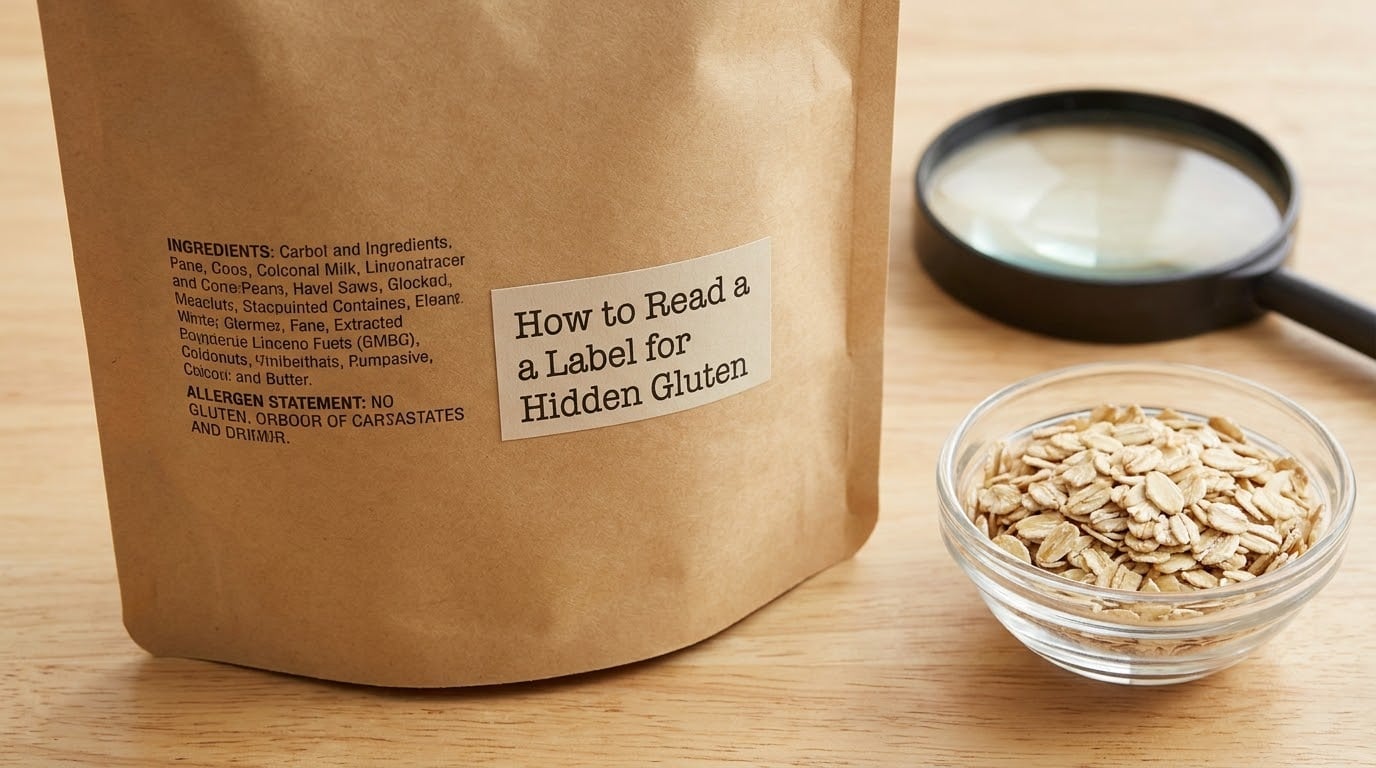
The scan has four parts and takes about sixty seconds. Read the allergen statement first, then the ingredient statement, then the front claims, then the advisory line.
Start With the Ingredient Statement
Ingredients are listed in descending order by weight, so the first item is the largest amount in the package by weight. That ordering is the single most useful fact on the panel, because it tells you where to look hardest. If the third ingredient is a word you do not recognise, the amount is small but not negligible.
Read the whole list once, top to bottom, before you decide anything. Scanning for the word “wheat” and stopping is how people miss barley, rye and malt.
Look for Wheat and Barley Terms
These are the ingredient names that signal the three main gluten sources. Wheat is the only one of the three that US rules require to be declared by name.
| Wheat and wheat relatives | Barley and its derivatives | Rye |
|---|---|---|
| Wheat flour, enriched flour, unbleached flour, whole wheat flour, wheat starch, semolina, durum, farina, couscous, bulgur, orzo, spelt, einkorn, emmer, kamut, farro, triticale, seitan, panko, matzo, atta, soy sauce, and the species names Triticum aestivum and Triticum spelta | Barley, malt, malt extract, malt syrup, malt flavoring, malt vinegar, brewer’s yeast, autolyzed yeast, and the scientific name Hordeum | Rye, rye flour, rye malt, and triticale, which is a wheat and rye cross |
Two details catch people out. First, brewer’s yeast and autolyzed yeast come from barley, so a yeast word on its own is not automatically gluten-free. Nutritional yeast grown on a gluten-free substrate is a different thing again. Second, seitan is pure wheat gluten sold as a meat substitute, and the word sounds like a grain-free choice for exactly the opposite reason.
Common household experience supports this reading. People in celiac forums describe being made ill by ordinary-looking cheese, cereal and deli meat more often than by anything exotic, and the pattern is almost always a product nobody thought to check because the front of the package looked innocent.
How to Read a Label for Hidden Gluten in Additives and Seasonings
The genuinely difficult words are the general-purpose additives and the seasoning blends, because they serve as thickeners, binders and anti-caking agents. A seasoning packet can carry wheat starch, and a soup can carry a modified starch, with no grain named anywhere on the front.
- Modified food starch and modified starch. The source can be wheat, corn, rice or potato. Unless the package says gluten-free or names the plant, treat it as unknown.
- Dextrin and maltodextrin. Frequently made from corn, potato or rice, and frequently made from wheat. The label rarely says which.
- Hydrolyzed vegetable protein, hydrolysed plant protein, HVP. Some is from wheat, and hydrolyzed wheat protein is a direct source.
- Textured vegetable protein, TVP. Usually soy, occasionally wheat-based.
- Natural flavor, natural flavouring, artificial flavor. Can carry grain-derived alcohol or malt. Corn-derived and MSG-based versions exist, so the word tells you nothing on its own.
- Mono- and diglycerides, mono- and diglycerol. Plant-based versions are common; the grain source is unstated.
- Gelantized starch, grain syrup, and brewer’s yeast extract. Worth a call to the manufacturer.
Read salad dressings, gravies, roux-based mixes, soup bases, marinades, spice rubs and seasoning packets with extra care. These are the everyday hiding places people report on forums, along with canned and frozen vegetables, canned soups, candy and cereal, because many of them carry a wheat-derived thickener or a malt flavoring for texture rather than taste.
Read the Allergen Statement Carefully
US rules require wheat to be declared as a major allergen, either inside the ingredient list or in a separate Contains statement near the ingredients. Barley and rye are not major allergens under those rules, so they frequently appear nowhere except the ingredient list, if at all.
That is why an absence of wheat in the allergen statement proves very little. A product can read “Contains: milk, soy” and still list barley malt, or it can say nothing at all because the shared-equipment risk is a judgment call the manufacturer made.
The Contains statement is not a gluten statement. Read it, then go back to the ingredient list and look for barley, rye and the ambiguous additives on their own.
Check Claims and Contact the Manufacturer
Front-of-package claims come in three flavours, and the differences matter more than most shoppers realise.
| Claim | What it means | What it does not mean |
|---|---|---|
| Gluten-free | Regulated by the FDA at under 20 parts per million | That no wheat, barley or rye crossed the line during production |
| Wheat-free | No wheat ingredient, with no federal definition or limit | Barley and rye are not covered, and malt is not covered |
| Certified gluten-free | A third party tested the product to that certification’s own limit, commonly well under 20 parts per million | That it is safe for someone with a wheat allergy rather than celiac disease |
| Naturally gluten-free | A single-ingredient food such as rice, corn or potato | Anything about cross-contact during milling or packing |
Wheat-free is the trap. A barley-heavy product labelled wheat-free is a real thing on shelves, and community members raise it constantly because a parent scanning for wheat misses it entirely.
When a term stays unclear, photograph the label and call the number on the package. Three questions get you useful answers: is this product made in a facility that also processes wheat, barley or rye, is the modified starch in this product corn, rice or potato, and has the recipe changed in the last year. Manufacturers answer these routinely. If a company cannot confirm, treat the product as unsafe rather than hopeful.
Contact is also worth doing about oats. Oats are a wheat relative and a rotation crop, so they carry the highest cross-contact risk of any common gluten-free grain. Look for the words certified gluten-free oats rather than assuming a bag of oats is fine because the plant itself contains no gluten.
Finally, re-read the label on every purchase. Formulas change, manufacturing sites change, and a product that was fine last month can be different this month. Screenshotting the current label makes the next shop a two-minute job.
Common Mistakes
Trusting the front of the package. “Multigrain,” “artisan,” “cracked wheat,” “lightly floured” and even a green leaf icon say nothing about gluten. Fix: turn the box over before deciding anything.
Assuming oats are safe. Plain oats are a wheat relative and a frequent cross-contact vector. Fix: buy certified gluten-free oats, or skip them if your clinician has said so.
Confusing wheat-free with gluten-free. Barley, rye and malt slip straight past a wheat-only scan. Fix: search the list for all three grains plus every malt derivative.
Reading the Contains statement and stopping. Only wheat is a federally required allergen there. Fix: treat the Contains line as one signal, then read the ingredient list itself.
Skipping the ambiguous additives. Modified food starch, dextrin, maltodextrin, HVP and natural flavor all appear on products people assume are gluten-free. Fix: skip or verify anything on that short list.
Not re-checking after the first purchase. Recipes and plants change. Fix: save a photo of the label so you can compare it each time you buy.
Ignoring the rest of the house. The best-read labels in the world will not help with a shared toaster, a bread box, or a school snack that arrives unlabelled. Fix: separate toasters, strainers and butter knives, and send a written safe-foods list to school, grandparents and birthday hosts.
And one place labels never appear at all: supplements, prescription and over-the-counter medicines, lip balm, hand soap, shampoo, conditioner and pet food. Medications can use wheat or corn-based fillers, and celiac parents raise this more often than anything else outside the aisle. The same four questions to the manufacturer work, and a pharmacist can check the excipients list for a medicine.
Frequently Asked Questions
Are oats gluten-free?
The oat plant itself does not contain gluten, but oats are a wheat relative and a rotation crop, so they pick up cross-contact during growing and milling more than any other common gluten-free grain. That is why certified gluten-free oats exist as a separate category. If your child has celiac disease or reacts to trace amounts, choose the certified version or follow your clinician’s advice about avoiding oats entirely.
Is wheat-free the same as gluten-free?
No, and the difference is a common source of accidental exposure. Wheat-free only rules out wheat, so a product made with barley, rye or malt can carry that claim and still contain gluten. Wheat-free has no federal definition or parts per million limit attached to it, while gluten-free is regulated by the FDA at under 20 parts per million. For celiac disease, only the gluten-free claim and the full ingredient list matter.
What does a ‘may contain wheat’ warning mean?
It is a voluntary advisory line, not a required one, and it means the manufacturer believes cross-contact is possible during production. The label does not tell you how much wheat is involved or whether the warning is strict or routine for that plant. For someone with celiac disease, treat the advisory as a warning sign: choose a product with a gluten-free or certified gluten-free claim, or contact the company.
Why does a gluten-free labelled food still make me sick?
Four explanations come up most often. The recipe may have changed after the label was printed, the product may share equipment with wheat, the item may have been handled or stored with gluten-containing food, or a term such as modified food starch or maltodextrin may be grain-derived. Also check the certified oats angle. A photo of the label plus a call to the manufacturer usually settles it faster than switching brands blindly.
How often should I re-read a label I have bought before?
Every time you buy it. Manufacturers change recipes, suppliers and sometimes production sites, and none of those changes trigger a new gluten-free claim you would notice in the aisle. Save a photo of the current label in your phone, dated, and compare it against the one on the next package. If anything in the ingredient list has moved up or a new additive appeared, call the manufacturer before buying.
When should I involve a doctor or dietitian about label reading?
Whenever symptoms are involved rather than just shopping questions. A persistent rash, abdominal pain, fatigue, or unexplained changes in growth or behaviour are clinical questions, and lab results such as antibody levels are interpreted by a clinician, not from a label. A registered dietitian who works with celiac disease can also set how strict your cross-contact rules need to be, including oats, supplements and school lunches.
Start at home, not in the aisle. Write down the products that are already safe, photograph each label, and build your own word list from those panels. In the store, work the same four spots in the same order every time, and when a term like modified food starch leaves you guessing, call the number printed on the package. This guide is general information about US food labelling; your child’s clinician or a registered dietitian should set the rules for their diet.