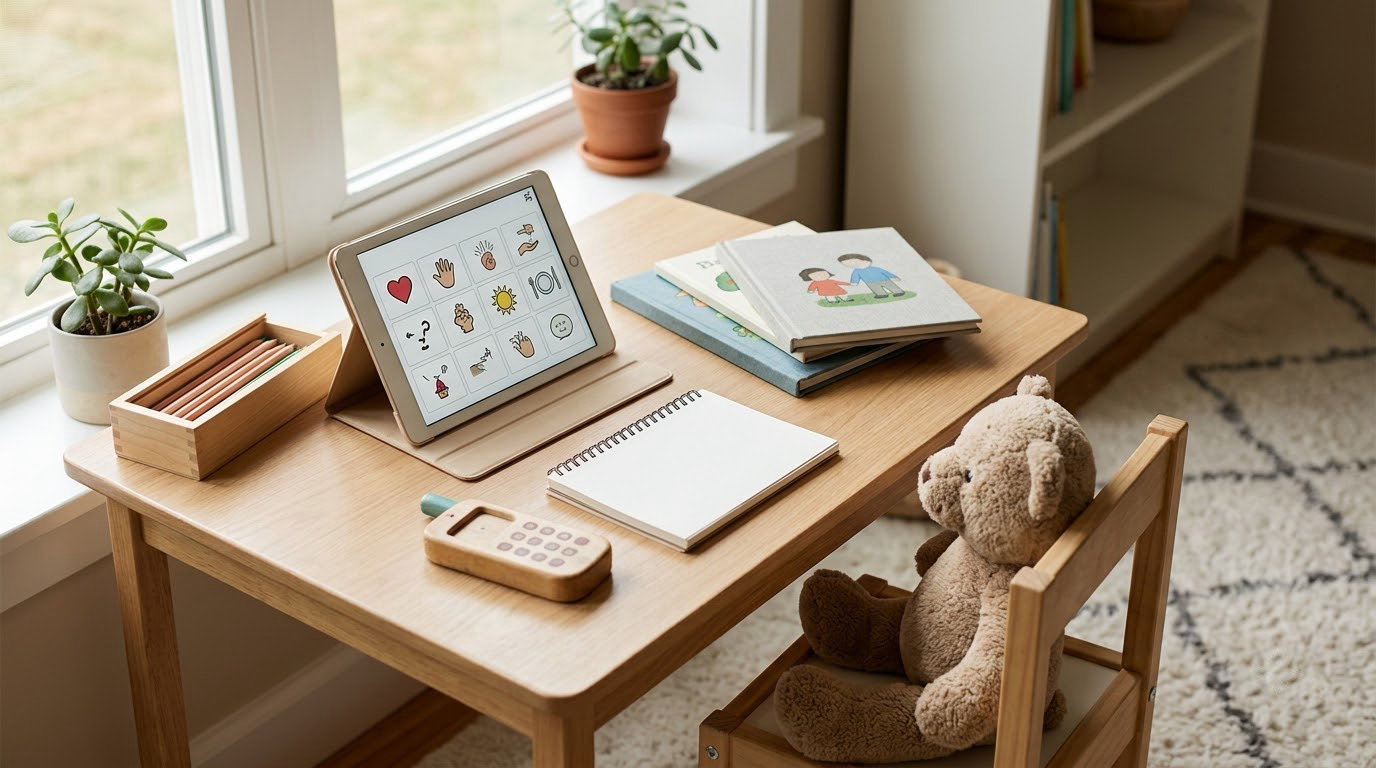
Short answer: AAC will not stop your child from talking. Augmentative and alternative communication adds a second way to communicate, and decades of research show it does not hold spoken speech back. Many children who start with a device or picture board later use more words, not fewer, because they can finally tell the people around them what they want.
That is still a hard thing to hear when someone first mentions AAC for your child. Most parents describe the same mix of hope and dread, and honestly, the dread is not a sign you are doing something wrong. It means you have been paying attention.
This guide walks through what AAC actually is, why the belief that it silences speech keeps coming back, and what a low-pressure start looks like at home. It is written for parents and caregivers, not as a clinical plan. Anything specific to your child belongs with their speech-language pathologist and care team.
Table of Contents
- What Is AAC and How Does It Support Communication?
- Why AAC Will Not Stop Your Child from Talking
- What Can AAC Do for a Child Who Is Not Speaking?
- Does AAC Mean My Child Will Never Learn to Speak?
- How Can Parents Introduce AAC Without Putting Pressure on Their Child?
- What Should You Do First if You Are Considering AAC?
- Frequently Asked Questions
- Will using AAC take away my child’s motivation to learn to speak?
- Does using an AAC device mean my child will never use words?
- What is the difference between AAC and speech therapy?
- Can a child use AAC before they are ready for a speech-generating device?
- How do I know which AAC option is right for my child?
- Should I wait to introduce AAC until my child is older?
- What to Do First
What Is AAC and How Does It Support Communication?
AAC is not one device. It is a whole category of tools, methods and strategies that give a person another way to send a message when spoken words are hard, unavailable or unreliable.
What does augmentative and alternative communication mean?
The two halves of the name are worth separating. Augmentative means adding to speech: a child who says the word “juice” and also points to a picture of juice is augmenting. Alternative means using something in place of speech: a child who selects the picture and the app speaks the word out loud is using an alternative channel.
Both live side by side. Most children who use AAC also use gestures, signs, vocalizations and whatever words they have. Nobody using AAC sits on speech. They add to it.
Unaided or aided: the two halves of AAC
Unaided AAC needs nothing but the person’s own body: pointing, facial expression, gestures, sign language, key word signs. Aided AAC uses something external, such as a paper communication board, a laminated picture booklet or a tablet app.
- Unaided: pointing to a door, waving for help, Makaton or signed words, pulling on an adult’s sleeve.
- Aided low-tech: a home-made board with photos, a single laminated card, a big single-switch message button.
- Aided high-tech: a tablet app or dedicated speech-generating device with recorded or synthesized voice.
Low-tech is not the lesser version. A board that always works, sits on the fridge and needs no charging has real advantages over an expensive tablet that runs flat by lunchtime.
Where speech-generating devices sit
A speech-generating device, sometimes called an SGD, speaks selected words out loud. Many parents assume this is the finish line, that giving a child voice output means giving up on their voice. In practice it is one option in a wide range, and it is rarely the right first step for a toddler.
Where a child starts matters far less than the fact that they have something available now. Plenty of children move from gesture to board to device to speech in a completely different order than anyone predicted.
Why AAC Will Not Stop Your Child from Talking
Because AAC does not compete with speech. It gives a child something to say, and a child who is not frustrated, exhausted or misunderstood uses more of their words, not fewer.
What the research says
The evidence here is unusually consistent for a therapy field. Reviews by Millar, Light and Schlosser from 2006 and Schlosser and Wendt from 2007 looked at how AAC affects speech production and found no evidence that aided systems reduce spoken output. The Beukelman and Mirenda textbook, widely used in training programmes since 2013, describes AAC as a tool that supports language development rather than competing with it.
Professional bodies have taken the same position. Communication disorders specialists and national joint committees have published statements pushing back on the idea that AAC should be withheld to protect speech. The reasoning is straightforward: keeping a child silent “in the hope” they will speak is a gamble with a high cost and no reliable payoff.
Four reasons AAC supports spoken speech
- Frustration drops. A child who can say “no,” “more” or “finished” spends less energy on breakdowns, screaming and dropping to the floor. That energy goes back into interaction, which is where language grows.
- There is a model to imitate. Hearing a word spoken, repeated and answered gives the child an auditory model with a cause-and-effect link attached. Many children pick words up from their own device first.
- Turn-taking goes up. Each exchange is a small conversation. Back-and-forth communication is the engine of expressive language, and a device keeps those exchanges from collapsing into a one-sided demand.
- Participation opens up. At school, at home, with strangers. A child who can answer a question joins the conversation instead of withdrawing from it.
None of this requires a specific device. A laminated card that says “all done” gives a child the same opportunity.
Where the myth comes from
The idea that speech must be protected at all costs comes from a cultural preference sometimes called speechism, the belief that spoken language is the only real communication and everything else is a lesser version. It shapes how some schools and clinicians talk about AAC, and it shapes how many families hear the recommendation in the first place.
There is a second layer. Spoken language carries history, closeness and identity, and parents can hear “I will not lose my child’s voice” as a sentence about their own future. That grief is real. It does not come from nowhere, and dismissing it usually makes a parent more suspicious, not less.
The strongest counter-example comes from people who use AAC themselves. Autistic AAC advocates, including writer Jamie Knight writing through the CoughDrop blog, are blunt about being denied a device “to encourage” speech. Their argument is not that every person needs AAC. It is that deciding for someone that they will speak, and holding their tools back until they do, does more harm than good.
The fears worth taking seriously
Some concerns parents raise are fair, and pretending otherwise pushes them away.
- A screen-heavy day. Fair. Bring the device down at bath and bedtime like any other thing with a screen, and start with paper boards if you want.
- A child who uses a device and stops practising speech out loud. If that happens, it is a signal to adjust the goals with the SLP, not to remove the tool.
- Cost and maintenance. Real, and worth planning for, but not a reason to wait years.
- Worry that a device is the final answer. It is rarely that.
What Can AAC Do for a Child Who Is Not Speaking?
It answers the questions a child cannot yet answer out loud. That sounds smaller than speech, and for a child it is enormous.
Everyday requests and refusals
Before a child has words, they have needs. Food, sleep, discomfort, being finished, a different cup. A board with about a dozen core words covers most of a morning, and it lets a child learn that requests get answered. That lesson transfers to spoken language later.
Frustration and behaviour
Challenging behaviour is often communication with no other outlet available. When a child has a reliable way to signal pain, confusion or overstimulation, the loudest and most exhausting behaviours usually settle. Parents notice this within weeks, usually without a formal measurement.
Social connection
Peers are unforgiving of silence. A child who can point to a card that says “let me play” gets invited in. One that cannot tends to sit near the group rather than in it, and social contact becomes the thing a child lacks rather than the thing AAC builds.
Learning and safety
In a classroom, AAC means a child can say “I don’t understand,” ask for a break or answer a question aloud. In a clinic or a hospital, a child can report pain. These are small-sounding rights that protect a child across a whole day.
There is a practical point parents sometimes miss. AAC does not require a child to point, reach or have steady hand control. Eye gaze, head pointing and a single switch all work. That matters for children with cerebral palsy, significant motor disabilities or limited voluntary movement.
Does AAC Mean My Child Will Never Learn to Speak?
No one can predict an individual child’s speech future, with or without AAC. Any clinician who tells you they can is overselling. What can be said is that withholding communication does not improve the odds.
Some children who use AAC go on to speak. Some use a combination of speech and AAC indefinitely. Some rely on AAC as their primary voice. All three outcomes are good ones, because in each case the child has words and is understood.
Here is the part that reassures parents most: children who begin with AAC frequently start using spoken words sooner than expected, not later. The research reviews find spoken speech increases after AAC introduction rather than decreasing, which is the opposite of what the worry predicts.
Speech therapy continues alongside AAC, and it should. Your SLP will keep working on sound production, imitation and oral motor skills. AAC is not a vote against any of that; it is a channel that runs in parallel.
How Can Parents Introduce AAC Without Putting Pressure on Their Child?
Keep the pressure on the adults instead. The goal is a tool that is always available and never tested, the way a child’s hands and face are.
Make it part of ordinary life
Put a few photos on the fridge. Keep a laminated card in the stroller. Let the board sit where everyone can reach it. AAC works when it is boring and constant, not scheduled.
Model it yourself
Use the system while you talk to your child, even before they can select anything. Point to the card as you say the word, which practitioners often call aided language stimulation. You are showing what the device is for, and being understood at the same time.
Follow the child
If they tap one thing repeatedly, keep that thing available and go deep with it. Repetition is not avoidance, it is how a lot of language gets built. A child who only ever uses “more” is a child who is communicating.
Wait for them
Pause after they select something and let them finish the thought. The silence is uncomfortable for adults and it is where most turning points happen. Answering too fast teaches a child that the device is for adults to fill gaps.
Treat it as a tool, never a test
Do not ask a child to show you words. Do not make access to a board conditional on saying something out loud first. That inverts the whole point and parents notice the shift immediately when a child stops pointing.
Include the household
Grandparents, babysitters and siblings need the same introduction you got. When everyone else treats the board as off-limits, a child learns quickly that it does not work everywhere. Short training sessions with the SLP do more than any single device purchase.
What Should You Do First if You Are Considering AAC?
Start with a conversation about communication in general, not about devices. The order matters, and it keeps the meeting from feeling like a verdict.
Note what your child already does
For a couple of weeks, write down what they use to get attention, show a want, say no or protest. Pointing to a door, a cry that means pain, a hand on your face, a sound you have learned to read. Bring that list. It shows you are describing a child with a communication profile, not a child with a problem.
Ask for an evaluation that covers AAC
Request a speech-language pathology evaluation specifically for a child who is not reliably using spoken words. Say the phrase “and communication options beyond speech” on the phone so it lands in the referral.
Ask about the full range, low-tech included
If the first suggestion is a tablet, ask what the low-tech options are and why. A board, a switch and some core words should be part of any genuine assessment.
Ask the questions you are actually holding
Write them down before the appointment, because it is easy to forget the big one. Parents often ask, “Will this stop him speaking?” out loud for the first time and hear a clear answer in the clinician’s voice.
Check funding early
Devices may be funded through a school’s special education budget, a state programme, Medicaid or a private insurance plan, and the process takes time. Ask at the start of the process rather than after you have already chosen a system.
Ask for partner training in the plan
Add it to the written goals so it does not depend on anyone’s memory. The most common failure I hear about is not the wrong device; it is a device nobody around the child knew how to respond to.
Frequently Asked Questions
Will using AAC take away my child’s motivation to learn to speak?
No. Speech is faster and more natural than any device, so children tend to shift back toward their own voice whenever spoken words become easy enough. AAC gives them practice and a reason to keep communicating in the meantime. Reviews of the evidence, including work by Schlosser and colleagues, have not found that AAC reduces speech production.
Does using an AAC device mean my child will never use words?
It does not. Plenty of children start on a picture board or speech-generating device and later use spoken words alongside it. Some children keep AAC as their main voice permanently, and that is a good outcome too. Nobody can predict an individual child’s speech future, but withholding AAC has never been shown to improve the odds.
What is the difference between AAC and speech therapy?
Speech therapy works on producing and understanding spoken language. AAC provides another channel for expressing ideas when speech is hard or unavailable. They are not competitors and they are usually used together, with an AAC system giving your child something to say while the speech-language pathologist works on sound production, imitation and oral motor skills.
Can a child use AAC before they are ready for a speech-generating device?
Yes, and low-tech options come first for most families. A laminated card, a photo board or a single message button can be set up at home this week. There are no prerequisite skills a child must meet first. Starting small keeps the learning load low and lets you see which symbols your child actually reaches for before investing in anything complex.
How do I know which AAC option is right for my child?
An evaluation should look at motor access, vision, receptive language, the words your child already shows interest in, and how much support each person around them can give. Any option that works is a good option. Ask to trial more than one, because families often notice quickly that the system you expected to use is not the one your child actually uses.
Should I wait to introduce AAC until my child is older?
There is no good reason to wait. Communication support can start in early intervention and works best when it is available before frustration builds up. Parents are sometimes told a child is too young, or not ready, or should try harder with speech first. Those gatekeeping claims have no research behind them, and each month of silence costs a lot of interaction.
What to Do First
Write down what your child does now to communicate, then book an evaluation that explicitly includes AAC options. Bring your honest questions, including the one about speech. Nothing about starting later makes the outcome better, and nothing about starting now closes the door on spoken words.