
You ask for a one-on-one aide in writing, you bring data showing your child cannot access instruction without dedicated adult support, and you ask the IEP team to write it into the plan as a service with a set number of minutes per day. If the team agrees out loud but nothing goes into the document, the support is not real. Most families spend two to four weeks gathering documentation before the meeting itself, and the rest of this guide covers exactly what to collect, what to write, and what to say.
I want to be straight with you about the other half of this. A 1:1 is not something you get by asking loudly. It has to be justified by data, agreed to by the team, and written into the plan with specifics. Districts resist because of cost and staffing, and a well-prepared request still sometimes loses. What the process buys you is a real paper trail, a real meeting, and a written record of the school’s reasoning if the answer is no — and those three things are what make the next request stronger than the last.
The steps below follow the order families tell me works best, and the rules they cover are current as of 2026. If your child does not have an IEP or a 504 plan yet, skip to the second section; you can request an evaluation and the aide conversation in the same conversation with the school.
Table of Contents
- How to Ask for a One-on-One Aide at School: What You Need
- Step-by-Step: How to Ask for a One-on-One Aide at School
- 1. Review Your Child’s Current IEP or 504 Plan
- 2. Gather Examples of Why Independent Support Is Needed
- 3. Write a Specific One-on-One Aide Request
- 4. Send the Request to the School Team
- 5. Ask for a Meeting and Bring the Right People
- 6. Discuss the Aide’s Role, Schedule, and Training
- 7. Get the Decision in Writing
- 8. Follow Up and Review Whether the Support Is Working
- Common Mistakes When Requesting a One-on-One Aide
- Frequently Asked Questions
- Conclusion: Start With a Clear Written Request
How to Ask for a One-on-One Aide at School: What You Need
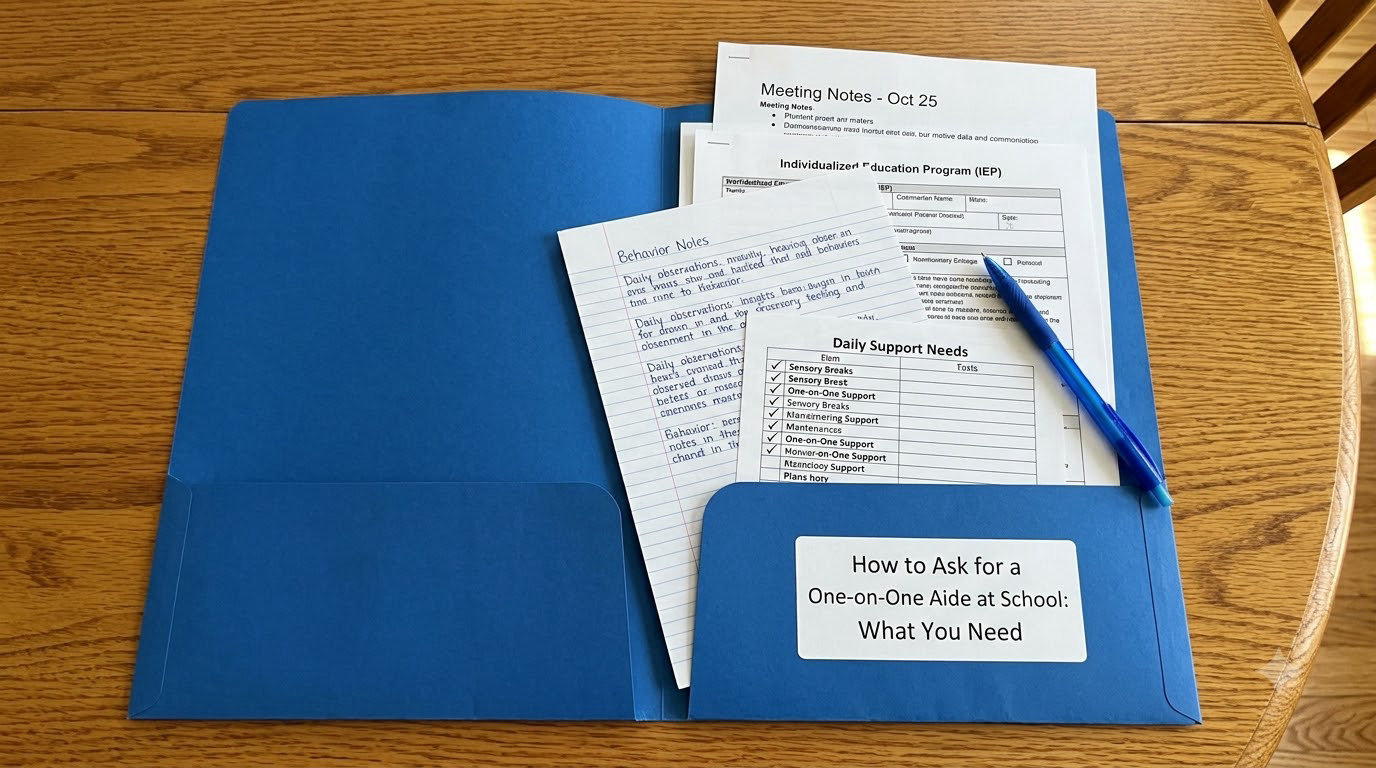
Families who get a 1:1 usually arrive with more documentation than the school asked for, and it rarely is a single document. It is a folder. Build yours before you contact anyone, and pull from these five areas.
- The current plan. Your child’s IEP or 504 plan, plus the most recent progress reports. This tells you what is already covered, so your request fills a gap instead of repeating a promise the school already made.
- Evaluation reports. The educational evaluation, any psychological or neuropsychological report, speech-language and occupational therapy evaluations, and any current functional behavioral assessment or behavior intervention plan.
- Progress-monitoring data. Whatever the school already collects: reading and math benchmark scores, writing samples, daily behavior sheets, attendance records, and office referral data. This is the part that turns opinion into evidence.
- Dated, school-only examples. A simple log with the date, what happened, where it happened, and what support was present. Keep it neutral and factual, the way a camera would record it.
- A short description of daily life. How your child handles the bus line, arrival, specials, lunch, transitions between rooms, and the last ten minutes of the day. Transitions are where most school days actually fall apart.
Describing the need across five categories also helps, because a team makes a better decision when the request is not one-dimensional. Safety covers leaving the room or the building and responding to unexpected noise or movement. Independence covers self-care, following a visual schedule, and recovering from a disruption without an adult. Academics covers whether your child can start, sustain, and finish work without constant one-to-one prompting. Sensory regulation covers overload, shutdown, or regulation that an adult has to manage. Routines and transitions cover the movement between places and activities, including the bus.
One more thing to know before you start: the support you ask for is not the same thing as the support that exists. Here is the difference families most often miss.
| Support option | What it actually looks like | When families request it |
|---|---|---|
| Full-day 1:1 aide | One school employee assigned to your child for the whole instructional day, in the general education classroom and on transitions | Safety risk across settings, or your child cannot remain in instruction without continuous adult support |
| Part-day 1:1 aide | A set number of minutes on specific periods, specials, lunch, arrival, or the bus | The hard parts of the day are predictable and specific, such as specials or arrival |
| Shared paraprofessional (floater) | One adult rotating among several classrooms, including yours part of the time | Your child needs prompting support in class but not continuous one-to-one attention |
| Dedicated paraprofessional | An adult assigned to your child’s classroom or to your child, but not necessarily one-to-one all day | Your child needs a consistent, familiar adult more than constant proximity |
Step-by-Step: How to Ask for a One-on-One Aide at School

Eight steps, in the order that keeps the most leverage for you. Start at the top and do not skip ahead, because each one feeds the next.
1. Review Your Child’s Current IEP or 504 Plan
Read the service pages first, not the goals. Look for the exact language on special education and related services, the number of minutes per week, the frequency and duration, the location where the service is delivered, and who provides it. If a classroom aide or in-class support is already listed, note the minutes and the setting precisely.
Then read present levels of performance and look for anything the team already wrote about safety, independence, following routines, or accessing instruction. School language you can quote back at them is worth more than a parent’s summary.
You will know this step worked when you can say the current service in one sentence, with its number.
2. Gather Examples of Why Independent Support Is Needed
This is where most requests fail, because they arrive as a feeling instead of a record. Build a simple log: date, what happened, where, who was present, and how it ended. Ten to fifteen dated entries across different settings is usually plenty.
Keep the language flat. “Left the classroom and reached the parking lot at 11:20 a.m. on March 4, staff followed within one minute” is usable. “He is a flight risk and the classroom is chaos” is not.
Include the days that went well too. A record that shows support helping on Monday and not helping on Tuesday is stronger evidence of a support gap than a record made only of the worst days.
If the school tells you a repeat functional behavioral assessment is redundant, ask in writing for the specific data they already hold for your child’s current placement and current teacher. That question is hard to answer casually.
3. Write a Specific One-on-One Aide Request
Your request should define a service, not a person. Districts change staff constantly, so a request for a named individual tells you nothing about the next school year. Request the support and describe the role instead.
Use this outline. Fill in the blanks, keep it to one page, and attach your data log.
Date. To the case manager, principal, and special education director. Subject: Written request for a one-on-one aide for [child’s name], grade [grade]. My child is eligible for special education under [IEP dated ___ / 504 plan dated ___ / evaluation pending]. Based on the data attached, I am requesting a one-on-one aide for the following reasons: [two to three specific, dated observations]. I am requesting [full day / X minutes per day during ___], beginning [date], delivered in [setting], supervised by [role], trained on [BIP, safety protocol, medical needs]. I am asking the team to write this into the plan as a special education service with service minutes, plus a progress-monitoring goal and a review date of [date]. I am requesting an IEP team meeting to discuss this and a written response to this request. Signed, [your name].
On minutes, be honest and specific. If the difficulty is concentrated in arrival, specials, lunch, and the last period, ask for those. A request for the full day when the data supports three periods is easy to refuse, and it can make the whole letter feel inflated.
4. Send the Request to the School Team
Send it to more than one person: the case manager or special education teacher, the building principal, and your district’s special education office. Use email so the date and wording are on record, and ask for a reply confirming receipt. Keep a copy in your folder, and save any portal submission confirmation.
If the school tells you it will not consider a change in services, ask for prior written notice in response. Parents are entitled to receive notice in writing when a district proposes or refuses to initiate or change identification, evaluation, placement, or services, and requesting it keeps the refusal from living only in a hallway conversation.
5. Ask for a Meeting and Bring the Right People
Your written letter should carry a requested meeting date. Ask for the meeting purpose in writing too, so the agenda is not decided for you. Federal timelines set a sixty-day window for a completed evaluation after you sign consent, though most states set shorter targets of their own, so check yours.
Know who actually decides. The case manager and the special education teacher or director usually carry the recommendation, the principal carries staffing reality, and your child’s general education teacher carries classroom information. Address your questions to the people who can answer them.
Bring one more person if you can: a special education advocate, an attorney, the evaluator who wrote the report, or your child’s therapist. An advocate is there to keep the meeting on the data and to slow down a rushed decision, not to argue with the teacher.
6. Discuss the Aide’s Role, Schedule, and Training
Once the team agrees in principle, the useful conversation is about implementation, because that is where a 1:1 quietly becomes three adults sharing a room. Ask these questions out loud and get the answers into the record.
- Who directs and supervises the aide, and who can answer questions during the day?
- What training does the aide receive before starting, and on which procedures from the behavior intervention plan?
- What are the aide’s specific responsibilities, and what are they explicitly not responsible for?
- What happens on a substitute day or when the aide is absent? Who covers, and for how long?
- Does the aide stay in the classroom during instruction, and how do they handle lunch, specials, and transitions?
- Does the aide accompany your child on the bus, and is that written down?
- How will the aide communicate with the teacher, and how often?
Teachers describe aides as highly variable, and a consistent dedicated adult usually serves a child better than a rotating shared one. Say that preference out loud in the meeting so it is part of the decision rather than a preference you discover later.
7. Get the Decision in Writing
Before the meeting ends, ask to read the summary of the decision. If it is vague, say so then, while the room is still assembled, and ask for the specific language. Correct anything inaccurate in writing within a few days.
The sentence you are aiming for names the provider, the minutes per day or week, the duration and start date, the settings, and the fact that it is a service in the plan. A good version sounds like this: adult support provided one-on-one for a minimum of 240 minutes per day, Monday through Friday, in the general education classroom, during instruction, specials, lunch, and transitions, delivered by school staff under the direction of the special education team, reviewed quarterly.
If the team agreed verbally and the writing is thin, send a short follow-up email restating what you understood and ask them to confirm or correct it. That email is the beginning of a failure-to-implement record if things do not match later.
8. Follow Up and Review Whether the Support Is Working
Decide at the meeting when you will look at this again, and put that date in the plan. Until then, track the delivery yourself, not just the results: was the aide present, for how many minutes, who covered absences, and what happened on the days the support was missing.
If the support is not being delivered, document each date in writing and request a meeting. If the support is being delivered and your child is not making progress, that is a different conversation, and it is a good moment to ask about progress-monitoring goals, a re-evaluation, or a functional behavioral assessment.
If the school will not move, work up the ladder in order: an informal meeting with the special education director, a state complaint to your state education agency, mediation, and a due process hearing. Each step is slower and more formal than the one before it, and each one puts the district’s reasoning in writing somewhere official.
Common Mistakes When Requesting a One-on-One Aide
Asking for a specific person instead of a defined service. Staff leave districts. Request a role, hours, setting, and supervision, and add that you prefer a consistent assignment once the service is approved.
Describing your child emotionally. Frustration reads as advocacy; dated observations read as evidence. Save the hard parts of the story for the relationship and put the facts in the letter.
Leaving out implementation details. A 1:1 with no schedule, no supervising role, and no plan for absences will drift. Schedule, supervision, training, and absence coverage belong in the request, not in a hope.
Treating a verbal yes as a decision. If it is not in the document with minutes, it does not exist. Follow up the same week in writing.
Waiting for the annual review. You can request a team meeting at any time. If a placement has changed, a teacher has changed, or behavior has escalated, waiting months for a calendar date costs you a year.
Believing a doctor’s note settles it. A medical letter neither requires nor prevents a district from providing a 1:1. The district’s obligation flows from the evaluation data and the team decision, and the note is supporting context, not the deciding factor.
Frequently Asked Questions
What qualifies a student for a 1:1 aide?
There is no single checklist, and no diagnosis automatically earns a 1:1. The team looks at whether your child can access instruction and stay safe without continuous adult support: leaving the room, daily behavioral crises, inability to follow routines or transitions, self-regulation needs, or academic work that cannot begin or finish without one-to-one prompting. Data from the evaluation, progress monitoring, and dated school examples matters more than a label. The determination belongs to the IEP team, and it must be supported by the record.
What does a one-on-one school aide actually do all day?
A 1:1 supports one student for the school day under the direction of the special education team. In practice that means prompting and cueing during instruction, supporting transitions, helping with routines and self-care, implementing the strategies in the behavior intervention plan, and giving the teacher a second set of eyes on data. A good aide is not there to remove your child from class, and a bad match is a real risk worth naming in the meeting.
Can my child have a one-on-one aide in a general education classroom?
Yes. Nothing in federal special education law prevents a 1:1 from being delivered in a general education setting, and the least restrictive environment is a required consideration, not a prohibition. The concern parents raise often comes from districts assuming a 1:1 means pulling a child out into a resource room, which is a different and more restrictive service. State the setting you want in the request, write it into the service description, and ask the team to explain any placement reasoning in writing.
How many minutes a day should I request for a 1:1 aide?
Request the minutes your data supports, not the largest number you can defend. Parents often make the case stronger by asking for a defined schedule, such as arrival through morning instruction plus specials and lunch, when the difficult parts of the day are predictable. A request tied to specific times and settings is harder to dismiss as inflated than a blanket full-day request. If your child needs the full day, your examples should show what happens during the other periods.
What if the school says it does not have staff for a 1:1 aide?
Staffing is a real constraint and a real answer, but it is not a final one. Ask what data they have for your child’s current placement, whether the need is documented, what interim supports they can offer, and by when they will revisit it. Then escalate in order: an informal meeting with the special education director, a state complaint to your state education agency, mediation, and a due process hearing. Each step asks the district to put its reasoning in writing, which is where most parents find the leverage they were missing.
Conclusion: Start With a Clear Written Request
Start with the folder, not the meeting. Read the current plan and find the exact gap, log ten to fifteen dated examples across settings, and send a one-page written request that defines the support, the minutes, the schedule, the supervision, the training, and the review date.
Send it to the case manager, the principal, and the district office the same week, and ask for a meeting with a stated purpose. Whatever the team decides, get it into the document with numbers in it, because a one-on-one aide that is verbally agreed to but never written into the IEP is not something your child can count on.