
To handle autism meltdowns at home, lower the demands first: cut your language to a few words, turn down noise and light, move your child away from hazards and other people, and keep everyone safe until the peak passes. Then wait. Recovery takes far longer than the meltdown itself, and a quiet debrief later does more good than any conversation in the moment.
That is the whole sequence, and almost everything below is detail on those five moves. It takes a few minutes of practice to feel natural, and no strategy works every time.
One thing to say out loud, because it is the most repeated thing autistic parents hear from professionals: a meltdown is not a behavior problem. It is an involuntary nervous-system response to overload, the same category of event as a seizure or a panic attack, and reasoning and language access drop away while it is happening.
| What it is | What causes it | How long it lasts | Goal-directed? | What helps most |
|---|---|---|---|---|
| Meltdown | Sensory, emotional or environmental overload | Minutes to hours, then a long recovery | No | Reduced stimulation, few words, space |
| Tantrum | A goal the child wants and expects to get, usually by an adult | Short, ends when the goal is met or refused | Yes | Consistent boundary, simple choice |
| Shut down | Same overload, withdrawn rather than explosive | Can last hours or days | No | Low demand, warmth, quiet, time |
Shut down is the one most families miss. A child who goes quiet, stops moving, stops answering, and curls up on the floor is not being obedient, and pushing for a response can push them further under.
Reviewed for accuracy in September 2026 and informed by guidance from the Child Mind Institute, the National Autistic Society, Autism Speaks and the CDC. This is general information, not medical advice. Individual plans should come from your child’s pediatrician, occupational therapist, BCBA or psychologist, who can factor in age, communication level and any coexisting conditions.
Table of Contents
- What You Need Before the Meltdown Starts
- How to Handle Autism Meltdowns at Home Step by Step
- Common Mistakes and What to Do Instead
- Frequently Asked Questions
- What is the difference between an autism meltdown and ordinary frustration?
- How can sensory tools help during an autism meltdown at home?
- How should I handle autism meltdowns at home when the child is near a door, window, or stairs?
- How long does it take for a child to recover from an autism meltdown?
- When should I seek professional help for my child’s meltdowns?
- Conclusion: Start With Safety and One Calm Step
What You Need Before the Meltdown Starts
Almost every calm response in this article depends on things you set up while your child is regulated. Ten quiet minutes of preparation is worth more than ten frantic minutes of improvising.
A written safety plan. One page, on the fridge. It covers which triggers are highest risk, where the quiet area is, what you will and will not do, who to call, and what to say if police or paramedics ever arrive. Families in situations where a violent meltdown is likely can register a child with autism with their local police and fire department ahead of time, so a future call doesn’t start with explaining.
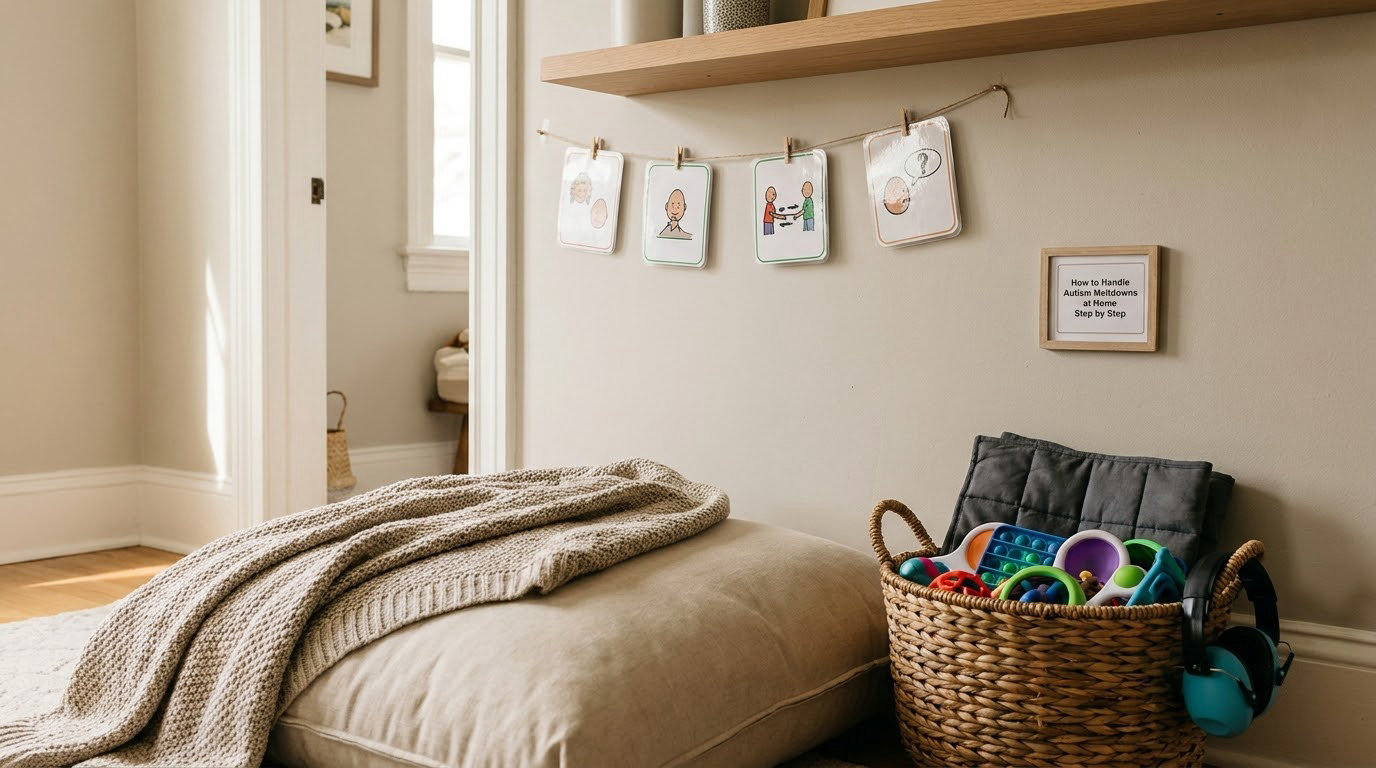
A low-stimulation area. It does not need to be a special room. A corner of a bedroom with the blinds drawn, a soft cushion, a blanket and a predictable seat works. Familiar objects beat new ones every time, and the doorway should stay open so the room never becomes a trap.
Communication supports that already work. Whatever your child already uses to get a need across, when they are calm, is the system to lean on during a meltdown. For some that is a picture card, a small sign, a device, a written word or a sign. Introducing a brand new communication method during peak distress rarely works.
A sensory kit that lives in one place. Noise-cancelling headphones, a soft or weighted blanket, a fidget item, a water bottle, a chew item if that is wanted. Put it in a basket by the calm area so you are not searching a cupboard mid-meltdown.
A cleared safety path. Walk your home once with fresh eyes and note the sharp corners, glass, stairs, the hot kitchen, the front door, and the smallest room that can be emptied quickly. Keep a list of what to move first.
A way to protect the rest of the household. Decide in advance where siblings and pets go during a violent episode, and pick a spot with a door they can close.
Then adapt all of it to your child’s age, communication style and known triggers. A two-year-old and a fourteen-year-old need entirely different responses from the same room.
How to Handle Autism Meltdowns at Home Step by Step
How to handle autism meltdowns at home when escalation starts
Escalation usually announces itself. You are probably looking at the rumble stage: pacing, repeated questioning, louder voice, stimming that has turned frantic, clinging, or a sudden refusal of something that was fine an hour ago. In the rumble stage the child can still hear you, which is your window.
Drop the demand. A request you made two minutes ago is not urgent compared to the child coming apart in front of you, and it will still be there later. Turn down the television, step away from the dishwasher, kill the overhead light if it is harsh.
Offer one thing, not a menu: a choice between two acceptable options, a visual prompt, or a single short sentence naming the next step. Then stop talking and wait. Sixty seconds of silence costs nothing and breaks the argument loop.
What working looks like: the child gets slightly quieter, stops an escalating behaviour, accepts the transition, or stays where they are. Those are wins, even if nothing is fixed.
Move to a safer, quieter area
Less stimulation, more space, same room if possible. Moving house mid-meltdown is often worse than staying put, so a change of scene should be optional and easy to refuse.
When you do move, walk beside your child rather than dragging or carrying them, unless they are in immediate danger. Keep your hands visible and low. A calm, close presence does more for a nervous system than a wall of talking.
Clear a path to the quiet area first if you can. Block stairs and dangerous doorways with your body rather than furniture you will be knocking over. A child who cannot leave sometimes needs to know the exit is not a request, and one without a fight.
Reduced pacing, quieter screaming, or a first attempt to leave the area all suggest stress is dropping. Nobody comes straight back to baseline.
Use few words and simple choices
Language access drops during overload. A long explanation of why the schedule changed is not just useless, it adds another demand to a system that is already full.
Replace sentences with the shortest version that works: “Shoes. Now.” or “Break, then bath.” Two options beat an open question. “Blanket or headphones?” costs three words and gives back a sense of control, which is often the thing they have lost.
Use the visual or communication support if your child has one, and stop over-prompting. Repeating a direction six times adds pressure rather than clarity. If they point, sign, hand you a card, nod, or move away, communication is still happening, and you should treat that as a real answer.
At peak distress, make no new demands at all. Not a reward, not an apology request, not eye contact.
Protect everyone without restraining the child
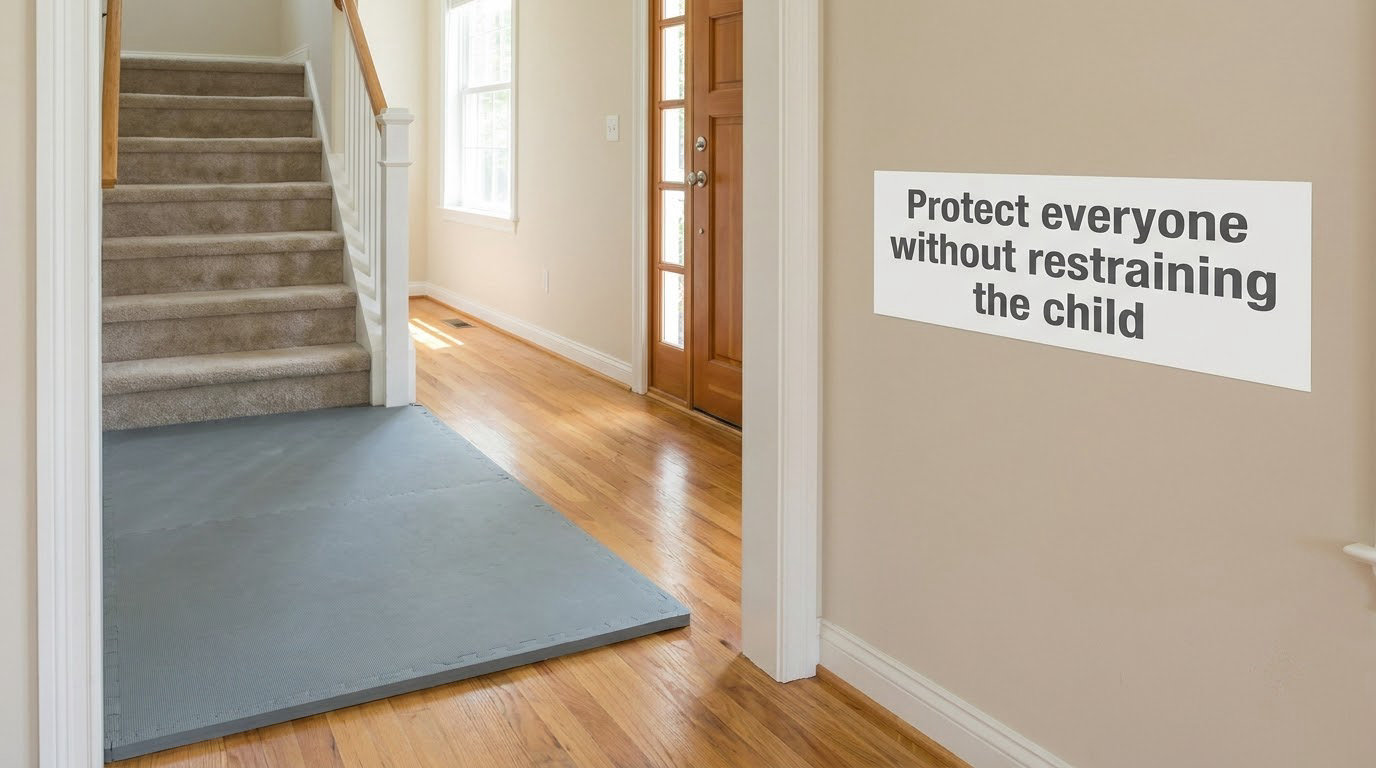
Safety comes before comfort, and it comes for every person in the house. If there’s a weapon in that moment, it is a chair leg or a fist aimed at your face, and the adults in the room are the ones nobody warns about.
Move siblings and pets out first, even if they are mid-conversation or upset about it. Give the older sibling a job rather than a vague instruction: sit in the hallway with the dog, put headphones on, come tell me when the screaming stops.
Clear hazards if you can do it without getting between your child and something. Put yourself between the child and the stairs, the kitchen, another child, or the front door. Give yourself an exit route. Turn your body, keep your hands open and low, and stay back from the face unless a blow is genuinely imminent.
Physical restraint is not a routine strategy. It is generally not effective, it tends to escalate rather than settle the episode, and it can injure an adult or a child. If someone is in immediate danger, follow the steps in your written safety plan and get urgent professional guidance rather than improvising in the moment.
Know the difference between blocking a doorway and holding someone down. The first keeps a hazard from becoming a serious injury. The second is restraint, and it needs a professional’s plan behind it.
Wait and support recovery after the peak
The screaming stops and the real work is still ahead. The post-meltdown crash is the part almost nobody prepares you for: exhaustion, a sensory hangover where ordinary sound and light feel unbearable, slowed thinking, and sometimes hours of appearing fine before the processing catches up.
Keep demands at zero. Offer water if it is wanted, a comfortable place to sit or lie, dim light, less noise. A snack is fine. A lesson about behaviour is not, and neither is a debrief right now.
Some children want to be held. Some need to be alone, and want a blanket and a closed door rather than a hug. Parents on r/autism describe both, and soft blankets come up over and over as something that helps. Follow what your child asked for before the meltdown, not what the moment makes sense to you.
Recovery signs look quiet: slower movement, steadier breathing, accepting a familiar item, eye contact if eye contact is comfortable, or asking for something in words. A child who shrugs off a blanket is not rejecting you.
Expect the late crash. A calm afternoon can still be followed by a rough bedtime, and the evening is not a fresh start to manage.
Review the episode when everyone is calm
Never try to reconstruct every detail during the event. You were managing the room, and your memory of the sequence will be unreliable, which is its own kind of unfair to yourself.
Later, when your child is settled, keep a short written record. A trigger log with a handful of fields beats a long journal you stop filling. Record the time, what happened just before, what the noise level or routine change was, how long it ran, what you did, what actually helped, and anything that looked like a warning sign. Three lines is enough.
Over weeks, patterns show up: one weekday, one room, one hour before dinner, one transition. That pattern is what a functional behavior assessment works from, and it is worth bringing to a professional.
Keep the review factual rather than a courtroom. “I gave four instructions in two minutes” is useful. “I ruined it by spoiling him” is not, and it will stop you looking at the data properly.
A completed log entry, or one change you make to the plan, counts as progress. Do not wait for a month of perfect weeks.
Common Mistakes and What to Do Instead
Most parents are not doing these things because they do not care. They are doing them because the alternative feels like losing the child, and because the internet gives contradictory advice. Here is the usual list, with the fix next to it.
Arguing or reasoning. “You can’t hit, this is not how we treat people.” Logic needs a brain that is online for language, and during a meltdown it is not. Fix: one short sentence, or silence.
Giving too many instructions. Three commands in twenty seconds is three conversations. Fix: one instruction, one repeat, then stop for a minute.
Crowding the child. A ring of worried adults is more input. Fix: clear the room, stay within sight, close enough to be safe and far enough to breathe.
Blaming, shaming or assigning motives. “You’re doing this to manipulate me” sets up a fight with a child who cannot hold the argument. Fix: describe the behaviour and the need, not the character. Private self-blame afterward helps nobody, and post-meltdown guilt is one of the most common things parents bring to support groups.
Treating every episode the same. A 5pm every-day meltdown and a rare one after a fire alarm do not get the same response. Fix: use your log to separate routine from unusual, and treat unusual triggers as information.
Promising it will stop. Support can reduce frequency and intensity. Nobody can promise elimination, and parents are right to be wary of anyone who does. Fix: aim for shorter episodes, easier recovery, fewer triggers.
Managing every episode in silence. Autistic adults on forums describe being left alone, in a low-stimulation room, with soft items and no noise. Others describe being held. Fix: ask your child when they are well, and write the answer down.
Ignoring the caregiver. Your nervous system co-regulates the room. When the adult is shouting, the child has another overload source. A slow exhale, a hand on your own chest, and stepping into the hall for thirty seconds are regulation moves, not cop-outs. If you are at the end of your rope, that is a reason to ask for support, not a failure.
Waiting for a crisis to call a professional. An occupational therapist for the sensory and room side, a BCBA or psychologist for the behaviour side, and a functional behavior assessment when a specific behaviour is frequent, intense or injurious. Bring your log. Practitioners do much more with six weeks of real data than with a description.
Two more household details worth sorting now. Protect siblings properly: many parents debrief them the same evening, privately, without making them responsible for what they saw, and that consistently comes up as the right call. And plan for the after-school pattern, where a child holds everything together for eight hours and then comes through the door and unwinds. That is not your evening failing, it is a full day of load discharging at the safest place they have. A predictable decompression window before you ask anything of them, and a snack they choose, does more than arguing with the timing.
Frequently Asked Questions
What is the difference between an autism meltdown and ordinary frustration?
A tantrum is goal-directed: the child wants something, expects an adult to give it, and the episode ends when the goal is met or clearly refused. A meltdown is an involuntary nervous-system response to overload, so it has no goal, cannot be reasoned with or talked out of, and often continues after the original trigger is gone. If a tantrum stops the moment you hold the line, that was probably a tantrum.
How can sensory tools help during an autism meltdown at home?
Sensory tools work by lowering input, not by distracting. Headphones reduce sound load, a weighted or soft blanket provides deep pressure, and a fidget or chew item gives the hands and mouth something regulated to do. They help most in the rumble stage, before escalation. During the peak, offer rather than require, and keep everything in one basket beside the calm area so nothing has to be found mid-meltdown.
How should I handle autism meltdowns at home when the child is near a door, window, or stairs?
Position yourself between your child and the hazard without blocking the whole room, and stay out of reach of swinging hands. If there is time, move the hazard first. Give yourself a clear exit route so you are not trapped. Blocking a dangerous opening is a safety move, not restraint, and it should end the moment the risk passes. If restraint seems necessary, follow your written safety plan and get professional guidance.
How long does it take for a child to recover from an autism meltdown?
The meltdown itself may run from a few minutes to a few hours. Recovery is usually longer and less visible: exhaustion, a sensory hangover, slowed thinking and sometimes a rough evening hours later. There is no fixed number that counts as normal, and a trigger worth understanding is worth discussing with your care team. Judge progress by the trend over weeks, not by one episode.
When should I seek professional help for my child’s meltdowns?
Seek help when episodes are frequent, injure someone, damage the home, prevent sleep or school, or leave your family in a constant state of bracing for the next one. An occupational therapist can advise on sensory environment and tools. A BCBA or psychologist can run a functional behavior assessment and build a plan. Bring your trigger log. Bring it sooner rather than later if anyone in the house is getting hurt.
Conclusion: Start With Safety and One Calm Step
The response that works most often is unremarkable: reduce stimulation, say almost nothing, keep everyone safe, let the peak pass, allow a long quiet recovery, and write it down afterwards.
Start where you can do something today. Put the sensory kit in one basket, pick the corner that becomes the calm area, and write the one-page safety plan while your child is calm enough to help you name the triggers.
Then take that plan to their care team, because individualized guidance on sensory load, communication and behaviour support will outperform anything generic, including this. Review it in 2026 and again whenever the pattern changes.